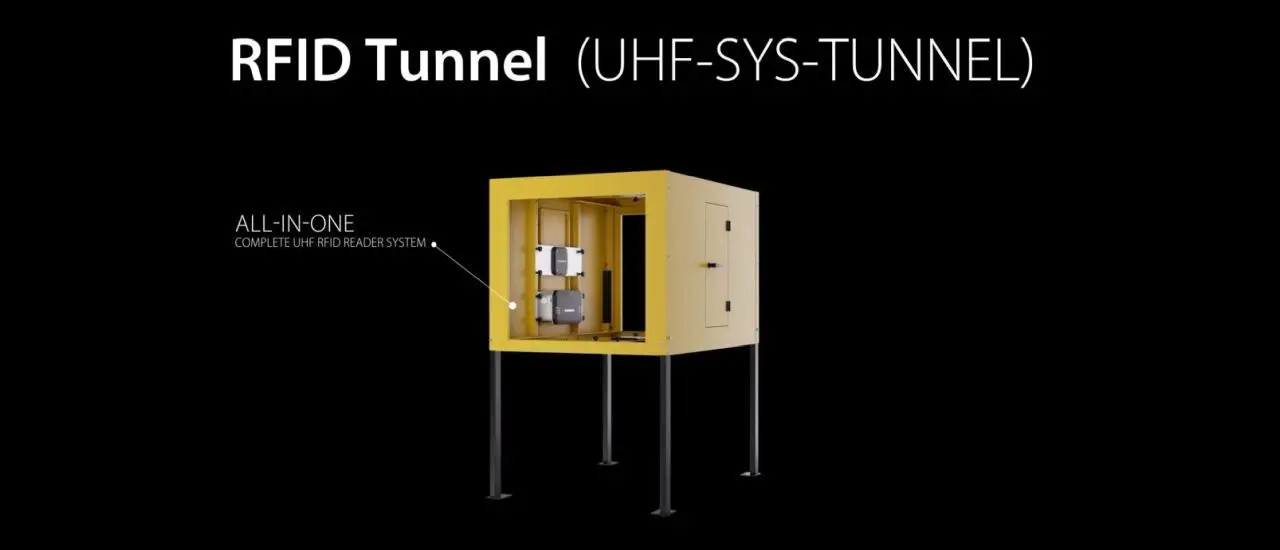

- The RFID tunnel is a fully standardized, ready-to-order package enabling self-assembly and fast deployment, typically within a few hours.
- It provides raw EPC tag data through a REST API, allowing customers to handle data processing and logic within their own IT environments.
- The product offers a middle ground between individual RFID components and full integration solutions, appealing to customers seeking flexible but structured implementation.
- Turck supports customers with consulting and startup assistance to mitigate the intrinsic challenges of UHF RFID technology and ensure reliable operation.
RFID "just do it" – without weeks of project planning?
This is exactly where Turck comes in with a new, deliberately standardized approach: an RFID tunnel as a complete package that can be ordered immediately. Think WIoT spoke with Bernd Wieseler, Director of Product Management RFID Systems at Turck, about the "out of the box" principle, typical use cases on conveyor lines, and why the tunnel occupies a strategic middle ground between component sales and full integration.
"One item number – and everything is included"
Bernd, you talk about a genuine "out-of-the-box" approach with the RFID tunnel. What is behind this – and how quickly can you typically be productive with it?
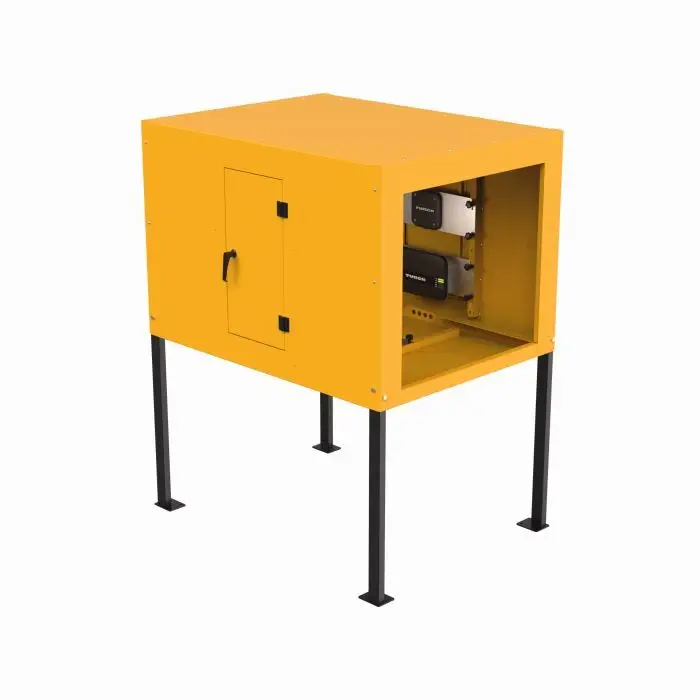
Bernd Wieseler: The advantage is quite simple: it is a standard product that you order with an item number. It comes as a set, including components and instructions – similar to furniture assembly instructions. The metal construction is designed so that you can easily assemble it yourself.
It's easier with two hands because the parts are heavy. But within a few hours, the tunnel is up and connected – and you can start being productive, i.e., measuring and reading tags.
How do customers react to the fact that they can get started quickly and independently?
Bernd Wieseler: Very positively. Many customers want to integrate themselves, may only need one or two tunnels, and don't want a complete system integration solution right away. They say, "Give me the data – I'll do the rest myself." This package is perfect for that: instead of putting everything together individually, you order the item number and get started.
"Many don't want to start from scratch or take on a mammoth project. They want to get started quickly, integrate cleanly, and then scale up – that's exactly what our out-of-the-box RFID tunnel is designed for."
What is the Turck RFID tunnel – and how is it designed?
Can you briefly describe the product: size, passage, features?
Bernd Wieseler: The tunnel is approximately 1.2 m long and has a passage for conveyor belts up to 720 × 660 mm. It is made entirely of metal and contains all the electronics: a UHF RFID reader with up to 2 watts ERP and four external antennas, which are arranged in the tunnel so that they "look" at the goods optimally from several sides.
Which interface do you use?
Bernd Wieseler: We work with a standardized REST API so that the customer's IT department can integrate the tunnel into their own systems with relative ease.
What specific data does the tunnel provide?
Bernd Wieseler: Raw data: EPCs read by the antenna, typical reader returns – everything is provided via the REST API. The processing, the "target vs. actual" comparison (e.g., "Are all 50 parts really in the box?") deliberately takes place at the customer's level above – in the production, warehouse, or management system.

Between "component" and "feel-good package": the strategic middle ground
It sounds like you're serving a new product logic with this.
Bernd Wieseler: Exactly. There is the classic approach: buy the component and see for yourself how to build around it. And there is complete integration as an all-inclusive package.
But many customers ask: "Can I do this myself – but please with a sensible framework?" The tunnel is exactly this middle ground: Turck provides the proven, standardized environment, while integration remains with the customer. And if more support is needed later, it can be expanded.
Do customers often still need support despite plug-and-play?
Bernd Wieseler: Yes. UHF RFID is not trivial. Data carrier selection, medium, attachment, speed, reader settings – these things have to be tested. We provide consulting support and, on request, offer services such as start-up/enablement so that customers can get up and running quickly and smoothly.
Metal tunnels sound like shielding – but also like reflections.
Bernd Wieseler: Exactly. Reading accuracy depends heavily on the medium and the tags – you have to test it. And: At high power, radiation to the outside can also be an issue, which is why you should take the distance to surrounding objects into account. Additional shielding materials would be theoretically possible, but would have to be evaluated on a case-by-case basis – because shielding can also reduce reflections that are useful for reading in the tunnel.
Who would benefit from the tunnel?
Which industries do you see as the main target group?
Bernd Wieseler: The RFID tunnel is always worthwhile when companies in intralogistics or production need security, speed, and data quality at a single point in the material flow – without first having to plan a customized complete solution.
Many processes fail not because of a lack of automation, but because of small deviations: a part is missing from the box, a container is incorrectly loaded, a shipment goes out incomplete. This is exactly where the tunnel shows its strength: it creates a robust, repeatable identification point on the conveyor line – as a reliable "source of truth" before goods continue on their way.
This is particularly exciting for teams that want to digitize pragmatically: start quickly, see benefits early on, and then scale up. The tunnel is therefore ideal for companies that do not view RFID as a research project, but as a tool for process assurance – for example, to reduce packing and shipping errors, manage inventory more efficiently, or bring transparency to closed loops.
And because integration is done via standardized interfaces, the approach is particularly well suited to users who say, "Give us stable reading data – we'll build the logic and decisions into our systems ourselves."
See it live, test it, scale it
If you want to experience the tunnel in advance, Turck can also demonstrate it in its showroom – including a sample conveyor belt and tests for speed/automation. And if you prefer a hands-on approach at a trade fair, Turck will be presenting the RFID tunnel at this year's LogiMAT in Stuttgart from March 24 to 26, 2026, as it did last year.
Conclusion
Turck's RFID tunnel is a deliberately standardized ready-to-go package: order, set up, read, integrate – while retaining the freedom to control the data logic in your own system. It is precisely this combination of speed, standardization, and freedom of integration that makes the approach exciting for many logistics and production environments.
"Ultimately, it's not about RFID for the sake of technology – it's about process reliability. The tunnel is the point in the material flow where assumption becomes certainty." – Bernd Wieseler, Turck.