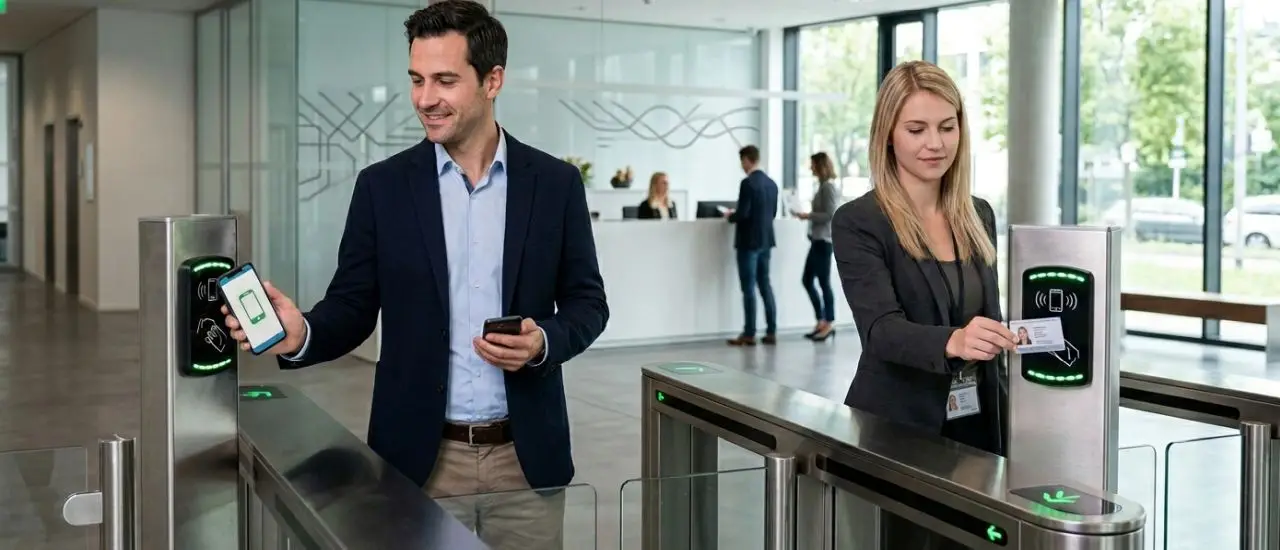

- RFID employee cards integrate multiple corporate functions including physical access, digital identity, and internal payment systems.
- More than 1.6 billion access cards are currently used globally in building access systems, reflecting their sustained importance.
- Physical ID cards offer superior reliability and security compared to smartphones, especially in sensitive environments.
- Hybrid access models combine RFID cards for employees with smartphone credentials for visitors or temporary users.
Digital Keys in the Market
The smartphone has long been regarded as a universal companion in everyday life, it unlocks hotel rooms and serves as a ticket or payment method. Yet in the corporate world, a different picture emerges: despite mobile access solutions, the RFID employee card remains a central element of modern access and identity systems.
Many technology concepts of recent years assumed that the smartphone would completely replace the classic chip card. After all, modern devices feature NFC interfaces, secure hardware elements, and biometric authentication. In practice, however, this development is proceeding much more slowly than expected.
While mobile solutions primarily offer convenience and multifunctionality, other factors take precedence in businesses: reliability, clear responsibilities, simple management, and high security. Smartphones can be lost, the battery can run out, or software issues can block access. An RFID card, on the other hand, is a dedicated security medium used exclusively for business applications.
A look at the market confirms this trend. According to analyses by the market research firm Omdia, more than 1.6 billion access cards for building access systems are in use worldwide. At the same time, according to the Eurosmart association, the industry produces over 10 billion smart cards annually for identification, payment functions, or access control. Contactless cards thus remain a stable component of modern corporate infrastructures.
A key for many applications
RFID employee cards combine physical and digital access in a single identification medium. An integrated chip and antenna enable contactless communication with readers.
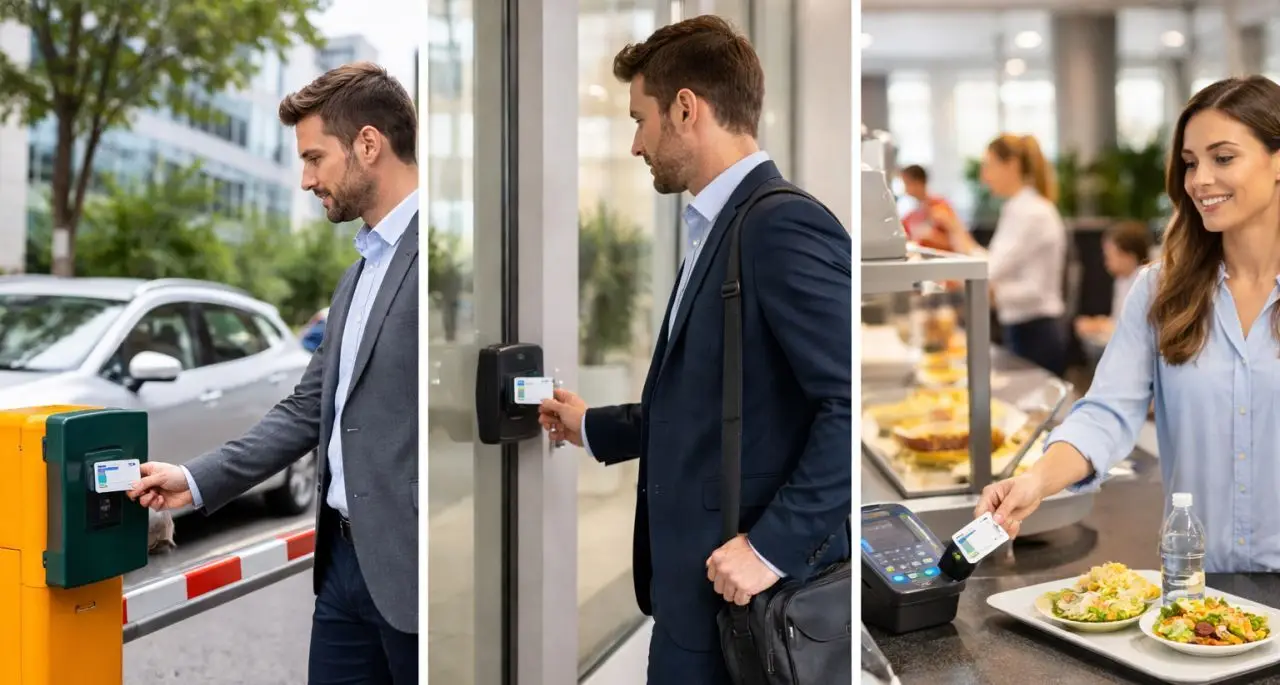
In everyday corporate life, this allows for the consolidation of numerous applications:
Access to buildings and secure areas
Logging in to workstations
Time and attendance systems
Payments in cafeterias or vending machines
Authentication at printers or machines
Access to parking areas or barriers
In many organizations, the employee card is thus evolving into a universal corporate key. It can serve simultaneously as a physical access pass, a digital identity in the IT system, and an internal payment method.
New applications on the corporate campus
In addition to traditional access functions, new applications for RFID cards are increasingly emerging. One example is authentication at charging stations for electric vehicles on company premises. Employees can simply hold their card up to the charging station to start the charging process. Usage is automatically assigned to the respective employee account or the company fleet.
Other services can also be integrated. In modern corporate environments, employees can use the same card, for example, to:
book workstations or meeting rooms
Use bike-sharing or car-sharing services
Access internal services on campus
This turns the employee card into an interface between physical infrastructure and digital corporate systems.
Security as a Critical Factor
Especially in sensitive areas, security is a key factor in choosing access technology. Modern RFID cards support encrypted communication between the card and the reader, as well as secure authentication procedures and highly secure chip architectures.
For Steffi Lasch, Head of Sales & Marketing at Thales DIS BPS Germany and a long-time expert in access systems and identity management, physical ID media continue to play an important role.
“Physical ID media remain indispensable, especially in security-sensitive environments such as research facilities, military installations, laboratories, or large data centers,” explains Steffi Lasch. “Companies must be able to track at all times who has access to sensitive areas and when that access was used.”
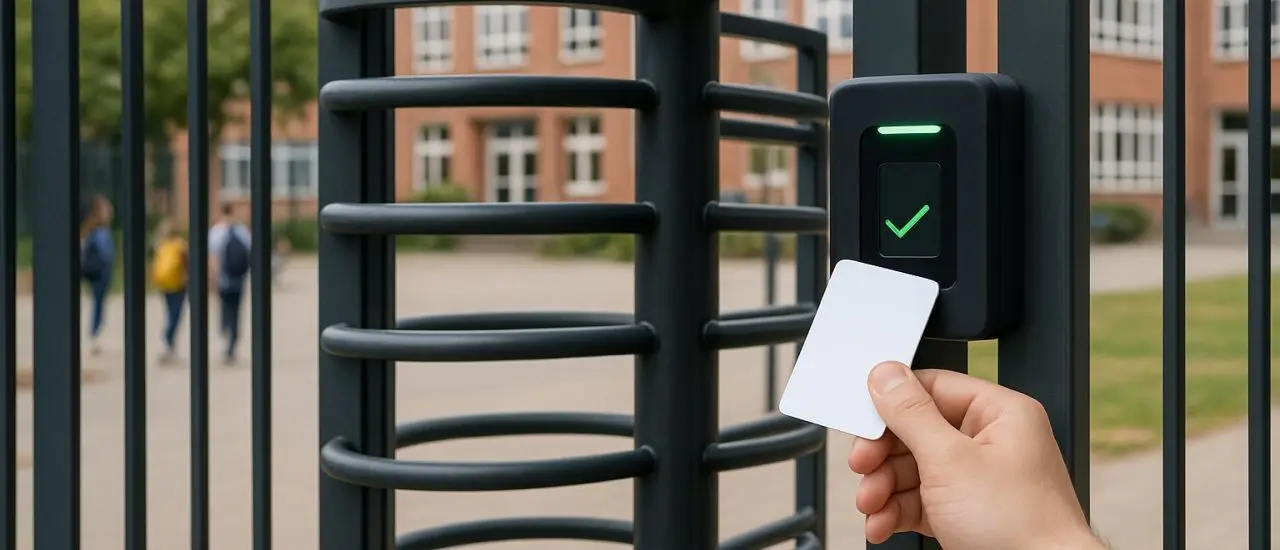
Smart cards also remain widespread in the education sector. “Universities and large schools often use them not only for access systems but also for libraries, printing systems, or cafeteria payments,” says Steffi Lasch. “A single card can combine many functions while ensuring a high level of security.”
Another advantage lies in administrative control: cards can be issued, blocked, or replaced as needed. Smartphones, on the other hand, are personal devices used outside the corporate context.

Smartphones as a supplement, not a replacement
Mobile access solutions are nevertheless gaining importance. Many modern access systems today support both RFID cards and mobile access credentials on smartphones.
This gives rise to hybrid models: employees continue to use physical cards, while visitors or service providers receive temporary access via their smartphones.
Steffi Lasch sees this as a pragmatic combination of different technologies: “In many projects today, we observe a coexistence of cards and smartphones. The smartphone offers additional convenience, but the chip card remains the stable foundation of the access infrastructure in many organizations.”
Integration Facilitates New Applications
The widespread use of RFID employee cards is also due to their easy integration. Many companies have existing infrastructure for contactless identification media such as access readers, time-and-attendance systems, and printer authentication.
New applications can often be integrated via existing identity platforms without replacing the entire infrastructure. This keeps expansions manageable both economically and organizationally.
Conclusion
Smartphones will play a greater role in access systems in the future. Nevertheless, the classic RFID employee card remains an indispensable element for many organizations.
It is robust, independent of batteries or operating systems, and enables clear control over access rights.
Steffie Lasch sums it up this way: “The smartphone offers convenience, the chip card offers stability. Especially in security-critical environments, companies need both, but the card often remains the foundation.”