


Wi-Fi HaLow: Low Power, Long Range
Wi-Fi HaLow is evolving into a practical, scalable technology that delivers secure, long-range, low-power wireless connectivity with native IP integration, addressing specific IoT and industrial network challenges.
- Revised: February 01, 2026
- By: Anja Van Bocxlaer
- Read: 7 min
- Wi-Fi HaLow operates in sub-1 GHz bands, offering longer range and better obstacle penetration than traditional Wi-Fi bands.
- The technology now benefits from mature hardware ecosystems with certified modules and deployable access points.
- HaLow is IP-native, facilitating direct integration into existing enterprise and cloud networks without intermediary layers.
- Regional spectrum regulations significantly influence HaLow’s throughput and operational patterns, with Europe imposing stricter constraints.
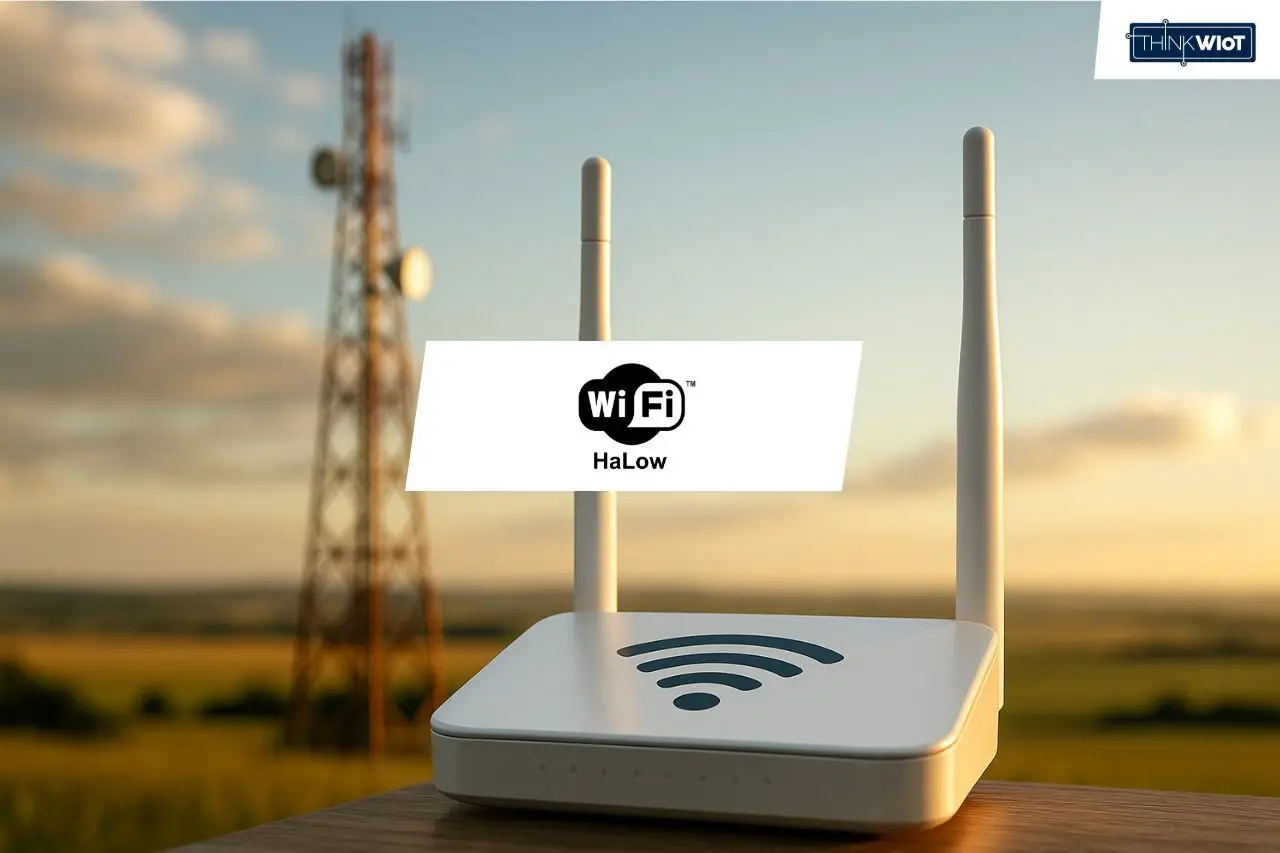
Wi-Fi HaLow (IEEE 802.11ah) combines sub-GHz propagation, low-power operation, and IP-native networking to provide a scalable, secure wireless backbone for distributed IoT and industrial deployments.
Why HaLow is suddenly “real” in 2026
For years, Wi-Fi HaLow sat in an awkward middle ground: strong on paper, but held back by limited hardware options, fragmented market availability, and uncertainty about how well it would translate into real deployments. That has changed.
Over the last 18 months, the ecosystem has matured quickly. New generations of chipsets and modules have become easier to source, certification and regional compliance are improving, and complete infrastructure devices are now available off the shelf.
This shift matters because it changes HaLow from a specialist component into a deployable connectivity layer. Instead of building everything from evaluation boards, integrators can now pilot and scale with products designed for field installation, bridging, and ongoing operation. HaLow is no longer just a “future IoT Wi-Fi,” it is becoming a practical choice for private, long-range, IP-native networks.
What Wi-Fi HaLow is, and what it is not
Wi-Fi HaLow is a sub-1 GHz extension of the Wi-Fi family designed specifically for IoT and industrial environments. In Europe it typically operates around 868 MHz, while North America and several other regions use the 900 MHz range. The physics is the point: lower frequencies attenuate less over distance and penetrate obstacles more effectively than 2.4/5/6 GHz, which can reduce infrastructure density and improve link stability in challenging environments.
Equally important, HaLow is IP-native. Unlike many low-power wireless protocols that rely on gateways and translation layers, HaLow can speak TCP/IP directly, which simplifies integration into enterprise networks and cloud stacks and keeps the development model familiar for teams used to Wi-Fi networking.
What HaLow is not meant to be is a replacement for high-throughput office Wi-Fi. It delivers strong coverage and practical data rates for IoT, but the best value appears when reach, penetration, and operational simplicity matter more than peak bandwidth.
Performance: range first, throughput where regulation allows
HaLow’s performance depends on channel width, modulation, antenna setup, and the environment. Under favorable conditions, it can deliver kilometer-class links, especially in line-of-sight deployments. Throughput varies significantly: narrower channels and longer distances typically mean lower rates, while wider channels and shorter links can push HaLow into the tens of megabits range.
The key nuance is that regional spectrum regulations heavily influence what is practical. In countries with more accommodating sub-GHz rules, HaLow can behave closer to “wide-area Wi-Fi,” with more sustained data transfer and more flexibility in channel use. In Europe, where constraints on bandwidth, transmit power, and duty cycle are stricter, HaLow remains valuable, but it shines most in bursty, intermittent communication patterns rather than continuous broadband-style traffic.
-%C3%BCber-Wi-Fi-HaLow-responsive.webp)

Technology Interview with Dr. Daniel Martini (IMST) on Wi-Fi HaLow
Wi‑Fi HaLow fills a distinct technical niche between Wi‑Fi and LPWAN by combining extended range, low power, and IP‑based bidirectional communication, but its European market success depends on regulatory change, cost reductions, and targeted use cases.
HaLowLink 2 and what “deployable HaLow” looks like
A major sign of mainstream momentum is the availability of compact routers that package HaLow into a deployable form factor. Devices like HaLowLink 2 are designed to operate as access points or stations and can bridge long-range HaLow links into local Ethernet and conventional Wi-Fi, creating a practical hinge between remote field connectivity and existing networks.
That flexibility enables two important deployment patterns: wide-area coverage for endpoints across large footprints, and point-to-point bridging where cabling is expensive or impractical. It also lowers the barrier for pilots because power, mounting, and local distribution are handled in a single device rather than a custom stack.
Where HaLow fits best in the real world
HaLow is easiest to understand by looking at where classic Wi-Fi becomes costly. As sites get larger or more obstructed, traditional WLAN often requires dense access point placement, careful channel planning, and significant backhaul work. HaLow changes the economics by extending coverage and improving penetration, which reduces the number of nodes required.
In agriculture and environmental monitoring, HaLow supports sensors spread across fields, orchards, vineyards, and greenhouses with minimal infrastructure. In industrial environments, it improves reliability across metal-dense layouts, storage areas, yards, and multi-building campuses where links must pass through structures and equipment. In smart buildings and smart city deployments, it can cover large properties or outdoor zones with fewer access points, which reduces installation complexity and maintenance burden.
In regions outside Europe, HaLow becomes particularly compelling in the middle zone between tiny sensor messages and full broadband. Periodic image uploads, inspection snapshots, richer telemetry, mobile worker check-ins, diagnostics, and firmware updates are examples where HaLow’s practical throughput and reach can outperform ultra-narrowband alternatives while keeping the network privately operated.
Hardware maturity: from evaluation boards to real products
HaLow’s ecosystem used to be dominated by developer kits and early reference designs. Today, the landscape includes more mature chipsets, certified modules, and complete infrastructure devices. That progression matters because it reduces engineering overhead for OEMs and integrators. Instead of solving RF, firmware, and compliance from scratch, teams can build on modules and deployable devices that are closer to production readiness.
At the same time, the conversation is shifting. It is no longer only about maximum range demonstrations. The focus is moving toward operability at scale: provisioning, monitoring, security, device lifecycle management, and the ability to integrate seamlessly into IT and cloud environments. HaLow is increasingly positioned as part of a broader edge and industrial networking architecture rather than a stand-alone radio link.
Global spectrum reality: why Europe feels different
HaLow is a global standard, but deployments are shaped by local spectrum policy. Europe’s sub-GHz environment is among the most constrained major markets for Wi-Fi-like data networking. Limits on channel usage, power, and duty cycle reduce the feasibility of always-on, high-volume transfer. That does not remove HaLow’s value, but it pushes the technology toward disciplined, bursty communication patterns.
Outside Europe, more permissive allocations often translate into higher link budgets, broader channel choices, and a more “always-on” feel. The practical result is that the same class of HaLow hardware can serve very different roles depending on geography: specialist IoT connectivity in one region, wide-area private Wi-Fi in another.


AgriLink in Morocco: Smart Irrigation Tackles Water Scarcity
Deploying low-power wireless IoT like LoRaWAN, with future upgrades to bidirectional protocols such as Wi‑Fi HaLow, enables data-driven irrigation that conserves water and strengthens agricultural resilience in Morocco.
HaLow in the broader connectivity ecosystem
HaLow’s defining advantage is that it combines long-range propagation with native IP networking in a privately operated infrastructure. Compared with cellular LPWAN, it avoids SIM provisioning and recurring connectivity costs and gives operators more control over their networks. Compared with LoRaWAN, it typically offers greater payload flexibility and a more direct integration path into IP systems. Compared with Zigbee and Thread, it avoids mesh complexity when distance and penetration are the primary challenges. Compared with classic Wi-Fi, it trades peak throughput for reach and stability across large or obstructed spaces.
In many projects, the decision comes down to architecture. If you need ultra-long range with tiny payloads and extreme power budgets, LPWAN approaches can still win. If you want private infrastructure with IP simplicity, stronger payload flexibility, and familiar security concepts, HaLow is increasingly becoming the most pragmatic option in the middle.
Outlook
Wi-Fi HaLow is transitioning from a promising spec into a practical deployment toolset. The next wave of growth will be driven by broader availability of certified modules and endpoint devices, more infrastructure options for indoor and outdoor coverage, and better operational tooling for managing fleets at scale.
In 2026, HaLow is no longer something to watch from a distance. It is ready for pilots now, and in the right regions and use cases, it is ready for rollout.