

Ultra-Wideband Technology
Ultra-wideband technology delivers highly reliable and precise localization, enabling advanced positioning and secure proximity applications across industrial and consumer domains.
- Revised: March 04, 2026
- By: Anja Van Bocxlaer
- Read: 8 min
- UWB offers highly accurate indoor positioning down to the centimeter range using time-based ranging methods.
- UWB transmits low-power, wideband pulses that coexist with Wi-Fi and Bluetooth without causing interference.
- Typical UWB systems consist of mobile tags, fixed anchors, and positioning engines that compute real-time locations.
- UWB has expanding applications in industrial logistics, automotive security, smart homes, healthcare, and agriculture.
What is Ultra-Wideband Technology (UWB)?
Ultra-wideband, or UWB, is a short-range radio technology that enables extremely precise distance and position measurement. While Wi-Fi and Bluetooth are mainly designed to connect devices and move data reliably across rooms or buildings, UWB is especially strong when the key question is “Where is it?”. That is why UWB is widely used for real-time locating systems (RTLS) and indoor positioning, where GPS/GNSS signals are weak or blocked.
UWB works by transmitting very short pulses across a wide frequency spectrum, typically within the 3.1–10.6 GHz band, depending on regional regulations. This wide bandwidth enables highly accurate time measurements. Since radio signals travel at the speed of light, measuring the signal’s travel time allows distance to be calculated with high precision.
In well-designed systems, this can result in positioning accuracy down to the decimeter range and, in optimized setups, even to a few centimeters. At the same time, UWB uses very low transmission power, which helps it coexist with other radio technologies in the same environment.
UWB is no longer only an “industrial RTLS” technology. More and more end devices now integrate UWB chips, which has accelerated adoption and opened up new use cases in consumer electronics, smart homes, and automotive applications.
Frequency spectrum and UWB channels
Ultra-wideband operates across a very large portion of the radio spectrum. In most regions, UWB systems use frequencies between 3.1 GHz and 10.6 GHz, although the exact bands permitted vary depending on regulatory frameworks.
In Europe, UWB positioning systems commonly operate in the 6–8.5 GHz range, while global implementations typically use standardized UWB channels such as channel 5 (6.5 GHz), channel 6 (7 GHz), channel 8 (8 GHz), and channel 9 (8.5 GHz). These channels are defined within the IEEE 802.15.4z standard and are widely used in industrial, automotive, and consumer devices.
Unlike narrowband radio technologies that rely on a single carrier frequency, UWB spreads its signal across a bandwidth of at least 500 MHz per channel. This extremely wide bandwidth is what allows the system to measure signal travel time with very high precision.
The use of wide spectrum and very low transmission power has several important implications:
High positioning accuracy: large bandwidth improves timing resolution, enabling centimeter-level ranging.
Low interference: UWB signals are transmitted at extremely low power levels and appear similar to background noise for other radio systems.
Reliable coexistence: UWB can operate alongside Wi-Fi, Bluetooth, and cellular networks without causing disruption.
This spectrum design makes UWB particularly suitable for dense indoor environments such as factories, warehouses, hospitals, stadiums, and smart buildings, where multiple wireless systems operate simultaneously.
What is included in a UWB system?
A UWB positioning system typically consists of mobile devices and fixed infrastructure.
The mobile part is usually a UWB tag, transponder, or tracker that is attached to an object, vehicle, or person. The fixed part is a set of anchors placed at known positions in the building or site. A positioning engine collects the timing information from multiple anchors and calculates the location. Software then visualizes movements, provides analytics, and often connects the results to an IoT platform or business systems such as ERP.

Compared with radio technologies that estimate distance from received signal strength, UWB mainly uses time-based ranging. Common methods include Time of Flight (ToF) and Time Difference of Arrival (TDoA).
The principle is straightforward: several anchors receive the tag’s signals at slightly different times, and from those time differences the system calculates distances and then the tag’s coordinates.
In practice, three anchors are typically needed for stable 2D positioning, and four anchors are used for 3D positioning. This is why UWB is particularly effective indoors. In warehouses, factories, hospitals, tunnels, and stadiums, satellite navigation is unreliable, but UWB can still deliver stable and precise location information.
How does UWB work?
UWB transmits information using extremely short pulses, typically on the order of nanoseconds. This creates a wide bandwidth signal that allows the receiver to resolve timing very precisely. That timing precision is the basis for accurate ranging.
Another advantage shows up indoors. Reflections are common in buildings, especially around metal shelving, machinery, and moving people. Many wireless systems struggle with these “multipath” effects. UWB can often handle multipath better because the receiver can distinguish the earliest arriving signal components from later reflections, improving robustness in complex environments.
Although UWB operates in frequency ranges that overlap with other technologies, it generally does not create noticeable interference because its transmission power is very low.
In many deployments, UWB can run alongside Wi-Fi, Bluetooth, and cellular networks without causing disruption.
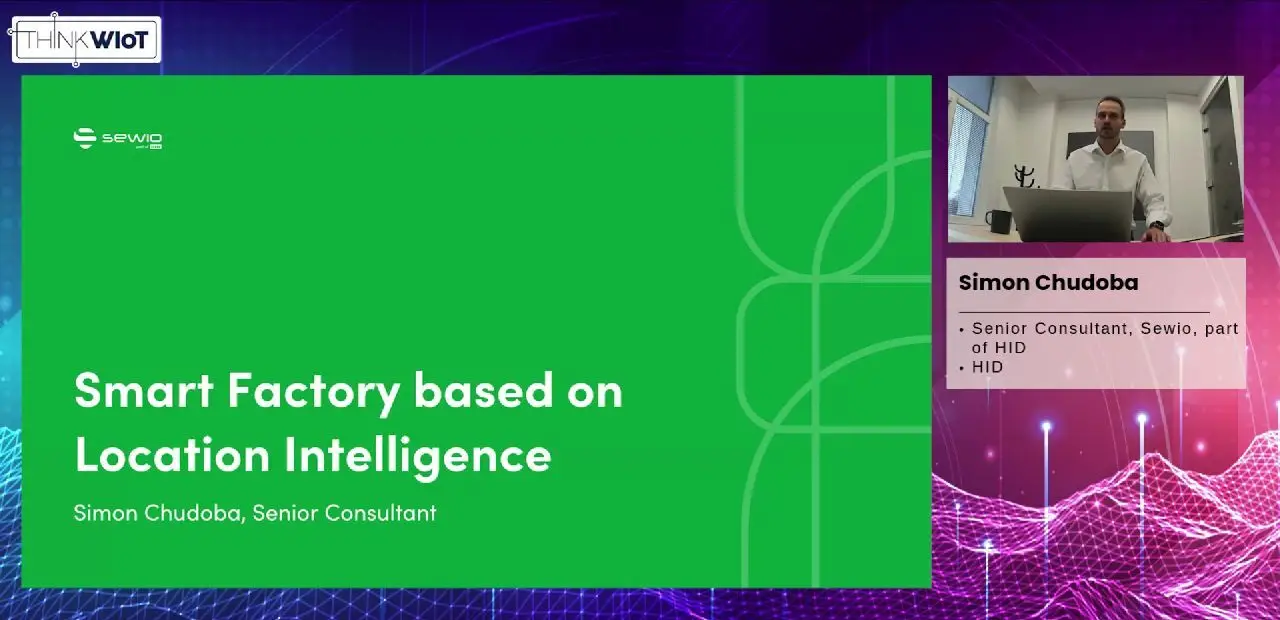

Simon Chudoba: Driving Precision and Efficiency with UWB RTLS at Marmon Foodservice
Deploying Ultra-Wideband real-time locating systems provides the precise indoor tracking data necessary to materially improve operational efficiency, safety, and cost-effectiveness in industrial and foodservice environments.
Facts and figures
UWB adoption is growing because it is now used in both industrial and consumer markets. In industry, the demand is driven by automation, safety requirements, and transparency in logistics and production. In consumer markets, the growth is fueled by UWB-enabled smartphones, wearables, and vehicles.
Market research firms consistently forecast strong growth for UWB and RTLS over the coming years, with positioning and secure access being the key drivers. The important point for IoT decision-makers is not the exact market number, but the direction: UWB is moving from niche deployments into scalable ecosystems, supported by standards and broader device availability.
In which industries is UWB used?
Industrial and warehouse logistics
This remains the strongest UWB domain. Companies use UWB to locate forklifts, pallets, containers, tools, and shipments in real time. The benefits are typically higher throughput, fewer bottlenecks, improved safety, and better visibility of material flows. In many setups, UWB complements RFID: RFID identifies an item, while UWB provides precise real-time location.Automotive
UWB is widely used for secure digital car key systems. By measuring true distance, UWB can reduce the risk of relay attacks that affect classic keyless entry. UWB is also becoming relevant for in-cabin sensing functions, including occupant monitoring and child presence detection concepts.Smart home and consumer electronics
UWB adds spatial context to device interactions. A phone can identify which device you are closest to, and in some ecosystems it can support “point and control” experiences. UWB tracking tags also benefit from accurate ranging, making it easier to locate items within a room rather than only knowing they are nearby.Healthcare
Hospitals use UWB to locate mobile medical devices and equipment quickly. Typical goals include reducing search time, improving asset availability, and supporting critical workflows where delays matter.Smart farming
UWB can support tracking of vehicles, equipment, and livestock where precise movement patterns matter and where local positioning is required. It is especially useful when combined with sensors and IoT platforms for monitoring and analytics.


Advantages of UWB technology
UWB’s advantages are mostly tied to precision and reliability. It delivers high positioning accuracy, works well in GPS-denied environments, and is comparatively robust in reflective indoor spaces.
Its low transmission power supports coexistence with other radio technologies, and the increasing availability of UWB chips in end devices makes deployments easier to scale.
Does UWB cause interference?
In most practical deployments, UWB does not cause significant interference. The signals are transmitted at very low power and spread across a wide bandwidth, which makes them appear similar to background noise for many other radio systems. As a result, UWB can usually coexist with Wi-Fi and Bluetooth, and it also remains usable in environments with high radio traffic.
Standards: IEEE 802.15.4z
Modern UWB systems for secure ranging and positioning are closely linked to the IEEE 802.15.4 family, particularly IEEE 802.15.4z. These specifications define how UWB devices communicate and how ranging can be made more secure and reliable. Standards matter because they support interoperability and reduce vendor lock-in, which is important as UWB expands across smartphones, vehicles, and industrial IoT deployments.


Range, accuracy, and battery life
UWB is typically used at short to medium range. Indoors, ranges of several tens of meters are common depending on building structure and anchor placement. Outdoors, longer ranges are possible under good conditions. Accuracy is often in the 10 to 30 cm range for industrial RTLS, with higher precision achievable in optimized setups.
Battery life for UWB tags depends strongly on how often they transmit. Low update rates can enable multi-year battery operation. High update rates, such as in sports tracking or fast vehicle tracking, reduce battery life accordingly. The technology supports low power operation, but the application design determines the real-world result.
Conclusion
Ultra-wideband is a key technology for precise localization, secure proximity-based access, and spatial device interaction. It combines centimeter-level ranging with low transmission power and strong reliability in indoor environments.
As UWB becomes more common in consumer devices and vehicles, it is also becoming more relevant for industrial IoT, smart buildings, healthcare, and logistics, where accurate position data unlocks automation, transparency, and new services.