When radio signals become sensors – and SMEs understand processes in real time

DeltaPro: An SME innovation project that brings "sensing by connectivity" to production
Many medium-sized manufacturing companies have a blind spot that is costly: they notice too late that a process is out of sync. A work step takes too long. A part is missing. A process stalls – and in the end, there is rework, scrap, or delivery delays. Transparency would be possible, but traditional sensor technology is not the answer for many SMEs: too expensive, too complex, too maintenance-intensive – or difficult to scale in practice. Where machine data is lacking, sampling is often the only option.
This is exactly where DeltaPro comes in – and it is generating excitement precisely because the promise on the shop floor sounds almost too good to be true: real-time monitoring without additional sensor hardware, retrofittable without interfering with existing processes. The project will run until March 31, 2026 – so the results should be visible soon.
The core idea: Radio signals are more than just connectivity
Radio signals are everywhere: in Wi-Fi networks, mobile communications, BLE – and, depending on the setup, also UWB. What is often forgotten is that these signals "see" their surroundings. Every person, every movement, every change in geometry influences the propagation of the radio field. These influences are not a disruptive factor, but a data set – if you read it correctly.
DeltaPro deliberately views production as a "black box": not every machine is deeply instrumented, but the process is described from the outside via signal parameters. The changes in the radio channel create a digital image of process states – and with AI, deviations are detected early on, before they noticeably damage quality and efficiency.
Fraunhofer IIS: From radio sensing to semantic sensing
The work of Fraunhofer IIS in the field of radio sensing and semantic sensing shows that this approach has substance. There, research and development is being carried out to use next-generation radio networks not only for data transmission and positioning, but also as a comprehensive sensor layer. The key feature is that existing radio infrastructure is used to derive information about the environment from channel parameters – without additional sensors.
And then comes the step that makes the whole thing really exciting for industrial processes: semantic sensing. Here, physical changes in the radio field are translated into "meaning." AI methods translate radio signal and environmental data into context: process states, disturbances, anomalies. Suddenly, radio is not just a measurement variable—it is interpretation.
More on this: https://www.iis.fraunhofer.de/en/ff/lv/lok/sensing.html
DeltaPro in practice: Microscopic changes become immediately visible
The Fraunhofer environment provides insights into how DeltaPro is designed to operate: For example, a UWB mesh can evaluate the channel impulse response (CIR) – an extremely detailed "fingerprint" of the radio channel. Every tiny change in the environment immediately leaves traces in it: a person enters the zone, a tool is missing, a part is positioned differently, a process is interrupted.
The data is streamed to an edge system, where it is processed locally and evaluated with the help of AI – with the aim of detecting anomalies or classifying process states. The appeal lies in the consequences: no forest of sensors, no direct human observation, no major conversion work – but still real-time transparency.
Why the project finale is so relevant
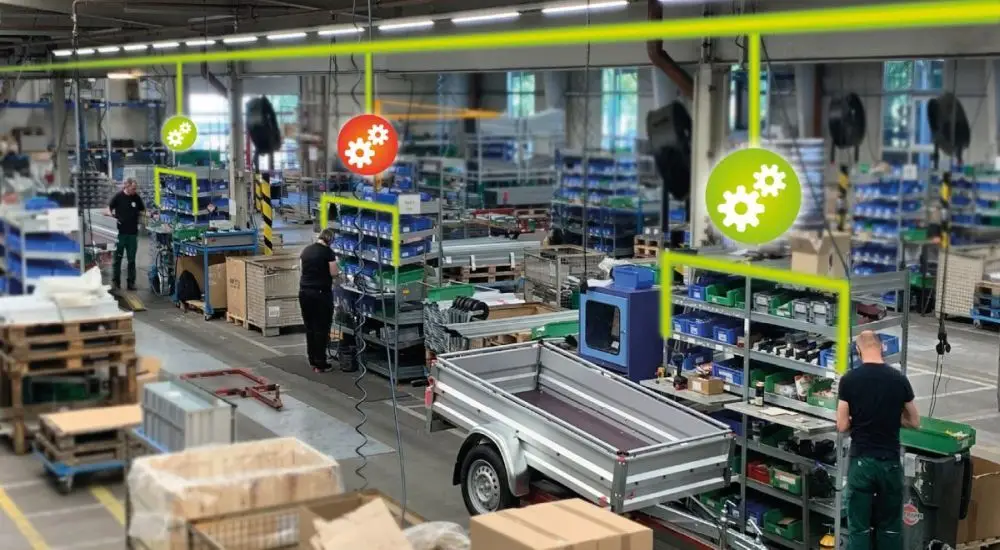
DeltaPro is more than just another pilot project. It is a practical test for a new logic: communication networks become sensors, making process monitoring potentially affordable and scalable for SMEs. The demonstrator in trailer production is not a high-gloss laboratory, but an environment with variants, partially manual processes, and precisely the disruptions that characterize everyday life.
If DeltaPro can demonstrate at the end of the project that radio signals function reliably as a sensor layer, a fundamental assumption of industrial digitalization will shift: transparency will then depend less on expensive additional hardware and more on intelligent signal interpretation. For many SMEs, this could be the entry point that has previously failed due to cost, effort, or acceptance.
And because the project will run until the end of March 2026, the crucial question is no longer whether results will be achieved, but how strong they will be. Because if "sensing by connectivity" proves itself in the field, a fascinating idea could become a new standard tool: production that senses when something is out of sync via its own radio signals.
Project partners
DeltaPro is being implemented jointly by ASTRUM IT GmbH, Fraunhofer-Gesellschaft, Qualigon GmbH, and STEMA Metalleichtbau GmbH.