Walmart Opens US Checkouts to NFC After a Decade of Resistance

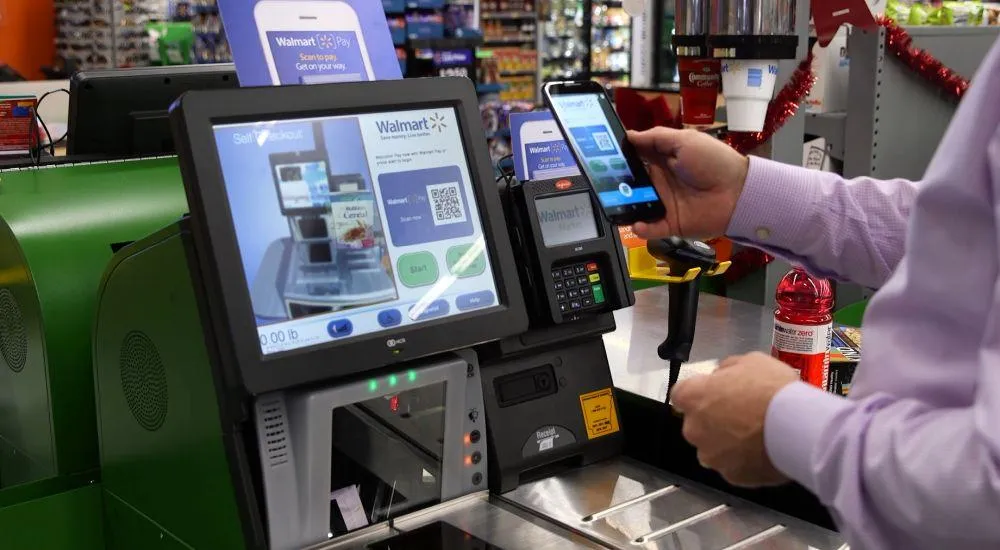
Walmart, the largest US retailer, is enabling NFC-based tap-to-pay across its US stores for the first time. Contactless cards, Apple Pay, Google Pay and compatible smartwatches will now work at checkout, ending a decade in which Walmart favored its own QR-based payment ecosystem.
NFC Comes to Walmart and Sam’s Club
Walmart announced on August 21, 2026, that tap-to-pay would begin at selected Walmart stores and Sam’s Club locations from August 24. All US stores and clubs are scheduled to support contactless payments by the end of 2026, with fuel stations following by mid-2027.
The change applies not only to Apple Pay and Google Pay. Customers will also be able to tap contactless credit and debit cards, making this a broader introduction of NFC and EMV Contactless across Walmart’s US checkout network.
NFC and EMV Replace the QR-Only Approach
Contactless payment uses NFC at 13.56 MHz to establish the short-range connection between a terminal and a card, smartphone or smartwatch. EMV Contactless defines the payment transaction running over that interface.
For mobile wallets, payment tokenisation adds another security layer. Apple Pay and Google Pay both replace the underlying card number with a payment token, although their device-side security architectures differ. Dynamic cryptographic data protects individual transactions.
This contrasts with Walmart Pay. Introduced nationally in 2016, Walmart’s proprietary system uses the smartphone camera to scan a QR code displayed at checkout. The payment remains within Walmart’s app and digital ecosystem.
A Ten-Year Strategic Shift
Walmart’s resistance to NFC was not primarily a technical issue. The retailer was a major member of the Merchant Customer Exchange, which developed CurrentC as a merchant-controlled alternative to emerging wallets such as Apple Pay.
CurrentC was discontinued in 2016, but Walmart continued with Walmart Pay while contactless payment expanded across US retail.
The 2026 decision therefore represents more than another checkout feature. Walmart is accepting an interoperable payment infrastructure alongside its own app, loyalty and payment services rather than treating the two models as alternatives.
Europe Chose NFC Earlier
Europe followed a different path. According to the European Central Bank, 93 percent of the approximately 25.7 million POS terminals in the euro area supported contactless payments by the end of 2025. Contactless card payments reached 32.9 billion transactions in the second half of 2025 alone.
Carrefour illustrates how retailers can combine open NFC acceptance with proprietary digital services. The French retailer introduced Apple Pay in France in 2016 while also developing Carrefour Pay and its own loyalty ecosystem.
In 2020, Carrefour integrated its loyalty program with Apple Pay and Apple Wallet. The example shows that supporting interoperable NFC payments does not require retailers to give up direct digital customer relationships.
QR and NFC Serve Different Purposes
Walmart’s move also highlights that QR and NFC do not need to compete.
QR codes remain useful for customer identification, loyalty, app-based workflows and order retrieval. NFC is optimized for fast, short-range and interoperable payment without line of sight or camera scanning.
For retailers, the stronger architecture is often to use each technology where it fits best rather than forcing one interface to perform every task.
What Changed Is Strategy, Not NFC
There is nothing fundamentally new about the wireless technology behind Walmart’s announcement. NFC and EMV Contactless have been established in retail for years.
What changed is Walmart’s payment strategy.
By opening one of the world’s largest retail networks to contactless cards and mainstream mobile wallets, Walmart removes one of the most prominent remaining gaps in US NFC acceptance. The broader lesson is clear: interoperable payment infrastructure and proprietary retail platforms can coexist at the same checkout.