
Beyond the Router: Why Wi-Fi HaLow Fits Outdoor Camera Networks

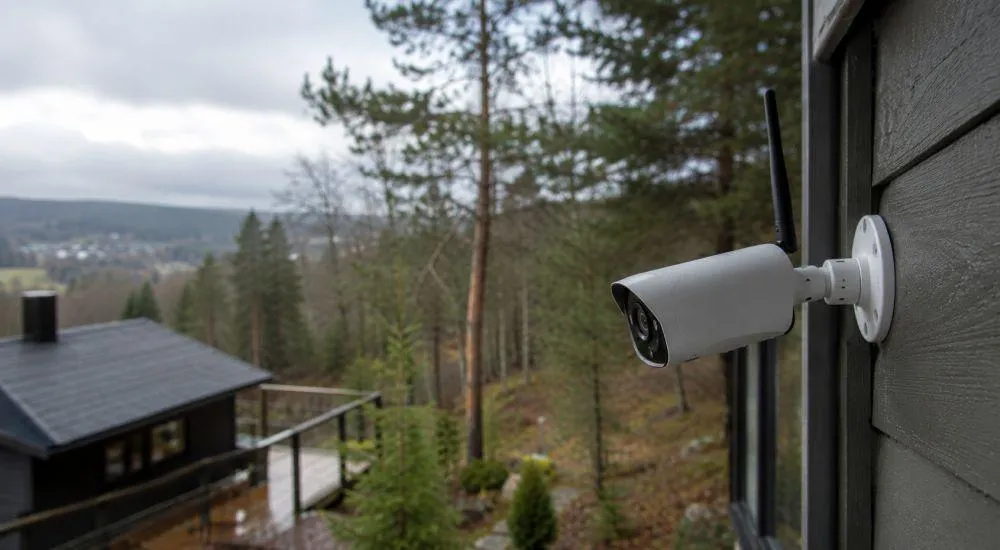
For cameras at gates, outbuildings, long driveways or larger properties, Wi-Fi HaLow can provide a more dependable wireless link than conventional Wi-Fi.
Outdoor surveillance faces a basic problem: cameras need to be placed where they protect the property, not where the router happens to be. A camera may need to cover a distant entrance, storage building, car park, stable, garden boundary or machinery away from the main building.
Conventional 2.4 GHz and 5 GHz Wi-Fi works well close to the router. Outdoors, distance, walls, vegetation, fencing and open terrain can make connections unstable. Video feeds may buffer, cameras may go offline, and installers may need repeaters, mesh nodes or cabling to reach that location.
Wi-Fi HaLow addresses this gap. Based on IEEE 802.11ah, it uses sub-1 GHz spectrum for long-range, low-power device connections. Its lower-frequency signals can travel further than standard Wi-Fi and are generally better suited to outdoor obstructions. This gives planners more freedom to locate cameras where they are most useful, not only where coverage is strongest.
Better for Distributed Outdoor Coverage
For camera networks, maximum throughput is not always the priority. A dependable connection at the edge of a property often matters more. Wi-Fi HaLow can help cover driveways, farm buildings, parking areas, workshops, perimeters and remote structures without a chain of conventional Wi-Fi extenders.
It is also designed for low-power communication. That is useful for battery-powered and solar-powered cameras, helping to reduce maintenance and support deployment where mains power is unavailable.
Like any radio technology, HaLow still has limits. Reinforced concrete, extensive metal surfaces, underground locations and several dense barriers can reduce performance. Site testing remains important for demanding installations.
Does a Wi-Fi HaLow Camera Need a Dedicated Gateway?
Usually, yes. A Wi-Fi HaLow camera normally communicates with a dedicated HaLow gateway, hub or bridge rather than directly with a standard router. The gateway receives the long-range HaLow signal and links it to the existing network through Ethernet or conventional Wi-Fi.
This lets the camera use HaLow’s range and energy efficiency while remaining compatible with recording systems, apps and internet access. Depending on the supplier, the gateway may be included in a kit or sold separately. Standard 2.4 GHz and 5 GHz routers do not automatically support Wi-Fi HaLow devices.
An Additional Radio Path, Not a Guarantee Against Jamming
Wi-Fi HaLow operates outside the conventional 2.4 GHz and 5 GHz Wi-Fi bands. An attempt to disrupt only standard Wi-Fi frequencies may therefore not affect a HaLow camera link. This can add resilience where surveillance would otherwise depend on a single conventional Wi-Fi connection.
However, Wi-Fi HaLow is not immune to deliberate interference. A jammer targeting the relevant sub-1 GHz band, or a broad-spectrum device, can still interrupt communication. For higher-security installations, it should be combined with local recording, connection-loss alerts, tamper detection and, where appropriate, a secondary wired or cellular connection.
Wi-Fi HaLow is not a universal replacement for high-bandwidth indoor Wi-Fi. But for outdoor cameras beyond the practical reach of a router, it provides an energy-efficient, flexible wireless foundation.
What to Consider in Europe
Wi-Fi HaLow is also available for European deployments, but the available spectrum is more limited than in markets such as the United States. Systems generally use the 863–870 MHz short-range-device band, where channel availability, transmit power and access rules can vary by country.
This means Wi-Fi HaLow should not automatically be treated as a direct replacement for conventional Wi-Fi video links. Depending on the approved configuration, continuous high-bitrate video streaming may be limited. It can be particularly suitable for event-triggered images, short clips, camera status data and low-power monitoring.
Before deployment, check that the camera and gateway are approved for the intended market and that the supported data rate matches the required video mode. Wi-Fi HaLow can extend outdoor coverage, but actual performance depends on the regional radio configuration.