
ISO 14001:2026: Measure, Analyze, Act with Wireless IoT

ISO 14001:2026 provides an updated framework for systematically managing environmental aspects, resource consumption, and risks. Wireless IoT supplements the data foundation: sensors, meters, and identification systems automatically record conditions. Within the IoT-edge-cloud continuum, data is visualized, evaluated, and translated into actions.
ISO 14001:2026 as a Framework
ISO 14001 is the internationally recognized standard for environmental management systems. The fourth edition, ISO 14001:2026, was published on April 15, 2026. It helps organizations assess their environmental impacts, incorporate legal requirements, and continuously improve their environmental performance.
The standard does not prescribe any specific sensor technology, wireless technology, or data platform. However, it does cover the monitoring of environmental performance, resource use, and waste management. Reliable data helps to evaluate measures effectively and transparently.
WIoT as an Automatic Data Source
Wireless IoT, or WIoT for short, wirelessly connects sensors, smart meters, gateways, actuators, and identification systems to edge systems and cloud platforms. Bluetooth Low Energy, RFID, LPWAN, Wi-Fi, and cellular networks transmit measurement values and events.
Sensors measure, for example, temperature, humidity, pressure, fill level, flow rate, power consumption, vibration, or door status. Meters provide data on electricity, water, heat, compressed air, and steam. This automatically generates time series, status reports, and motion events during operation.
Monitoring Energy, Equipment, and Material Flows
Wireless meters and sensors complement measurement points in buildings, production facilities, and technical infrastructure. Especially in existing environments, they collect consumption data without the need to install additional wiring in building structures or disrupt ongoing processes.
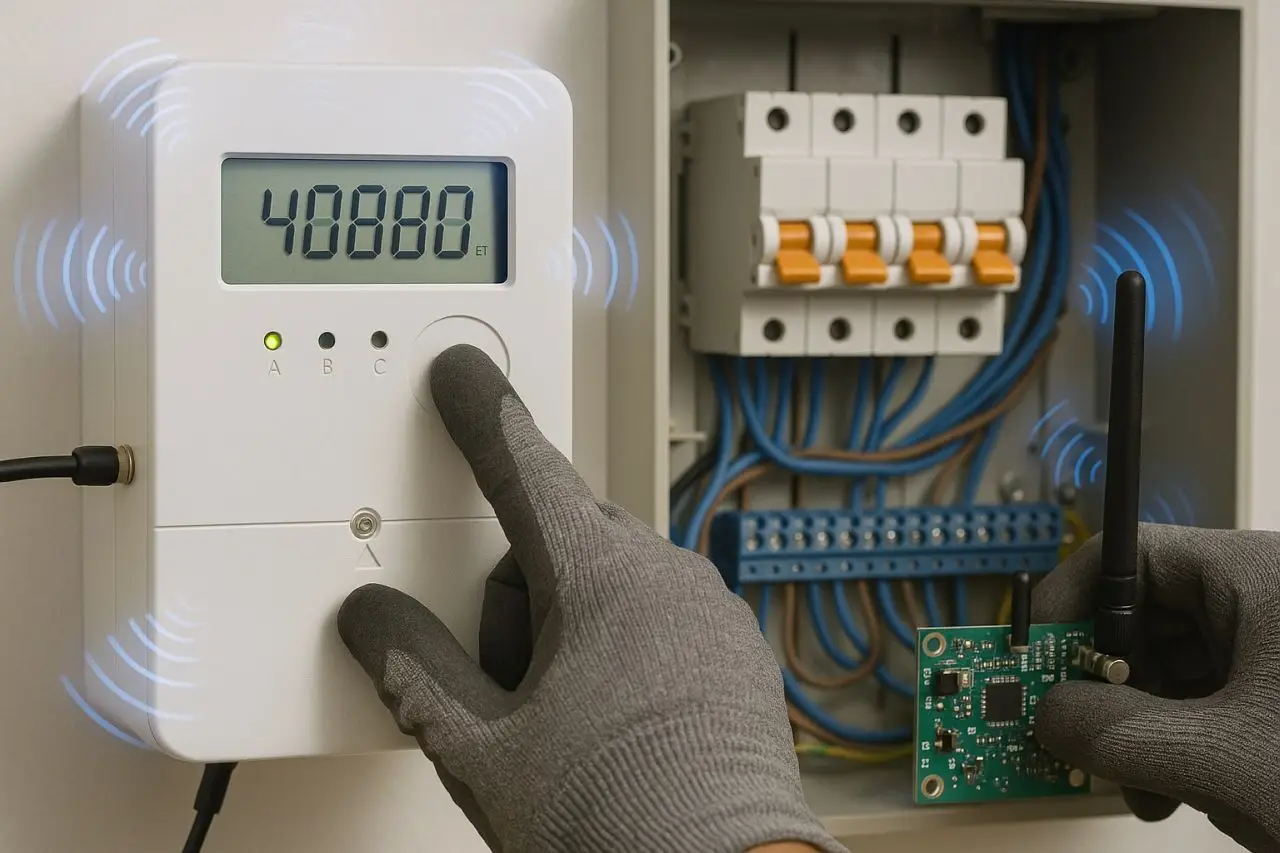
The data reveals consumption spikes, leaks, and discrepancies between systems or building areas. Temperature, pressure, vibration, and current sensors provide indications of inefficient operating conditions or incipient malfunctions in heating, ventilation, air conditioning, pumping, and refrigeration systems.
RFID automatically records movements and status changes of reusable containers, transport packaging, hazardous material containers, or waste bins at reading points. This makes inventories, circulation cycles, returns, losses, and reuse more traceable.
See, Analyze, Act—All in a Continuum
The IoT-Edge-Cloud continuum transforms data collection into a chain of actions. At the IoT edge, sensors, meters, and identification systems make environmental and operational conditions visible and continuously deliver data from systems, buildings, material flows, and logistics processes.
At the edge, information is filtered, validated, and checked against threshold values close to the process. This enables local responses, even with limited connectivity to the cloud. Alarms can be triggered when thresholds are exceeded, events can be buffered, and—based on defined rules and approvals—technical measures can be initiated via actuators, such as adjusting ventilation or cooling modes, controlling pumps as needed, or isolating a leak area.
The cloud aggregates data across systems, areas, and locations. It supports comparisons, root cause analyses, reporting, and the long-term evaluation of improvement measures. The process is as follows: observe what is happening, analyze which deviations are relevant, and take action before resource losses or environmental impacts increase.
Integrating Data into Management Processes
Data quality, timestamps, interfaces, and clearly defined responsibilities are crucial. This transforms an event into a verifiable action.
For operators, this links environmental management, energy management, building operations, maintenance, and procurement. System integrators integrate sensors, networks, edge components, and software in such a way that data becomes usable within the respective management process.
More information on ISO 14001:2026 is available on the ISO 14001 landing page. The Think-WIoT article on the IoT-Edge-Cloud continuum explains how devices, the edge, and the cloud interact in resilient real-time systems.