OPC Foundation Generates EU Digital Product Passports From Factory Data

The OPC Foundation Cloud Initiative has extended its open-source reference solution to generate Digital Product Passports directly from production data. The stack calculates product-specific sustainability data, creates a DPP for each item and makes it available through standardized interfaces.
From Production Data Directly to the Digital Product Passport
The OPC Foundation Cloud Initiative Reference Solution now supports the generation and storage of EU Digital Product Passports, or DPPs. The important point is where the information comes from: instead of building a passport manually in a separate database, the system can derive relevant information directly from industrial production data.
Erich Barnstedt, Senior Director & Architect, Industrial Standards at Microsoft and Chair of the OPC Foundation Cloud Initiative, describes the implementation as the world's first end-to-end, open-source DPP solution of its kind. The complete reference implementation is freely available under an MIT license.
The approach connects the shop floor with the Digital Product Passport. Machine and production data is collected, given a common structure and processed before the resulting product-specific information is published as a DPP.
How Does It Work?
At the industrial level, the reference architecture can connect OPC UA devices as well as equipment using other protocols. The UA Edge Translator can normalize data from sources including Modbus, LoRaWAN, OCPP and HTTP into OPC UA information models. Production information can then be transported through the architecture using OPC UA PubSub and MQTT.
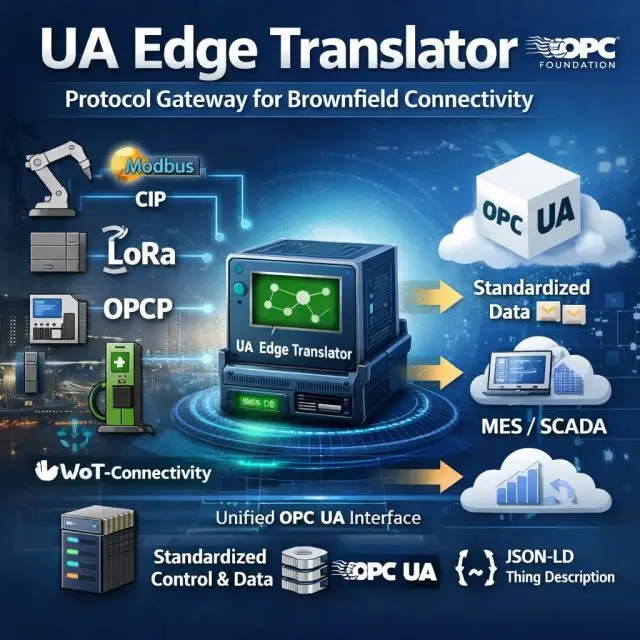

A new UA Data Processor turns this production information into information required for the product passport.
In the supplied production-line example, the processor follows an individual product by its serial number through assembly, testing and packaging. It combines the energy consumed while that product passes through the different stations and uses carbon-intensity information to calculate a Product Carbon Footprint.
The processor also collects end-of-line dimensional and quality information for a Digital Battery Passport. Together, these data sets form the Digital Product Passport for the individual manufactured item.
This is a significant difference from approaches in which sustainability information is collected separately after manufacturing. Here, the DPP can become an output of the production process itself.
One Passport for Every Produced Item
The resulting passports are published as OPC UA Information Models to a self-hosted UA Cloud Library.
The library provides storage, versioning, search and retrieval. Customers, recyclers, regulators or other authorized applications can retrieve the information through a REST API. The DPP repository can also remain on the manufacturer's own infrastructure instead of depending on a public cloud service.
In simple terms, the architecture connects three previously separate worlds: the machine that produces the item, the software that calculates its product information, and the system that makes its Digital Product Passport available.
Based on the New European DPP Standards
The timing is important. In July 2026, the European Commission published references to six harmonized European standards supporting Digital Product Passports under the Ecodesign for Sustainable Products Regulation.
These include EN 18222:2026 for APIs covering DPP lifecycle management and searchability, and EN 18223:2026 for system interoperability.
The OPC Foundation has also established a liaison with CEN/CENELEC JTC 24, the group working on the European Digital Product Passport framework. The aim is to connect standardized DPP interfaces and information models with OPC UA-based industrial systems.
This makes the project particularly relevant for manufacturers that already use OPC UA and want to connect existing OT data with future DPP requirements rather than create a separate data infrastructure.
Open Source and Designed for Edge or Cloud Deployment
The complete Cloud Initiative Reference Solution consists of open-source components and is available through GitHub under an MIT license. According to the project documentation, the complete stack can even run on an industrial PC costing less than $300. The same architecture can also be deployed across larger edge and cloud environments.
There are no subscription or per-message fees in the reference software itself. Companies remain responsible for hardware, operation, maintenance, security and integration.
The OPC Foundation explicitly describes the current configuration as a reference deployment rather than a production-ready system. The documentation includes a detailed STRIDE security analysis and recommends additional measures such as individual service credentials, trusted TLS certificates, restricted network access and hardened Kubernetes deployments before productive use.
Why This Matters for Wireless IoT
For Wireless IoT, the development addresses an increasingly important question: what happens to data after a product, component or asset has been identified and its manufacturing history captured?
RFID, NFC, QR codes and other data carriers can provide access to a Digital Product Passport, but the carrier alone does not create the passport. The underlying product information must first be collected, structured, maintained and made accessible.
The OPC Foundation reference implementation addresses this backend layer. It demonstrates how real industrial data can move from machines and IoT systems into a standardized, product-specific digital record that can subsequently be accessed throughout the product lifecycle.
For manufacturers, system integrators and IoT solution providers, this creates a direct connection between industrial connectivity, semantic data models and the emerging European Digital Product Passport infrastructure.
Explore and Test the DPP Reference Solution
The complete OPC Foundation Cloud Initiative Reference Solution is available on GitHub. Manufacturers, system integrators and developers can use it to explore the architecture, connect OPC UA and non-OPC UA devices, process production data, generate product-specific carbon footprint and battery passport information, store Digital Product Passports in the UA Cloud Library, test APIs and dashboards, and adapt the open-source components to their own industrial environment.
The repository also includes step-by-step tutorials for device onboarding, data queries, Grafana dashboards, OEE calculations, OPC UA Information Models, command-and-control workflows and the development of custom applications.
Explore the architecture, tutorials and source code on GitHub and build your own DPP test environment. Read more: OPC Foundation Cloud Initiative Reference Solution on GitHub.