OPC Foundation launches v7-2026 Cloud Reference Architecture

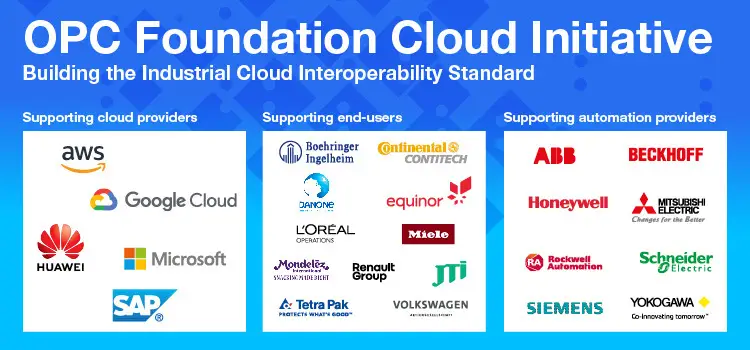
OPC Foundation has consolidated multiple efforts under a formal Cloud Initiative to accelerate interoperability between OT and cloud/IT systems using OPC UA. The initiative publishes a v7-2026 Cloud Reference Architecture, aligns technical working groups, open-source reference implementations, and a planned cloud validation and certification program.
Initiative overview
The OPC Foundation Cloud Initiative focuses on standardized collection, harmonization and secure sharing of industrial data to and within the cloud using OPC UA modeling language, OPC UA Information Models (including Companion Specifications) and OPC UA interfaces. The initiative explicitly does not change existing OT systems; instead it concentrates on cloud-centric integration patterns and interfaces for systems such as MES, DCS and ERP where these add value.
The Foundation published the new v7-2026 OPC Foundation Cloud Reference Architecture and intends to create best practices, an overall reference architecture and open-source reference implementations by harmonizing work from several existing working groups.
Scope and priorities
Key concerns addressed by the initiative include legislative requirements for broader data sharing (for example the EU Data Act), traceability use cases such as the Digital Product Passport, and cloud security. The initiative emphasizes reusing existing OPC UA Information Models and avoiding vendor lock-in while defining edge-to-cloud and cloud-to-cloud communication patterns.
A Steering Committee will recommend, harmonize and steer activities across technical working groups, and consolidate outputs to reduce integration cost and improve interoperability between cloud solutions.
Technical working groups and activities
The initiative groups several technical sub-teams and working groups, each with specific focus areas:
UA Cloud Library: An internet-hosted, queryable repository of OPC UA Information Models exposed via a RESTful API, with user access controlled through an identity provider.
OPC UA over MQTT Working Group: Examines use cases for OPC UA in MQTT messaging for edge-to-cloud and cloud-to-cloud transport. Work items include JSON header layouts, message format enhancements, PubSub actions, MQTT topic structure and security requirements.
OPC UA REST Interface: Defines use cases and potential OPC UA extensions for HTTP REST integration. Topics include a generic REST interface for common OPC UA services, datatype mappings, session-less service usage, Companion Specification REST support, OpenAPI-compatible definitions, and security requirements.
OPC UA WoT Connectivity: Defines how W3C Web of Things Thing Descriptions (JSON-LD) can be mapped into OPC UA address spaces to support protocol and data-model translation on industrial edge gateways.
OPC UA Industrial Metaverse Working Group: Demonstrated use cases such as remote condition monitoring via AR/VR, remote-assisted maintenance, immersive training in simulated environments, and logistics planning using head-up displays.
OPC UA AI leveraging Large Language Models Working Group: Will develop guidelines, examples and data files to help use generative AI with OPC UA constructs and information models. The group intends to publish guidance but not produce commercial domain-specific AI models.
Open-source reference implementations
The initiative lists a set of open-source projects intended as reference solutions and starting points for implementers. Notable repositories include:
UA-CloudLibrary (cloud-neutral repository of information models)
UA-CloudPublisher (OPC UA PubSub telemetry publisher)
UA-CloudCommander (online command & control app)
UA-CloudDashboard (dashboard for OPC UA PubSub data)
UA-CloudTwin (digital twin adapter for PubSub data)
UA-CloudViewer (online viewer for Information Models)
UA-EdgeTranslator (reference industrial connectivity translator)
IIoT Starter Kit (samples for OPC UA over MQTT)
Links to these repositories are provided by the OPC Foundation for review and adoption.
Validation and certification
The OPC Foundation will establish a validation and certification program for OPC UA Cloud interoperability. The program aims to provide rules and governance for cloud vendor support of OPC UA, noting that major cloud providers already offer varying levels of OPC UA support but without consistent OPC UA Cloud rules to date.
Relevance for integrators, solution providers and end users
System integrators and solution providers gain a consolidated set of architectures, reference implementations and proposed specifications to reduce custom integration work and achieve semantic interoperability in cloud deployments. End users can expect clearer patterns for secure, standardized data sharing between OT and cloud platforms, which supports analytics, digital twins and regulatory compliance use cases.
Adopters should evaluate the initiative's open-source components as potential accelerators and monitor the emerging certification program to ensure long-term compatibility with cloud vendor services.
Contact and next steps
The OPC Foundation requests industry participation in the Cloud Initiative. For inquiries and to express interest, contact Stefan Hoppe. The initiative aggregates existing working groups and provides downloadable reference materials, including the v7-2026 Cloud Reference Architecture.
Read more at https://opcfoundation.org/cloud/