OPC UA Connects Battery Production Data with Digital Battery Passports

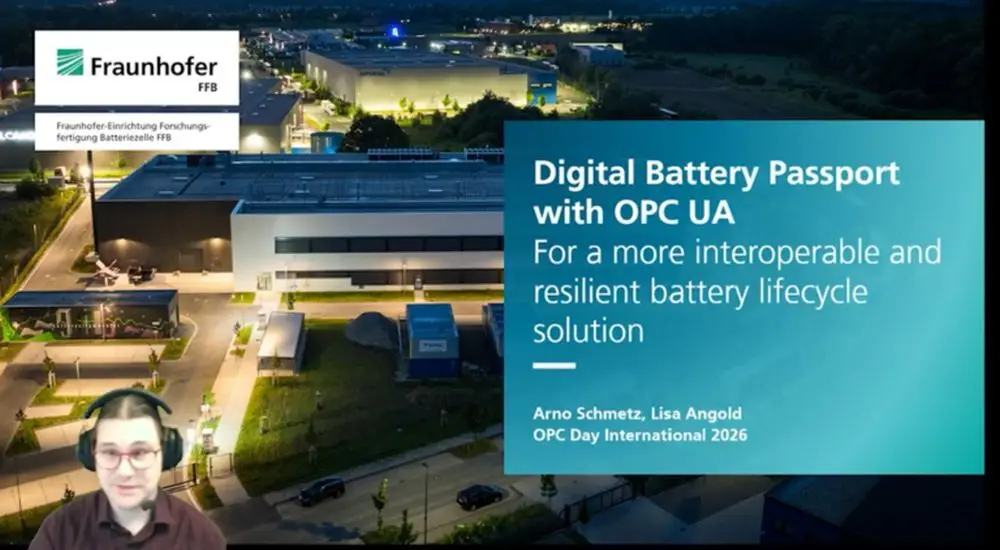
Digital Battery Passports will become mandatory under the EU Battery Regulation from 2027. A Fraunhofer FFB demonstrator shows how OPC UA can link production and lifecycle data for interoperable battery transparency.
Fraunhofer FFB Demonstrates Traceability
The EU Battery Regulation introduces the Digital Battery Passport as one of the first large-scale Digital Product Passport applications. From 2027, battery manufacturers and economic operators must provide structured information about batteries across their lifecycle.
At Hannover Messe 2026, the Fraunhofer Research Institution for Battery Cell Production FFB demonstrated how OPC UA can support this requirement. The demonstrator was developed with partners from Catena-X, IDSA, IDTA, OPC Foundation, VDA and VDMA.
The project shows that a Battery Passport is not only a database for production data. Its value lies in connecting information from raw material sourcing, manufacturing, operation, maintenance, second-life use and recycling.
From Compliance to Lifecycle Data
The regulation requires information on manufacturing, carbon footprint, material composition, recycled content, performance, durability and end-of-life handling. While current requirements focus on primary manufacturing data, lifecycle data is becoming equally relevant.
State of health, charging behavior, operating history and maintenance events can influence whether a battery is repaired, reused, qualified for second-life applications or recycled.
The Need for Interoperable Battery Data
Battery production is highly complex. Electrode production, cell assembly, formation, testing and packaging generate large volumes of process and quality data. The challenge is to preserve context and make selected information usable across organizations.
Manufacturers, equipment suppliers, operators, recyclers and authorities all need access to different parts of the data. Without standardized information models and interoperable communication, this information remains fragmented across machines, software systems and platforms.
OPC UA as a Technical Foundation
The Fraunhofer FFB demonstrator shows how OPC UA can connect production systems with Digital Battery Passport workflows. Production equipment communicates via OPC UA, allowing machine data, process parameters, quality information and traceability records to be collected consistently.
The technical relevance lies in the semantic layer of OPC UA. Data is not only exchanged as values, but with defined meaning and context. For system integrators and solution providers, this is central because Battery Passport implementations must connect machines, MES environments, data spaces, cloud platforms and compliance applications.
OPC UA information models can reduce proprietary interfaces and vendor-specific integration work. Existing modelling methods, companion specifications, NodeSet artifacts and validation workflows can also support consistent passport models.
During operation, the passport can be enriched with state-of-health information, usage history, maintenance records and performance indicators. For operators and recyclers, this can support valuation, reuse decisions and second-life qualification.
Explore how OPC UA supports Digital Battery Passports, battery traceability, and lifecycle transparency in the original OPC Foundation source, including the OPC Day International 2026 presentation by Fraunhofer FFB’s Arno Schmetz and Lisa Angold: https://opcconnect.opcfoundation.org/2026/06/digital-battery-passports-powered-by-opc-ua-from-manufacturing-data-to-lifecycle-transparency/