NXP Introduces KW43 and MCX W70 for Bluetooth Channel Sounding

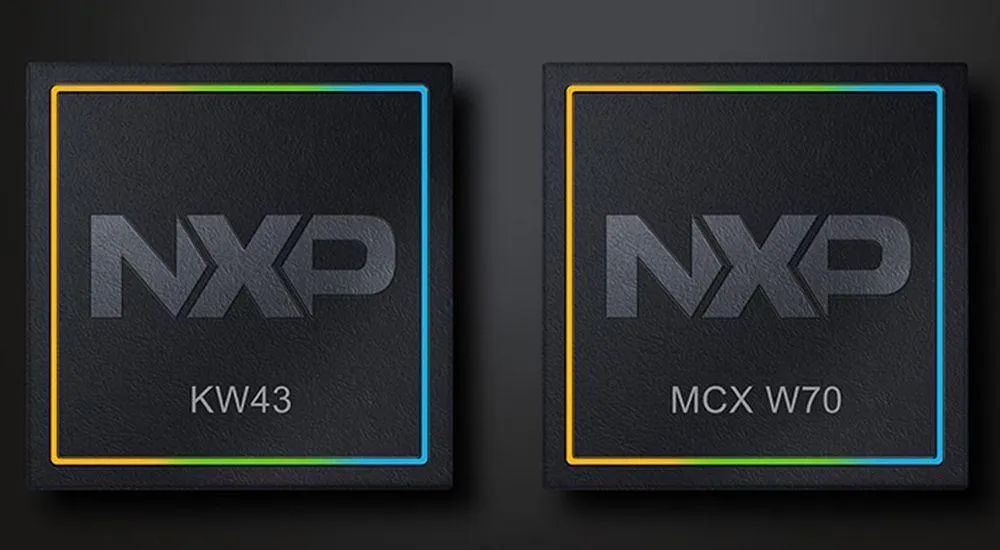
Bluetooth Channel Sounding is opening new possibilities for secure distance measurement, but widespread adoption depends on suitable hardware. NXP's new KW43 and MCX W70 wireless microcontrollers bring Bluetooth 6.x ranging to compact, power-efficient automotive and industrial IoT devices, with broader availability planned for 2027.
New Bluetooth Hardware Makes Secure Ranging More Accessible
How can a vehicle determine whether a smartphone is genuinely close enough to unlock its doors? How can an industrial device verify the distance to another wireless device without relying on signal strength alone?
Bluetooth Channel Sounding (BCS), introduced with Bluetooth 6.0, addresses these questions through precise, secure distance measurement. However, the technology is still in an early phase of commercial adoption. Its wider use requires microcontrollers that integrate ranging capabilities without significantly increasing device cost, size or power consumption.
On October 27, 2026, NXP Semiconductors introduced the KW43 and MCX W70, two new Bluetooth 6.x wireless MCU families designed for automotive and industrial IoT applications.
They extend NXP's first generation of Channel Sounding devices, launched in 2025, into more cost-sensitive applications.
How Bluetooth Channel Sounding Measures Distance
Traditional Bluetooth proximity applications often estimate distance using Received Signal Strength Indicator (RSSI) measurements. However, signal strength is affected by obstacles, reflections, antenna orientation and environmental conditions.
Bluetooth Channel Sounding uses two complementary methods:
Phase-Based Ranging (PBR): Evaluates phase differences in radio signals across multiple frequencies to estimate distance.
Round-Trip Timing (RTT): Measures signal exchange timing between devices to support distance estimation and security checks.
Combining these measurements enables more reliable ranging and helps detect certain relay attacks, in which an attacker attempts to make a distant device appear nearby.
Bluetooth 6.3 introduces further refinements intended to reduce ranging time and processing overhead.
Unlike a complete positioning system, Channel Sounding primarily measures distance between devices. Determining an asset's position requires additional reference points, measurements or localization algorithms.
Faster Ranging with Integrated Localization Processing
Both new NXP MCU families use a shared Bluetooth Channel Sounding architecture built around a dedicated Localization Compute Engine (LCE).
According to NXP, the engine accelerates the processing of ranging algorithms by nearly 45%, helping reduce response times and computational workload.
The KW43 and MCX W70 also introduce a unified memory architecture and a revised implementation of NXP's EdgeLock security functions.
By implementing more security capabilities through integrated IP and software rather than a separate hardware enclave, NXP aims to reduce system complexity and component costs.
The company reports SESIP Level 3 and PSA Level 3 certification for the new devices and describes them as ready for future post-quantum cryptography requirements.

KW43: Bluetooth Ranging for Digital Vehicle Keys
The KW43 targets automotive applications, particularly secure digital vehicle access.
Bluetooth Channel Sounding can help a vehicle verify whether an authorized smartphone is physically close enough for a particular action, rather than relying solely on a Bluetooth connection or signal-strength estimate.
The MCU meets AEC-Q100 Grade 2 requirements and integrates CAN and LIN communication interfaces for automotive systems.
Compared with NXP's earlier KW47, the KW43 focuses on designs where cost, space and power consumption are particularly important.
MCX W70: Secure Ranging for Industrial IoT
The MCX W70 brings the same Channel Sounding architecture to industrial, building automation and connected-device applications.
Alongside Bluetooth Low Energy, the wireless MCU supports Zigbee, Thread for Matter and connectivity applications involving Aliro.
This multiprotocol approach enables manufacturers to combine Bluetooth distance measurement with other wireless functions within a common hardware platform.
Potential applications include secure building access, proximity-aware industrial equipment, connected lighting, smart home systems and asset tracking solutions that require verified distance information.
For industrial applications, Channel Sounding can complement technologies such as RFID and UWB. The choice depends on the required ranging accuracy, infrastructure, operating environment and application.
Sampling Underway, Wider Availability in 2027
The KW43 and MCX W70 are currently sampling, and NXP provides evaluation kits for developers. Broader availability is targeted for the second quarter of 2027.
NXP's earlier KW47 and MCX W72 remain options for applications requiring greater scalability, while the new families address designs with tighter cost, memory and power constraints.
The launch illustrates an important stage in the development of Bluetooth Channel Sounding: the technology is moving beyond early high-performance platforms toward a broader selection of application-specific devices.
For manufacturers developing secure access, industrial IoT and connected products, the availability of suitable Bluetooth 6.x hardware will be an important factor in turning secure ranging into commercial applications.