Thermomix TM7: Connected Cooking on NXP’s Edge Platform
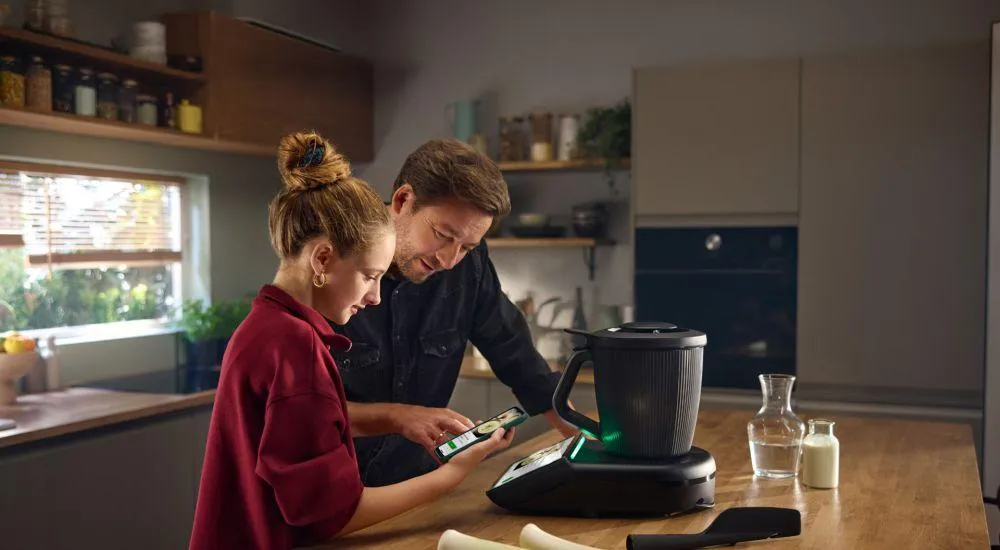
In developing the Thermomix TM7, Vorwerk and NXP collaborated across several key technology areas, including the development of an integrated edge platform for multimedia, real-time motor control, Wi-Fi 6 and power management. This architecture supports Guided Cooking on the TM7, OTA updates and connected use at home or via a smartphone hotspot while traveling.
Connected Cooking at Home and on the Go
Whether used at home in everyday life or while traveling, the Thermomix TM7 combines numerous functions in a single appliance. Cookidoo provides more than 100,000 recipe inspirations that can then be prepared using Guided Cooking for reliable results. Users can also cook manually, chop, blend, sauté or steam.
Cookidoo can be accessed via the app or directly on the appliance. Recipes can be transferred from the app to the TM7 or selected via Wi-Fi directly on the device’s 10-inch touchscreen for Guided Cooking. If no fixed internet connection is available, connectivity can also be established through a smartphone hotspot, keeping the recipe database and connected functions accessible while traveling.
This is where the intelligent edge architecture developed with NXP support comes into play. It is designed to handle multimedia processing, human-machine interaction, deterministic motor control, wireless connectivity and power management simultaneously.
Four Technology Areas on One Platform
For the TM7, Vorwerk required an architecture capable of handling several demanding workloads without affecting the responsiveness of the user interface or the precise control of the appliance.
The system brings together four key technology areas:
multi-core application processing,
real-time motor control,
Wi-Fi 6 connectivity and
integrated power management.
Rather than developing these areas as isolated subsystems, Vorwerk and NXP coordinated them within a single platform.
NXP’s customer application support and systems engineering teams worked closely with Vorwerk from the early architecture phase through to product launch. Regular technical workshops, regional application support and on-site engineering accompanied the hardware and software development.
Multimedia Processing for the HMI
Multi-core application processing supports the TM7’s digital interface and multimedia functions. The architecture processes 2D and 3D graphics, H.265 video as well as audio and voice functions on the same processing platform.
These resources provide the technical foundation for guided cooking content, a detailed graphical user interface and fast user interaction.
A shared board support package ensures software continuity between Thermomix generations. This allowed Vorwerk to build on more than a decade of existing software development and further evolve the platform specifically for the TM7.
Deterministic Motor Control
A dedicated real-time control core manages motor functions and power factor correction. Deterministic control supports the high-torque workloads associated with mixing, kneading and food processing.
Vorwerk used NXP’s FreeMASTER development tools for motor control to analyze the behavior of the high-performance TM7 motor and optimize the system during development. The architecture also supports optional functional safety.
Separating application processing from real-time control makes it possible to operate multimedia functions and motor workloads within one coordinated system while meeting different timing and performance requirements.
Wi-Fi 6 for Cookidoo and OTA Updates
A compact Wi-Fi 6 module provides the wireless connectivity required for Cookidoo recipe streaming, over-the-air software updates and Vorwerk’s broader connected ecosystem, whether through a home network or a smartphone hotspot while traveling.
For manufacturers of connected household appliances, the Wi-Fi architecture enables access to digital services without requiring a separate cellular module in the device.
Integrated Power Management
An integrated NXP power management IC controls and regulates the power domains of the edge platform integrated into the TM7. It supplies the high-performance multimedia subsystem and the motor control architecture.
The coordinated architecture has helped Vorwerk build on its existing software base, reduce migration risks and efficiently support development of the TM7. For system integrators and embedded solution providers, the project shows the importance of considering processing, real-time control, connectivity and power management together from the beginning of product development.
Read more at https://www.nxp.com/company/about-nxp/smarter-world-blog/SF-BL-VORWERK-THERMOMIX
Looking to advance your next connected product? Contact NXP to explore scalable technologies, system-level support and development expertise for secure, intelligent edge solutions.