
LoRa Alliance CEO: LPWAN Connects AI With the Physical World

AI needs data from sensors, machines and infrastructure to understand and act on the physical world. Alper Yegin, CEO of the LoRa Alliance, sees LPWAN and LoRaWAN as a key connectivity layer for Massive IoT and the emerging connection between AI and Wireless IoT.
AI Needs Physical-World Data
Artificial intelligence still relies largely on existing digital data. Its next development stage will increasingly depend on information generated directly in the physical world by sensors, connected devices and machines.
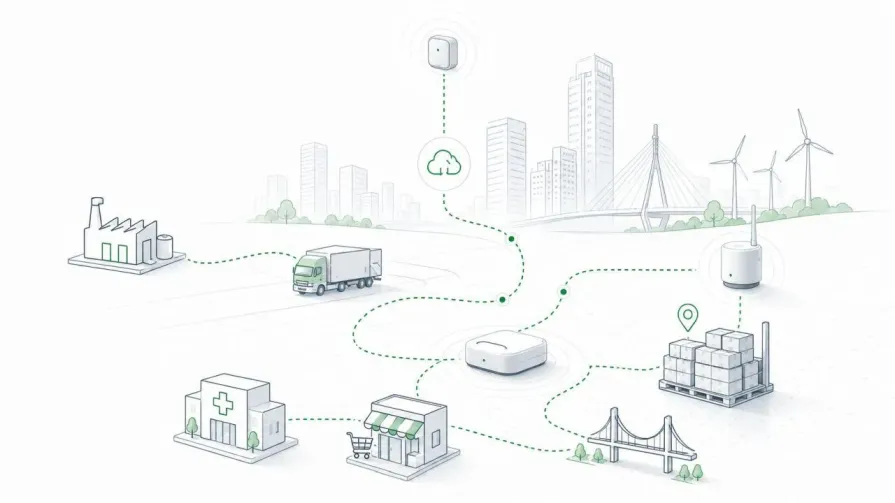
Alper Yegin, CEO of the LoRa Alliance, describes AI as the brain and IoT as the nervous system. Sensors provide physical inputs, while connected devices and actuators can translate digital decisions into actions.
The challenge is scale. IoT systems can combine vibration, acoustic, temperature, environmental, vision and location sensors. Many devices must operate over long distances with low power consumption, limited maintenance and low total operating costs.
LPWAN for Massive IoT
Yegin positions LPWAN as an important connectivity layer for this architecture. LoRaWAN addresses applications requiring long range, ultra-low power operation and connectivity through public, private or satellite networks.
He also explicitly points to Wi-Fi, Bluetooth Low Energy and cellular connectivity as complementary technologies with different strengths.
One technology not separately discussed in Yegin's analysis is Wi-Fi HaLow, another relevant wireless IoT option for longer-range and energy-efficient device connectivity.
From AIoT to Wireless IoT
Yegin connects this development with AIoT, or Artificial Intelligence of Things, the combination of artificial intelligence and IoT. IoT devices collect data from the physical world, while AI processes that data to detect patterns, predict conditions or initiate actions.
The LPWAN connectivity described by Yegin is part of the broader field of Wireless IoT, or WIoT, which connects physical objects, sensors and machines using wireless technologies. This includes LPWAN technologies such as LoRaWAN as well as BLE, Wi-Fi and Wi-Fi HaLow, cellular, UWB, RFID and NFC. Wireless IoT has been the central technology field covered by Think WIoT for many years.
AI processing can take place in the cloud, at an edge gateway or directly on the device. Moving intelligence closer to the sensor can reduce the amount of raw data that needs to be transmitted.
AI and IoT Reinforce Each Other
IoT supplies AI systems with current physical-world data. AI can then improve IoT systems by identifying relevant events, filtering information locally and reducing the amount of data that must be transmitted.
Yegin describes this as an AI-to-IoT flywheel. More sensors provide better data for AI models. Better models can reduce communication and operating costs, making larger sensor deployments economically viable.
This is particularly relevant for battery-powered wireless sensors. Instead of continuously sending raw measurements, edge AI can evaluate data locally and transmit only meaningful events.
From Raw Data to Events
One example is predictive maintenance. Vibration sensors with local machine-learning capabilities can detect bearing faults, imbalance or misalignment and report an event rather than continuously transmitting raw vibration data.
A similar concept applies to intelligent vision sensors. Image processing can take place locally, while only metadata or detected events are transferred through the network.
For wireless IoT, this changes the connectivity requirement. Many AIoT applications do not require continuous high-bandwidth connections. They need reliable transmission of relevant data from large numbers of distributed devices.
Applications From Industry to Logistics
Potential applications include predictive maintenance, occupancy-controlled HVAC and lighting, leak detection, metering, street lighting and waste management.
Agriculture can use soil moisture or livestock sensors, while logistics applications include geofencing events from pallets and containers and cold-chain exceptions. Safety systems can report air-quality thresholds or locally detected PPE violations.
LPWAN as Part of the AI Infrastructure
Yegin's central argument is that AI will increasingly depend on data generated in the physical world. Sensors, edge processing and wireless networks therefore become part of the infrastructure required to bring AI into industrial, logistics, building and utility applications.
For Massive IoT, he sees LPWAN and particularly LoRaWAN as a key connectivity layer for connecting large numbers of low-power devices and feeding physical-world information into AI systems.
Read more: Alper Yegin published the original analysis on September 1, 2026, as a Forbes Technology Council contribution.