
IDCRAFT: RFID as a Key Enabler for the Digital Product Passport

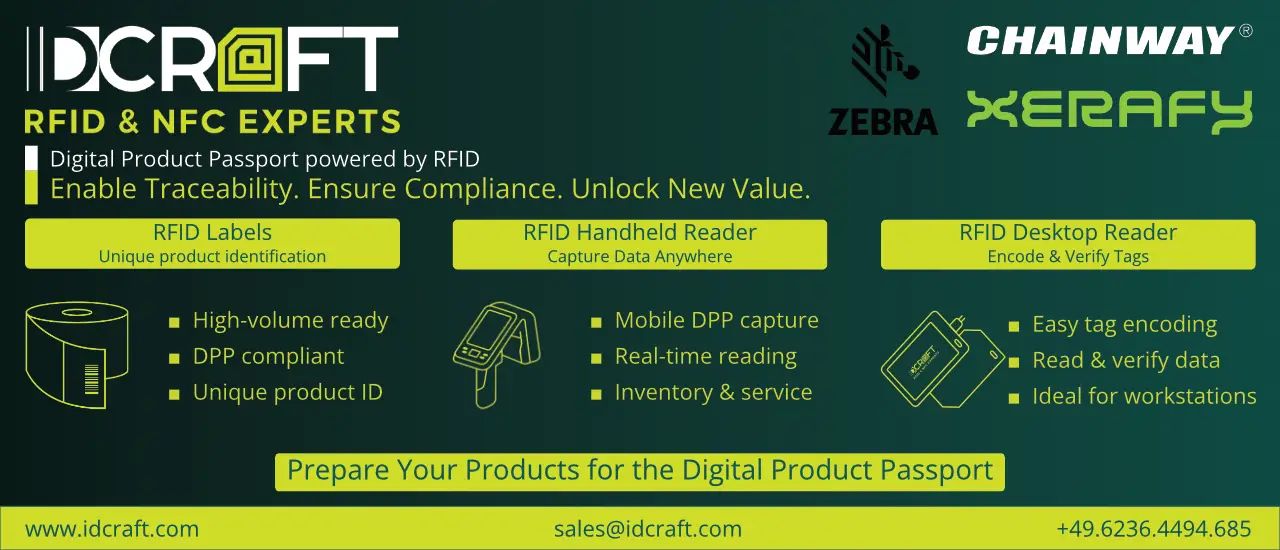
Digital Product Passport (DPP) & RFID – Efficient Identification and Traceability
IDCRAFT GmbH highlights the critical role of RFID technology in implementing the Digital Product Passport (DPP). The DPP is a European Union initiative aimed at improving product sustainability and transparency by making lifecycle-related data digitally accessible, from material origin and carbon footprint to repair history and recyclability.
Starting in 2027, the Digital Product Passport will become mandatory for initial product groups, requiring companies to provide product data in a machine-readable format. RFID technologies play a key role in meeting these requirements efficiently and reliably.
RFID as the Enabler for DPP
The two main RFID frequency ranges complement each other ideally in DPP applications:
HF | NFC RFID enables direct interaction with end customers and service technicians. Any NFC-enabled smartphone can scan a tag on the product and instantly access the Digital Product Passport.
UHF | RAIN RFID supports automated bulk identification in industrial and logistics environments. For example, an RFID reader installed at a goods-in gate can identify hundreds of DPP-labeled products within seconds.
Key Benefits of RFID for the Digital Product Passport
RFID offers several advantages for DPP implementation:
No line-of-sight required: Tags function even when concealed or under harsh environmental conditions.
Bulk identification: Hundreds of products can be captured simultaneously.
Durable and robust: RFID tags are designed for long-term use, even in demanding industrial environments.
Data stored directly on the tag: Memory capacity allows offline information access and secure data storage.
Choosing the Right RFID Hardware
Selecting the appropriate RFID hardware is crucial for a successful DPP strategy. The choice of RFID tag or label depends largely on the product material, form factor, and application environment.
Programming and encoding strategy is equally important. If transponders are encoded during manufacturing, stationary RFID readers — for example, devices with Ethernet connectivity — are typically required.
If labels are applied after production, RFID-enabled label printers with integrated encoding functionality may be the optimal solution. For warehouse and logistics operations, mobile RFID readers provide flexible and efficient data capture.
IDCRAFT GmbH supplies RFID hardware for a wide range of DPP applications — from RFID labels for product identification to stationary and mobile RFID readers for automated data capture, as well as specialized RFID tags for challenging industrial environments. IDCRAFT provides technology-neutral consulting to help companies select the right RFID solution for their Digital Product Passport strategy.
Contact: Interested in learning more about “RFID for the Digital Product Passport” or sourcing the right hardware? Patrick Kochendörfer (IDCRAFT) advises on availability, product variants, and integration.
www.idcraft.com | Phone: +49 6236 4494 685