
IDCRAFT Expands Its Portfolio with 3D-Printed RFID Transponders

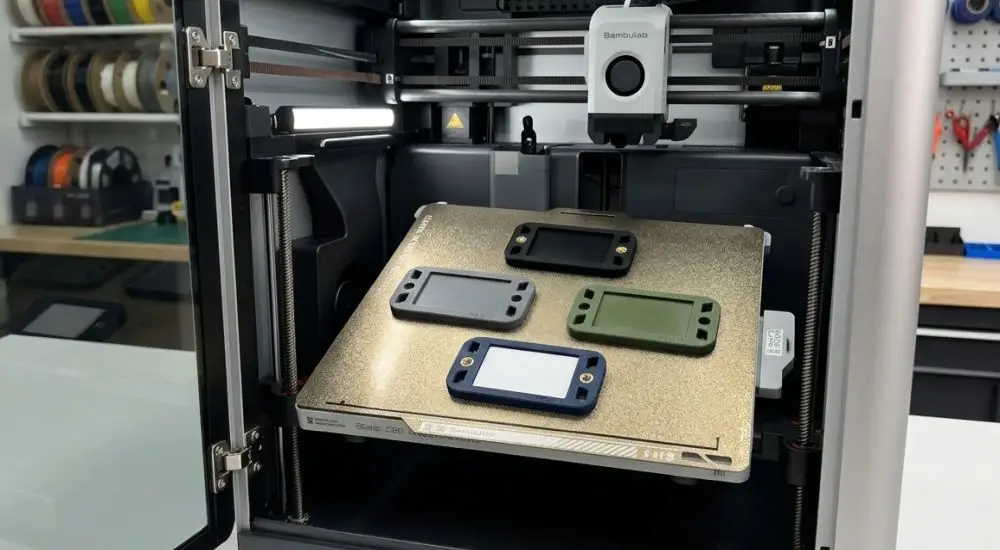
IDCRAFT focuses on in-house enclosure solutions for small and medium-volume production
RFID distributor IDCRAFT is expanding its portfolio to include 3D-printed RFID transponders. The solution is primarily aimed at projects involving small to medium production runs, as well as applications requiring custom designs or special mounting options.
The RFID distributor IDCRAFT is currently setting up its own production facility for 3D-printed RFID transponders. The goal is to provide customers with even more flexible support in the future for projects where standardized transponders reach their limits.
The focus is on two areas: a portfolio of standard housings and custom transponder housings that can be developed according to customer specifications or produced directly based on provided 3D printing files.
“Many projects require special designs or customizations that are difficult to implement with traditional transponders,” explains Patrick Kochendörfer, Managing Director of IDCRAFT. “With 3D printing, we can respond to such requirements much more quickly and flexibly.”
RFID inlay is integrated during printing
Technically, IDCRAFT relies on the FDM 3D printing process. In this process, plastic filament is heated and processed layer by layer. During the printing process, the RFID inlay is inserted at a defined point and then completely sealed within the housing.
“The RFID inlays are inserted during printing and are then completely protected,” says Patrick Kochendörfer. Currently, IDCRAFT primarily works with classic RFID inlays and labels. In the future, however, transponders with ceramic substrates can also be integrated.
The main advantage of this method lies in the design flexibility: unlike injection molding processes, no expensive tools are required. This makes it possible to produce even small quantities economically.
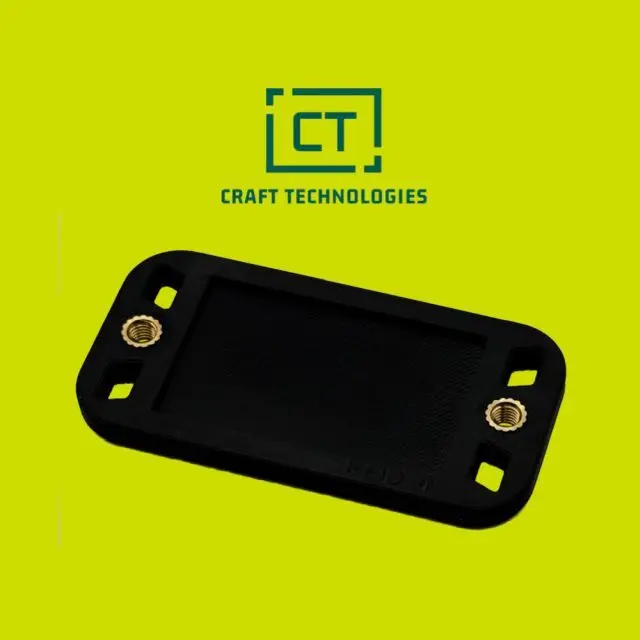

Standard housings and custom designs
With this new approach, IDCRAFT aims to address applications where customized transponder solutions are required. These include, for example, special designs for industrial systems, customized mounting solutions, or project-specific integrations.
The planned transponders support both UHF technology (RAIN RFID) and HF technology (NFC). Standard chips used include NXP UCODE 9, Alien Higgs 10, NXP I-CODE SLIX, and NTAG213. Additional chip types can be integrated on a project-by-project basis.
Custom labeling solutions are also available: serial numbers, barcodes, QR codes, or company logos can be applied via laser engraving or using durable labels.
Materials for various application environments
In terms of materials, IDCRAFT currently relies on PLA for indoor applications and ABS for outdoor and industrial environments. In addition, the company is already working on the integration of high-performance materials designed to withstand temperatures of up to 200 °C.
The transponders are available in both off-metal and on-metal variants. Mounting solutions such as M5 screws or cable ties are provided for installation.
Focus on flexible RFID projects
The move into 3D-printed transponder manufacturing arose from specific project requirements.
“In various projects, we repeatedly needed custom designs—for both transponders and readers,” says Patrick Kochendörfer. “This often led us to explore 3D printing.”
The company first wants to test how high the demand will be. “The first step is a test to see how the market reacts,” explains Kochendörfer.
For a standard product, current production capacity stands at around 200 transponders per day on a single printer. IDCRAFT aims to keep prices in line with industry standards—even for smaller quantities.
Added value through RFID expertise
Patrick Kochendörfer acknowledges that RFID transponders could theoretically also be manufactured using a proprietary 3D printer. However, he sees the difference in the overall package.
“Our advantage is that we don’t just offer printing,” he says. “We can design transponders, select suitable inlays, test the tags, and then encode or personalize them.”
As an RFID distributor, IDCRAFT thus combines 3D printing, RFID expertise, and project support —an approach that could be particularly appealing to companies requiring customized transponder solutions without having to build their own development resources.
Are you planning an RFID project with specific requirements regarding design, mounting, or quantity? IDCRAFT supports you from selecting the right inlay to the fully personalized transponder. Details on the 3D-printed RFID 3DTag for UHF and HF applications can be found on IDCRAFT’s product page.