IDCRAFT Insight: Asset tracking – Why are RFID readers and tags so important?
Optimizing Asset Tracking Through RFID
This article is provided by Patrick Kochendörfer, Managing Director of IDCRAFT.
Asset tracking refers to the process of monitoring and managing physical assets throughout their entire lifecycle, from acquisition and commissioning to maintenance and disposal. Companies across industries such as logistics, healthcare, manufacturing, and retail rely on asset tracking to maintain oversight of equipment, inventory, tools, and other valuable items.
Without effective tracking, organizations face inefficiencies, asset losses, compliance risks, and unnecessary replacement costs.
Traditional tracking methods such as manual spreadsheets or barcode scanning are time-consuming and error-prone. Barcodes require a direct line of sight for scanning, making large-scale inventory processes slow and labor-intensive. This is precisely where RFID technology (Radio Frequency Identification) offers a decisive advantage.
RFID for Asset Tracking
RFID is significant for asset tracking for several key reasons. First, it substantially reduces human error through automated data capture. Second, RFID offers scalability! Whether tracking hundreds or millions of objects, the technology handles high volumes effortlessly. Third, RFID supports lifecycle management by documenting the movements, usage history, and maintenance status of each asset, enabling data-driven decision-making.
Industries such as healthcare use RFID to track surgical instruments and medications, while logistics companies monitor pallets and containers along global supply chains. In manufacturing, RFID ensures that tools and semi-finished products are tracked at all times.
In terms of technology, the primary RFID technologies used are HF and UHF:
HF | NFC RFID (13.56 MHz) – suitable for short distances and controlled handovers
UHF | RAIN RFID (860–960 MHz) – for longer ranges and bulk capture
Typical standards include ISO 15693, ISO 14443, and EPC Gen2 (ISO 18000-63), among others.
An RFID system consists of:
Transponders (tags)
Readers (stationary or mobile)
Middleware
Interfaces to ERP or asset management software
The key advantage over barcode systems lies in contactless identification without line of sight, as well as the simultaneous capture of multiple objects.
Typical use cases:
Production equipment tracking in manufacturing
Tool management on construction sites
Medical device tracking in hospitals
IT asset management in enterprise environments
Key integration aspects include:
Connection to ERP systems
Data modeling and process definition
Security and compliance requirements
Infrastructure scalability
In summary, asset tracking refers to the digital monitoring and management of physical assets throughout their entire lifecycle. This includes machinery, tools, vehicles, IT equipment, containers, and medical devices.
RFID technology elevates asset tracking from a reactive, manual task to a proactive, automated level, saving time, reducing costs, and improving operational efficiency.
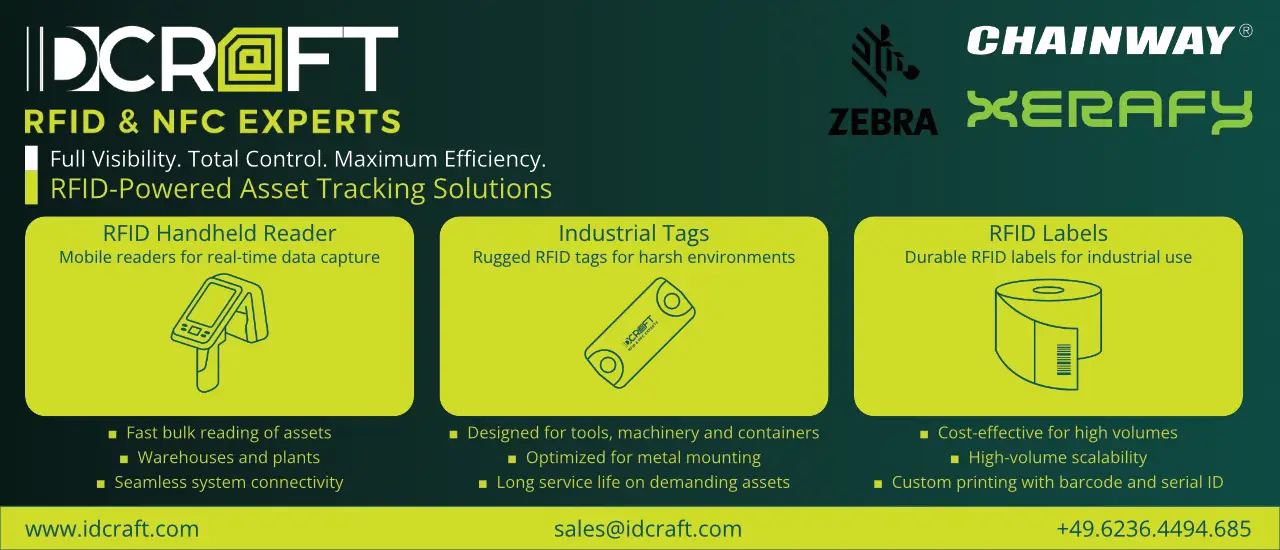
As an RFID & NFC specialist for asset tracking, IDCRAFT supports companies in selecting the right hardware, the best software partners, and with project implementation!
Contact
Would you like to learn more about the use of RFID in asset tracking applications or purchase the appropriate hardware? Contact Patrick Kochendörfer (IDCRAFT) for advice, project support, and information on availability, variants, and integration.
www.idcraft.com | Tel.: +49 6236 4494 685