Dracula Technologies Explores Organic Electronics Beyond OPV
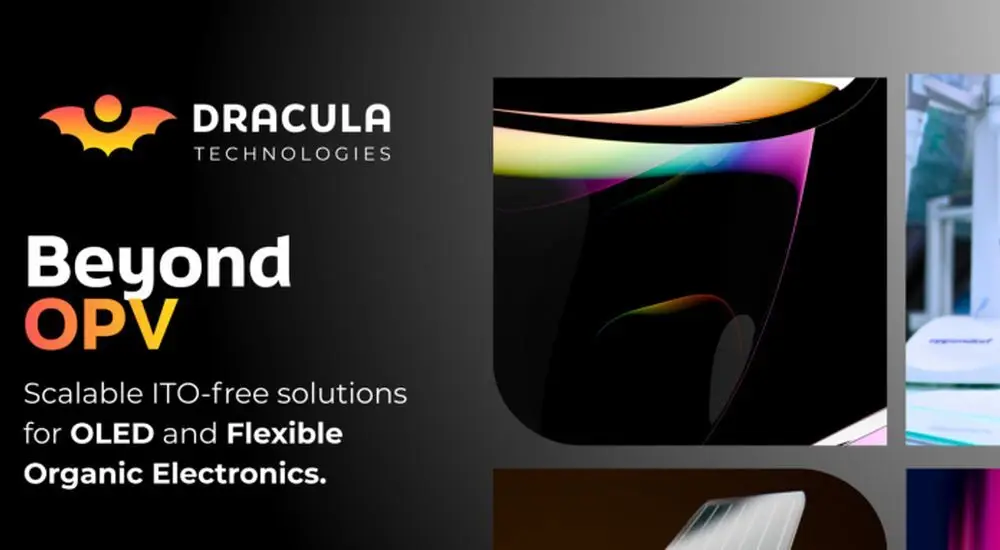
At Dracula Technologies, we are extending our technology focus beyond printed organic photovoltaics. Building on LAYER® OPV, we are exploring how our expertise in organic materials, flexible substrates and additive manufacturing can support OLED displays and ITO-free organic electronics.
From OPV energy harvesting to organic electronics
At Dracula Technologies, headquartered in Valence, France, our work has focused on LAYER® organic photovoltaic technology for low-power electronics. These printed OPV modules harvest ambient light and convert it into electricity for battery-free or battery-reduced IoT devices.
OLED displays operate differently. They do not harvest ambient light, but use organic materials to emit light. The connection between OPV and OLED lies in the technology base behind them: organic materials, thin films, flexible substrates and scalable printing processes.
We are now exploring whether the manufacturing know-how developed for LAYER® OPV can also support OLED displays and broader organic electronic applications.
Organic materials and flexible substrates
OLED and organic electronic devices can support thin, lightweight and flexible form factors. These characteristics are important for foldable displays, wearable devices, medical sensors and compact electronic systems.
At the same time, production routes for flexible electronics face technical and economic challenges. Material use, process complexity, substrate compatibility and scalability influence whether a technology can move from laboratory development to industrial production.
Our objective is to apply our experience in digital printing, organic materials and additive manufacturing to these challenges.
ITO-free electrodes as a development focus
A key technical direction is the development of ITO-free printable electrode formulations. Indium tin oxide, or ITO, is widely used as a transparent conductive layer in displays and electronic devices. However, ITO can create limitations in mechanical flexibility, cost, scalability and sustainability.
We are developing conductive layers based on organic materials as an alternative to conventional ITO electrodes. This approach is designed for flexible substrates such as PET and PEN.
According to our current development direction, these materials can be processed under ambient conditions and without vacuum manufacturing steps. For flexible electronics manufacturing, this could reduce production complexity and support more scalable additive processes.
From energy harvesting to multifunctional surfaces
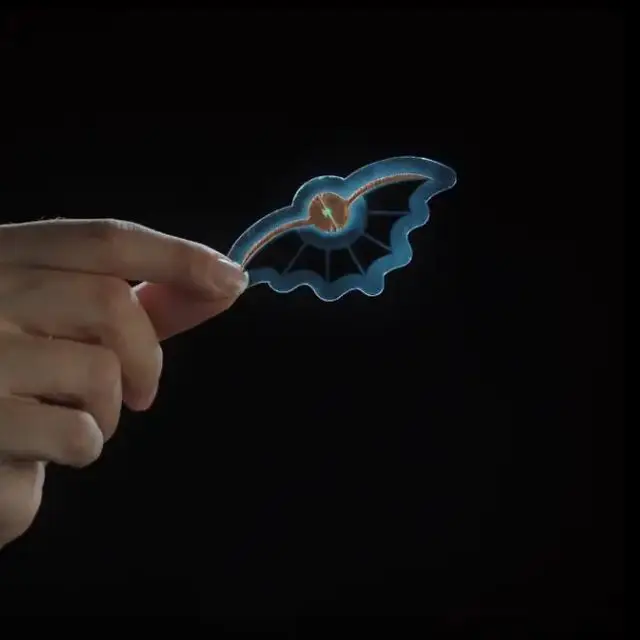
Recent developments in organic electronics point toward multifunctional electronic surfaces. These surfaces may combine energy harvesting, sensing, light emission or other electronic functions in thin and flexible formats.
For wireless IoT devices, this direction is technically important because device architectures are becoming more integrated. Low-power devices increasingly require compact energy sources, sensor functions and, in some cases, display or status indication within limited form factors.
With LAYER® and LAYER®Vault, we already address smart buildings, smart homes and smart asset tracking. Extending our technology base toward organic electronics could open further opportunities where energy harvesting, storage, sensing and visual functions are combined more closely.
Strategic partnerships for OLED and organic electronics
We are seeking strategic partners to explore our patented technology for OLED and organic electronics markets. This is not the presentation of a finished OLED product. It is a step toward collaborative development based on our IP, materials expertise and additive manufacturing processes.
OEMs, display developers, materials companies and system integrators working on flexible electronics can evaluate performance, durability, process integration and cost for specific applications through partnership-based development.
Industry presence at TechBlick
Dracula Technologies will participate in The Future of Electronics RESHAPED, organized by TechBlick, on June 10 and 11, 2026, in Mountain View, California. We will exhibit at booth D08.
The event focuses on printed, flexible, hybrid and organic electronics, making it a suitable platform for discussing our expansion beyond OPV energy harvesting.
Looking for sustainable, flexible and printable electronics for next-generation IoT devices, displays or sensor systems? Contact Dracula Technologies to discuss how our OPV, ITO-free electrode and organic electronics expertise can support future product development.