
Building the cloud with wood — and proving it works at scale

Mass timber: safe by design, sustainable by nature
Mass timber — and particularly cross-laminated timber (CLT) — has steadily grown into a credible alternative to non-renewable materials for large-scale buildings. It competes on performance: strong, durable, and significantly lighter than concrete and steel, which can be a major advantage on complex sites.
CLT-based projects can also benefit from extensive offsite prefabrication, enabling faster, more predictable delivery than traditional construction methods. Add to that the increasingly well-documented wellbeing benefits of timber environments, and it’s clear why engineered wood is moving from niche to mainstream.
But the most compelling reason is carbon.
Cement and steel remain two of the most emission-intensive materials in the built environment. Replacing them with engineered wood can significantly reduce embodied carbon — and because wood stores carbon captured during tree growth, mass timber structures can effectively act as long-term carbon stores across their lifecycle.
For data centres specifically, mass timber introduces an additional advantage: adaptability. Prefabricated timber structures can be easier to modify for cooling systems and changing tenant requirements. Need to reroute a cable run, add new pipes, or adjust internal layouts? In many cases, timber enables faster, simpler interventions — an attractive proposition in an asset class where upgrade cycles are constant and future-proofing is critical.
EcoDataCenter: sustainability by default, not by retrofit
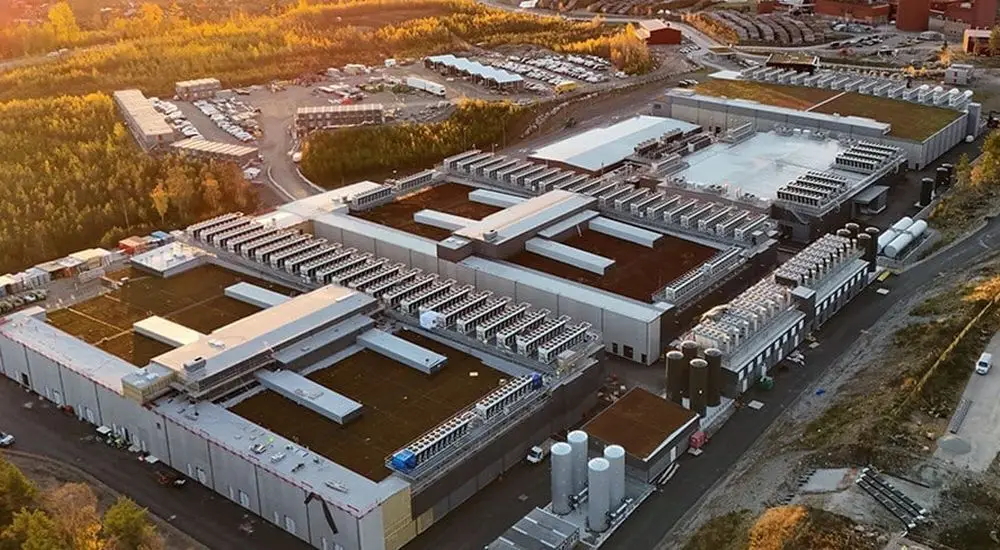
In Falun, Sweden, EcoDataCenter set out with a clear ambition: to build some of the world’s most sustainable data centres. Over time, timber became central to that strategy. Today, the vast majority of the structural frame at the Falun site is CLT — a clear statement that low-carbon construction can work even for mission-critical infrastructure.
That leadership didn’t come without challenges. Data centres operate under strict global expectations around safety, resilience, and security. Convincing customers — many of them global operators used to concrete and steel — required proof that mass timber could meet the same standards, particularly when it came to fire safety and physical security.
Safety and security: engineered solutions, proven in practice
The Falun journey has been defined by iteration: each new building has refined the approach to fire safety, compliance, and operational resilience. Fire safety solutions have evolved alongside the project, demonstrating that mass timber can be safe by design — not by exception.
On the security side, engineered timber components have also been developed to meet demanding resistance requirements, supporting the case that mass timber can satisfy both sustainability goals and stringent protection standards.
Collaboration that compounds innovation
A key factor behind progress in Falun has been close collaboration across the delivery chain — combining timber engineering expertise, construction partners, and a client willing to push boundaries. The site has been developed incrementally, using a modular approach that balances replication with continuous improvement.
This is where mass timber becomes not just a material choice, but an innovation framework: repeat what works, refine what doesn’t, and capture learning from every build. Standardisation supports speed and reliability; iteration drives performance and better outcomes over time.
Circular infrastructure: data centres as community assets
EcoDataCenter’s sustainability story goes beyond the structure itself. Circularity has been a guiding principle, with waste treated as a resource. Excess heat from the data centres is captured and reintegrated into the local energy system, and collaboration with local stakeholders has helped strengthen the municipal grid.
In this model, the data centre becomes part of the local infrastructure fabric — supporting regional resilience rather than simply consuming capacity.
Scaling up: a signal the industry is shifting
EcoDataCenter is expanding, and it’s not alone in rethinking how data centres are built. The wider market is increasingly acknowledging that decarbonising digital infrastructure means tackling embodied carbon alongside operational efficiency. Mass timber offers a practical route to both: lower-carbon construction, faster delivery through prefabrication, and flexible structures that can adapt as cooling strategies and tenant needs evolve.
The cloud, built with wood
Falun has shown that digital infrastructure can be high-performance and climate-conscious — and that sustainability does not have to sit in tension with safety, security, or scalability. Mass timber reduces embodied carbon, accelerates construction, and enables resilient design approaches that evolve with each project.
As demand for computing power surges, the question is no longer whether engineered wood can be used for data centres — but how quickly it becomes the standard.
Source reference: This article is based on Stora Enso’s feature “The World’s First Mass Timber Data Centre,”
EcoDataCenter is a Swedish data centre operator focused on building high-performance facilities with a strong sustainability profile. Known for innovations like mass-timber structures and circular energy thinking (including waste-heat reuse), the company develops and runs sites in Sweden for colocation and demanding compute workloads.