100% recycling transparency: Polytag relies on Zebra Machine Vision

Aurora Vision Library from Zebra Technologies enables real-time tracking, supports EPR reporting, and promotes circular economy.
Polytag, a specialist in QR code and UV tag and trace solutions in the circular economy, relies on Zebra Technologies' Aurora Vision Library in its systems. The aim of the collaboration is to make packaging waste visible in real time, down to the SKU level, thereby enabling data-driven sustainability strategies.
Invisible markings, visible data
Tracking single-use plastics is considered one of the biggest challenges in recycling: different shapes, colors, sizes, and mixing during the sorting process make it difficult to accurately identify materials and brands.
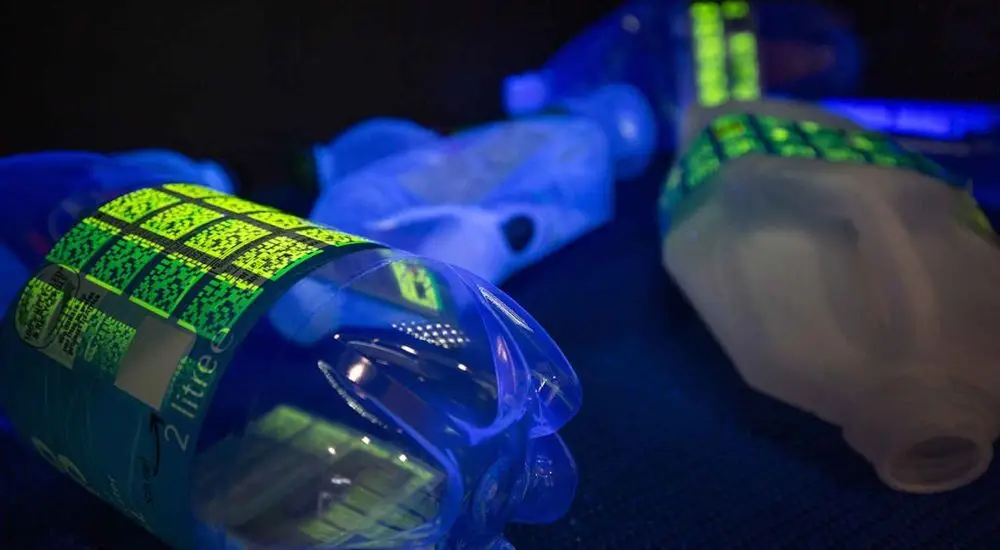
Polytag addresses this problem with invisible UV 2D markings on packaging labels. In recycling centers, Polytag detection units capture these codes to identify material origin, recycling rates, and recovery routes at the end of the product life cycle.
UV inks are already well established in the packaging and security industry – for example as invisible machine marks in printing processes or as protection against counterfeiting. Polytag now uses this proven technology for a new purpose: invisible UV 2D codes on packaging make recycling streams visible down to SKU level for the first time and provide the data foundation for a true circular economy and EPR reporting.
The Zebra Aurora Vision Library processes up to 20 images per second and reliably reads 2D codes even on fast conveyor systems in dimly lit environments. This creates a seamless data stream directly from ongoing operations.
"Our mission is to provide companies with tools that enable them to measure sustainability," explains Jonathan Anderson, CTO of Polytag. The integration of Zebra's machine vision software has significantly increased the accuracy of waste tracking and turned the concept of a truly circular economy from aspiration into reality.
From pilot plant to scalable industrial solution
In an early proof of concept, Polytag initially relied on integrated camera systems. However, these proved to be insufficiently flexible and scalable for continuous industrial operation. In search of a more robust architecture, Polytag collaborated with Zebra and industrial automation partner Automatica.
The result:
Cost reduction through the use of standardized, scalable machine vision software
Increased reliability and performance in harsh environments
High flexibility, as the Aurora software can also be operated with third-party hardware
The system runs in different recycling centers—even on high-speed lines—without the need to replace the image processing hardware. Even in humid, dusty, and poorly lit conditions, reading accuracy remains high, enabling precise real-time tracking of waste streams.
Real-time dashboards for EPR compliance and design decisions
The data captured by Zebra Machine Vision flows into dashboards that provide companies with insights at the item and location level. For example, products with low recycling rates can be identified, such as beverages consumed on the go or cosmetics in hotels.
This transparency creates several added values:
Monitoring by SKU and location
Identification of patterns in collection and recycling behavior
Targeted recycling campaigns and consumer communication
Optimization of packaging designs with a view to real return rates
The platform thus supports companies in meeting the increasingly stringent requirements of Extended Producer Responsibility (EPR). Instead of making assumptions, brands receive reliable data on which packaging is actually recycled—and which is not.
100% detection rate achieved in test facility
Polytag installed six detection units in a facility specially equipped for new recycling technologies to test and optimize the solution under real-world conditions.
The result: thanks to powerful image processing via Zebra's Aurora platform, a 100 percent detection rate was achieved.
Polytag has thus demonstrated that machine vision is a key tool for asset visibility in recycling – from individual bottles or packaging to the entire material flow.
Intelligent automation as a driver of the circular economy
"Polytag's success is a powerful example of the added value that intelligent, software-supported automation can deliver in waste management," says Donato Montanari, Vice President and General Manager, Machine Vision, Zebra Technologies.
Together with partners such as Polytag and Automatica, traditional waste management is being transformed into a data-driven, transparent process.
Zebra is contributing its experience in automation, machine vision, edge intelligence, and industrial data capture. Polytag combines this technological foundation with its expertise in the circular economy, packaging labeling, and EPR requirements.