
RFID in parcel logistics: UPS drives forward scaling


US rollout, focus on Europe, costs, and eco-gap
UPS is significantly expanding its use of RFID (UHF RFID) throughout its parcel logistics operations. In the US, the carrier offers RFID labels for shipments dropped off at any of its approximately 5 , 500 UPS Store locations. According to UPS, around 1.3 million parcels per day are already tagged with RFID at the point of origin in order to increase transparency and reduce error rates.
At the same time, UPS has installed RFID readers in all US package cars so that delivery vehicles can automatically identify packages – another step toward reducing manual scanning processes and increasing operational productivity.
"The approach is remarkably consistent: UPS is not only embedding RFID in hubs and vehicles, but also bringing the technology to parcel acceptance in stores," says Anja Van Bocxlaer, editor-in-chief of Think WIoT. "For shippers, this means more event density and fewer blind spots – especially at handover points."
USA: RFID labels at the origin and readers in package cars
UPS is positioning RFID labeling capability in UPS Stores as a measure to improve shipment transparency and reduce defects. RFID detection in the delivery fleet is intended to further automate processes and increase efficiency in the delivery process.
Europe: RFID particularly visible at UPS in the healthcare context
In Europe, RFID is particularly visible at UPS in the context of time- and temperature-sensitive healthcare shipments. UPS Premier Silver uses RFID sensor technology for "point-in-time/in-network visibility" and prioritized handling. A comprehensive, publicly communicated rollout of RFID labels for "every package" in standard European business – similar to the US UPS Store approach – is not yet known in the same form.
Costs: RFID labels are more expensive than barcode labels – who bears the additional costs?
The cost structure is a key factor for scaling: RFID smart labels are more expensive per unit than pure barcode labels. In practice, however, this is usually not communicated or shown to end customers as a separate "RFID surcharge". Instead, additional label and network costs are typically incorporated into rates, service levels, or contract terms – i.e., into the shipper's cost block or agreed B2B terms.
From a consumer perspective, RFID is therefore generally "invisible infrastructure". Most US customers do not have an active choice between "RFID vs. barcode" and perceive RFID less as a product feature and more (if at all) as providing greater transparency in status reports or faster clarification in the event of discrepancies.
Indirectly, additional costs can be passed on to consumers via shipping prices or product calculations, but they do not usually appear as a separate item at checkout.
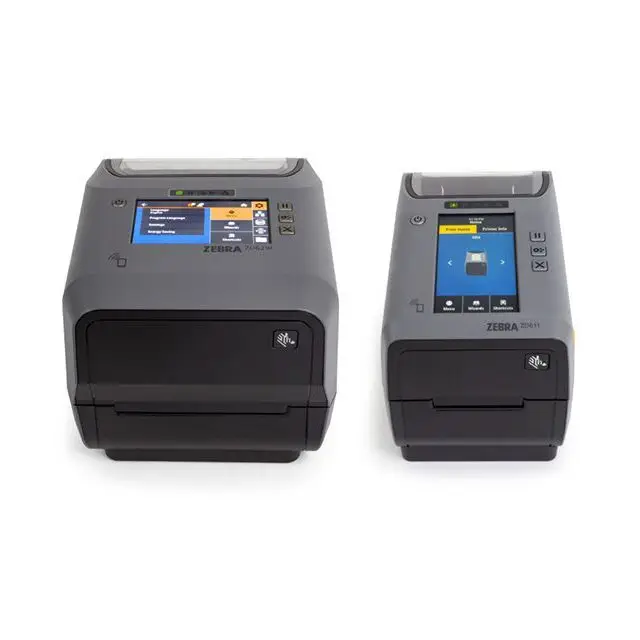
ZD621R/ZD611R RFID Desktop Printers

The Zebra ZD621R and ZD611R integrate advanced RFID encoding with versatile thermal printing and enhanced manageability.
Printing: Consumer flow remains barcode-based, RFID is more premium
For consumers, label creation via UPS online tools is typically barcode-based; a widely documented option to "print/encode RFID labels at home" is not currently apparent. RFID printing/equipment at UPS, on the other hand, is primarily available in contractual premium setups (e.g., Healthcare/Premier).
Sustainability: No clear statement on eco-RFID labels in rollout
With increasing RFID penetration, the environmental issue is coming into focus: RFID smart labels combine paper/adhesive with inlay, antenna, and chip—a mix of materials that can influence recycling streams.
In its RFID communications, UPS emphasizes productivity, quality, and transparency above all else; concrete public information on whether special eco-RFID labels (e.g., recycling-friendly inlays, material declarations, or disposal guidelines) are being used in the current rollout is not currently clearly stated.
"The scale is impressive – now we need the same consistency in material transparency and end-of-life guidance," says Anja Van Bocxlaer. "If RFID is to enter the mass market, RFID labels must be environmentally friendly – with clear material declarations, recyclable designs, and reliable disposal and recycling guidance."