
Salt shortage: Real-time IoT system helps winter services target operations

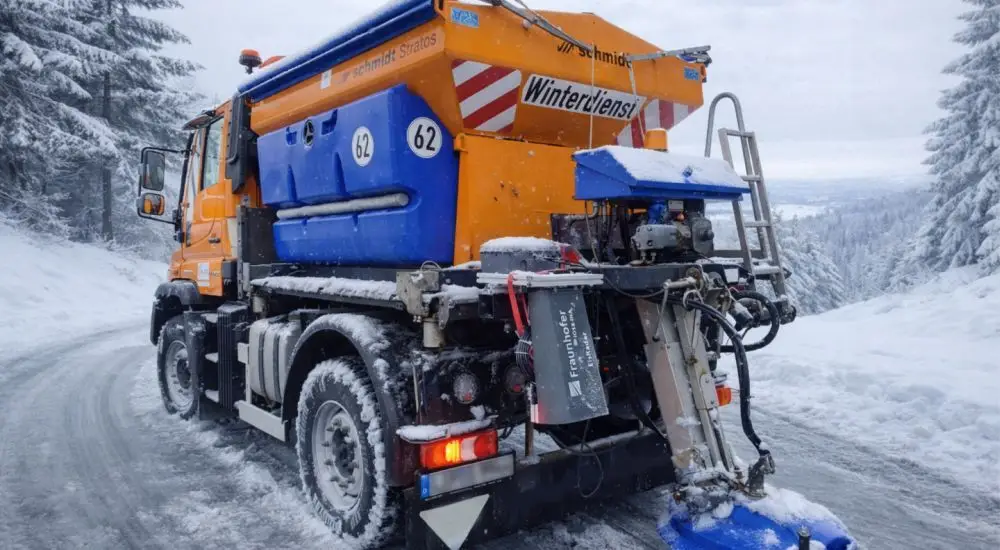
Fraunhofer Institute in Lemgo develops digital solution to combat slippery roads
Lemgo / Lippe district (North Rhine-Westphalia, Germany) – Road salt is in short supply and expensive in many places: supply bottlenecks, increased costs, and high demand are putting pressure on stocks – while traffic safety on roads, bike paths, and sidewalks must continue to be guaranteed.
This is precisely where the "NachWinD" research project comes in: Fraunhofer IOSB-INA in Lemgo is working with partners to develop a learning real-time IoT system that supports winter services in planning, deployment, and follow-up.
A central element is a measurement network of precise sensors that record local road conditions – either stationary on the road or mobile directly on the snowplow. The measurement data is transmitted wirelessly via radio so that it can be incorporated into operational decisions in real time.
In addition, a knowledge database is being set up that links practical experience with data (including weather forecasts, sensor technology, and historical consumption). This allows for a more informed assessment of gritting quantities, priorities, and operational requirements – and enables scarce resources to be used in a more targeted manner.
Project profile: NachWinD
Title: NachWinD – Increasing sustainability and precision in winter road maintenance
Duration: May 15, 2024 – May 14, 2027
Funding: European Union and State of North Rhine-Westphalia
Consortium & partners: Fraunhofer (Lemgo), Okeanos Smart Data Solutions GmbH, INFA-ISFM e.V., ASP Paderborn, Kreis Lippe – Eigenbetrieb Straßen, German Weather Service (DWD)
NachWinD shows how wirelessly networked sensor technology improves operational decision-making in winter road maintenance. Similar approaches to high-resolution, local situation assessment are also emerging in other regions – for example, with SMARTIES in Franconia: Ultra-light mini sensors are carried up by balloons, collect georeferenced atmospheric data, and transmit it to base stations via mioty. This makes local models more accurate and warnings of snow and ice available more quickly.