

Rems-Murr County in Baden-Württemberg Replaces Waste Fee Stickers With LF RFID


Approximately 390,000 trash cans and 9,000 containers in the Rems-Murr district will be assigned a digital identity via LF-RFID. Starting in 2027, the 134.2-kHz transponder will replace the current fee sticker. The fee model will remain in place; only the container identification will be digitized.
399,000 Waste Containers Receive a Digital Identity
The Rems-Murr district in Baden-Württemberg is switching to RFID for the identification of its waste bins. In 31 cities and municipalities covering an area of approximately 860 square kilometers, about 390,000 general waste, organic waste, and paper bins, as well as 9,000 larger containers, will be equipped with electronic transponders. Yellow bins are excluded, as they are not part of the municipal waste management fleet.
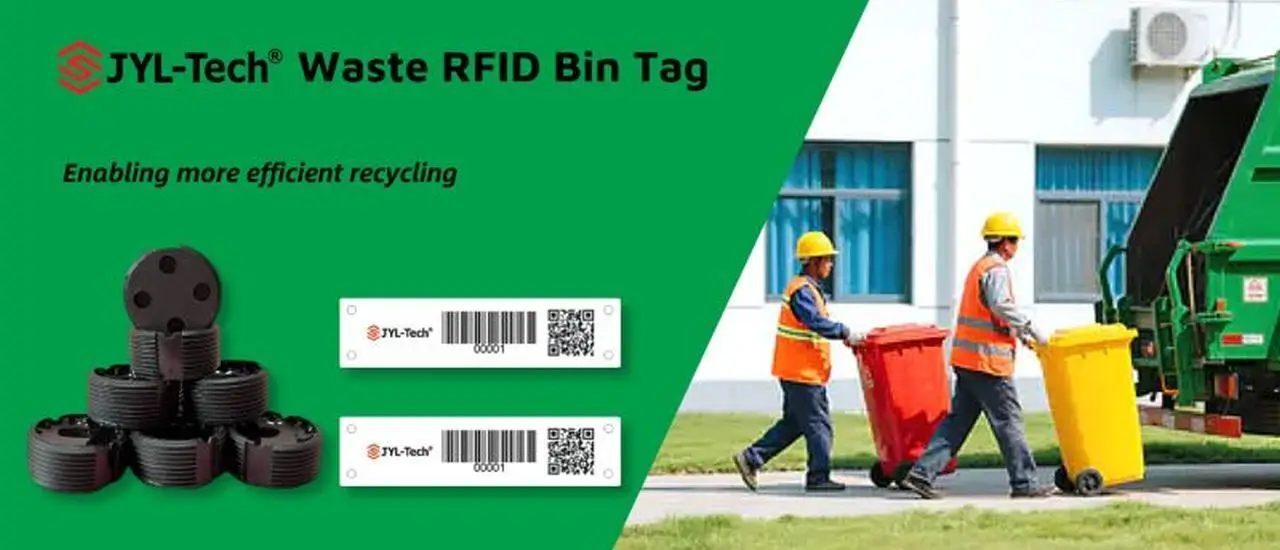
LF-RFID operating at 134.2 kHz is being used. Each container receives a robust passive RFID transponder with a globally unique 16-digit identification number. The chip itself does not contain any names, addresses, or other personally identifiable information. Only the internal container management system assigns the ID to the corresponding container and property.
Previously, a Fee Sticker Showed That the Bin Could Be Emptied
Until the end of 2026, authorization for the collection of residual and organic waste bins will be based on a physical fee sticker. Households purchase the annual sticker appropriate for their bin size and collection frequency and affix it visibly to the lid.
The sticker thus serves as an analog proof of authorization. At the same time, this process involves significant effort in the production, distribution, purchase, and application of the stickers. When replacing a bin or changing the collection frequency, fee stickers or corresponding proof of authorization must also be taken into account.
In the Rems-Murr district alone, the transition will eliminate the need for approximately 250,000 fee stickers per year.
From 2027, LF RFID Takes Over Container Identification
As of January 1, 2027, fee stickers will no longer be required. The unique RFID ID will be used to identify the container in the digital identification system.
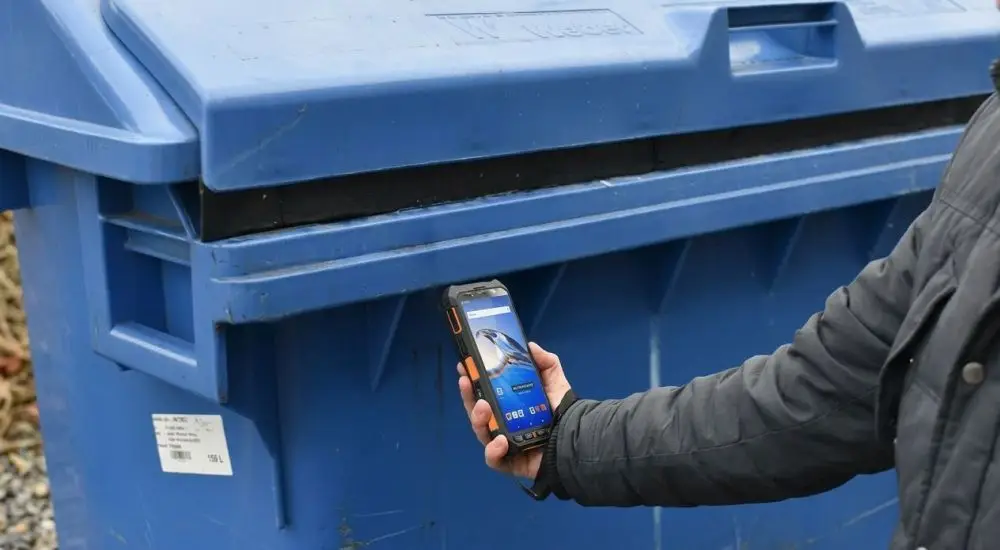
During the collection process, the bin is electronically recognized and its ID is cross-checked against the registered inventory. This ensures that only registered bins are authorized for collection. At the same time, collection routes can be digitally tracked.
This transforms a largely analog process into a digital one. Previously, the fee sticker on the container visibly indicated that the bin was authorized for emptying. In the future, this function will be handled by 134.2-kHz LF-RFID identification: The container is recognized by its unique ID, assigned to the registered object in the backend, and the emptying can be digitally documented as part of the collection route.
This is particularly relevant for handling complaints. Instead of relying solely on information provided by residents or waste collection staff, waste management can refer to the digitally documented route. The unique assignment is also intended to make it more difficult to misuse, swap, or steal containers.

Why LF RFID Fits This Process
This use case is not about detecting many objects simultaneously over a distance of several meters. Rather, the key requirement is the unique identification of a single waste container during the emptying process.
LF-RFID operating at 134.2 kHz is used for this purpose. Passive LF transponders do not require a battery and enable spatially limited identification. Unlike with UHF RFID, the focus here is not on range or the simultaneous detection of large populations of tags.
The Fee Model Remains Unchanged
The introduction of RFID is not a “pay-per-lift” system. Waste fees will continue to consist of a base fee based on household size and a collection fee based on bin size and collection frequency.
The only change is in the processing: Starting in 2027, the base fee and collection fee will be collected together via the annual fee notice. There will be no need to purchase and affix a fee sticker.
AWRM had already explicitly stipulated in the waste management plan that billing based on weight or the actual number of pickups is not planned.

What Would Be Technically Possible, but Is Not Being Used
The introduction of a unique digital container identity essentially lays the groundwork for more advanced applications. However, these are not part of the current system in the Rems-Murr district.
For example, an RFID ID could be combined with a vehicle scale to assign waste volumes to a specific container. Similarly, “pay-per-lift” or “pay-by-weight” models would be conceivable. Level sensors or camera systems for detecting improperly filled bins could also link additional data to the container ID.
The RFID transponder itself cannot do any of this. It neither detects the contents nor the fill level, nor does it weigh the waste. Its sole purpose is to uniquely identify the container.
In this way, the Rems-Murr district demonstrates a comparatively clearly defined RFID use case: The focus is not on collecting as much additional sensor data as possible, but rather on the digitization of an existing administrative and waste disposal process. The physical fee sticker is replaced by a permanent digital identity for the waste container.
The project began in October 2024 with a pilot area in Maubach. The regular deployment was subsequently rolled out across the entire district. Follow-up work on bins not yet registered is ongoing until the complete transition is completed at the beginning of 2027.
Further information: AWRM: Digital Waste Management – Simple. Practical. Good.