
Erich Barnstedt: 2026 will be the year of the Digital Product Passport

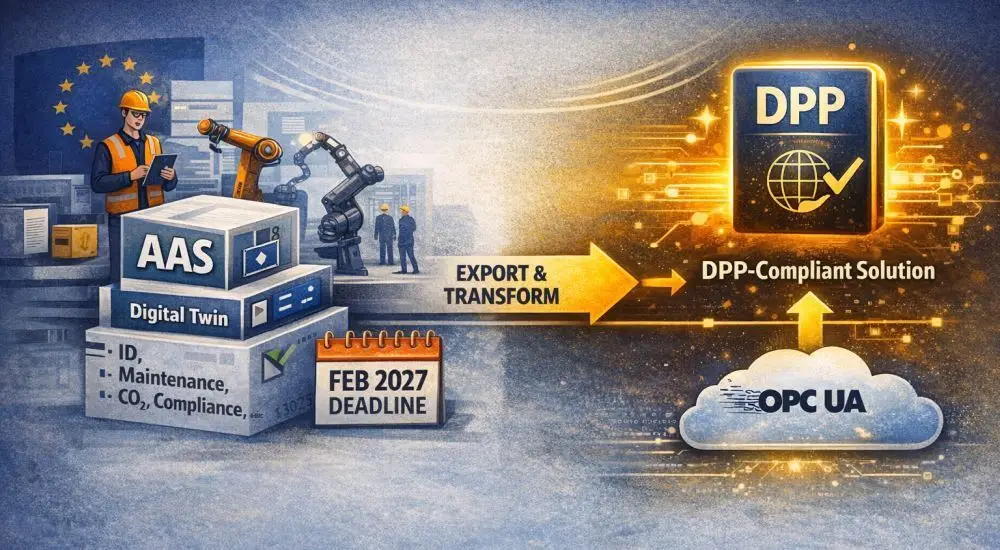
Think WIoT shares a 2026 prediction from Erich Barnstedt, Lead of the OPC Foundation Cloud Initiative: 2026 will be the year of the Digital Product Passport (DPP) as companies selling products in Europe accelerate implementation to prepare for the February 2027 deadline for batteries, with additional product groups expected to follow, such as clothing.
Barnstedt’s view is that DPP will move from concept to execution because it reaches deep into operational reality: product data governance, supplier onboarding, IT and OT integration, and customer facing access to verified information. For many organizations, 2026 is when pilots must become production programs.
A standards timing squeeze
Barnstedt highlights a pressing issue for implementation teams: certainty about the DPP interface and data model. The official EU DPP standard published via CEN/CENELEC cannot arrive quickly enough, with guidance anticipated around February, to reduce risk for companies currently selecting technology and designing data flows.
The AAS assumption: useful internally, risky as a DPP strategy
Many companies have looked at the Asset Administration Shell (AAS) as the obvious “default digital twin” for DPP. It is easy to see why. AAS provides a structured, machine-readable representation of an asset with modular “submodels” for areas like nameplate data, materials, compliance, carbon footprint, or lifecycle information. It is a strong internal backbone for organizing product data and connecting IT with operational systems.
Barnstedt’s warning is that the emerging DPP approach is not expected to use the AAS interface nor the AAS data model. In practical terms, that means an implementation that exposes only an AAS API or exports AAS packages may not be automatically DPP-compliant. The risk for 2026 projects is building an “AAS-only” solution and discovering late that an external transformation layer is required.
The pragmatic way forward is to treat AAS as an internal digital twin structure if it fits existing architecture, but plan for a standards-aligned DPP “output format” that may differ. In other words, keep internal modelling flexible and build explicit mappings to the DPP interface and schema once the EU standard is final.
OPC Foundation plans an open-source reference implementation by Hannover Messe
Barnstedt emphasizes that companies should not panic. He says the OPC Foundation will be ready with an open-source, EU DPP standard compliant reference implementation based on the globally accepted IEC standard OPC UA modelling language, hosted in the UA Cloud Library, with a target milestone of Hannover Messe in April 2026.
What is your opinion?
Do you agree that 2026 will be the DPP execution year, or do you expect uneven adoption across industries and supply chains? And if you are building today, are you treating AAS as your internal backbone with a DPP-compliant export layer, or betting on direct alignment? Share your view with Think WIoT.