Nordic Semiconductor Brings Battery Intelligence to IoT Devices

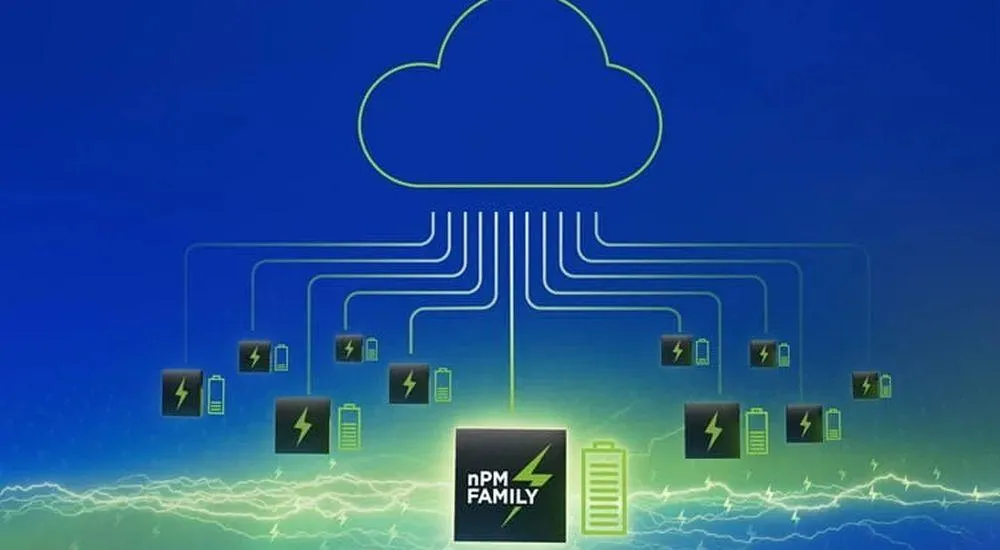
Fuel Gauge v2.0 Combines State of Health, Power Management, and Monitoring of Rechargeable IoT Products
Nordic Semiconductor is expanding its portfolio for energy-efficient wireless IoT devices with Fuel Gauge v2.0. The software solution for the nPM1300 and nPM1304 power management ICs (PMICs) complements state-of-charge determination with continuous assessment of battery aging.
The PMICs charge the battery, generate the required supply voltages, and monitor voltage, current, and temperature. In doing so, they complement wireless SoCs such as the nRF54 or nRF91 series by providing energy management for the entire device. The algorithm also runs on microcontrollers and wireless SoCs from other manufacturers.
From State of Charge to State of Health
The State of Charge indicates how much energy is currently available. The State of Health supplements this information with the battery’s aging status and remaining usable capacity. Fuel Gauge v2.0 combines both values in an adaptive calculation.
The host-based algorithm continuously compares the original battery model with the values recorded in the field. Voltage, current, temperature, and charge cycles are factored into the evaluation. This allows for the detection of capacity loss and long-term aging trends. For devices with replaceable battery packs, the condition of each pack can be tracked separately.
For small wearables and connected asset trackers
The two supported PMICs cater to different power and size classes. The nPM1300 offers charging currents ranging from 32 to 800 mA. It is suitable for, among other things, rechargeable asset trackers, sports and health devices, and wireless IoT products with extensive sensor suites.
The more compact nPM1304 supports charging currents from 4 to 100 mA and is designed for particularly small devices such as smart rings, body sensors, and miniature wearables.
This makes Fuel Gauge v2.0 relevant for both connected trackers and small ultra-low-power devices. Ultra-low-power systems achieve their low energy consumption through an optimized combination of efficient components, short active phases, and long idle periods. Asset trackers with GNSS or cellular connectivity can also achieve long battery life in this way.
Battery Data Becomes Operational Data
Battery Intelligence goes beyond a more precise charge indicator. In a device fleet, state of health, charge cycles, and temperature trends can be used to detect unusually rapid degradation early on, plan battery replacements, and optimize charging parameters.
This is particularly relevant for asset trackers, connected health devices, wearables, and mobile sensors. In these applications, deteriorating batteries lead to shorter runtime, additional service calls, or process interruptions.
Fuel Gauging via the PMIC
Fuel Gauge v2.0 utilizes the measurement functions of the nPM1300 or nPM1304. An additional fuel gauge IC is not required. This reduces component requirements, space requirements, and BOM complexity. During sleep mode, the algorithm does not result in any additional power consumption.
Battery data can be analyzed using various cloud infrastructures. Through nRF Cloud powered by Memfault, State of Charge, State of Health, and other performance metrics can be centrally aggregated. This provides visibility not only into connectivity, firmware, and device performance but also into the condition of the power supply throughout the product’s lifecycle.
Availability
Nordic Fuel Gauge v2.0 is available via nPM PowerUP in nRF Connect for Desktop and with nRF Connect SDK 3.4.0-rc2. The solution was unveiled in March 2026 at Embedded World and is now available for integration into rechargeable IoT products.