
Reliable battery-free RFID sensing: why Kliskatek’s CEO favors RF over ambient energy

A new commentary by Mikel Choperena, CEO of Kliskatek, argues that most “battery-free” concepts fail at the same point: reliability. In industrial IoT, reliability does not mean “it works sometimes.” It means a sensor delivers a clean measurement exactly when requested, in the locations that matter, for years, without maintenance routines.
Choperena’s core message is that far-field RF energy harvesting, particularly using sub-1 GHz UHF and RAIN RFID, provides what many ambient sources often cannot guarantee indoors: controllable energy on demand and predictable communication windows built on mature, deployable standards.
Why RF harvesting beats ambient power for battery-free IoT and active UHF sensing
Active UHF sensing: same RF path, different purpose
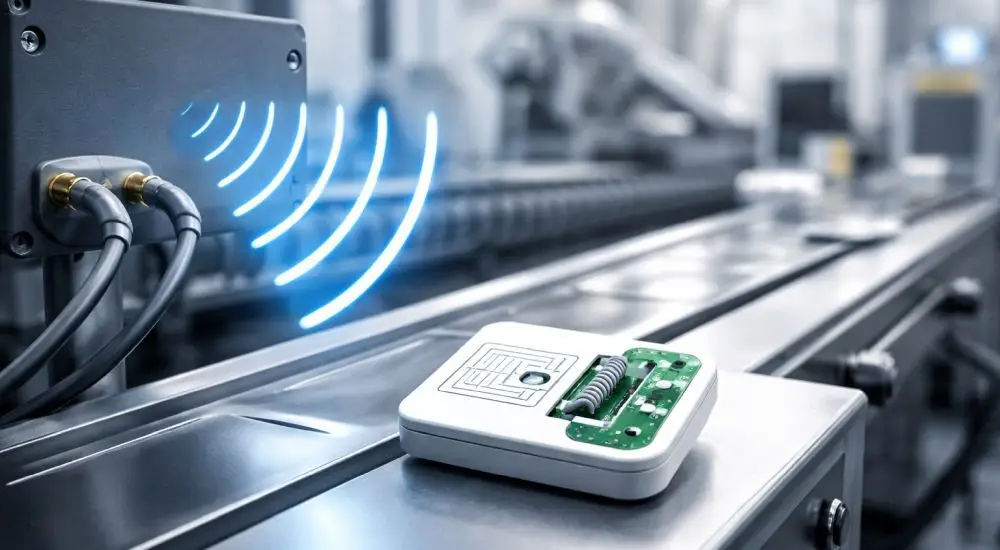
The activation and data return path look familiar to anyone who works with UHF RFID: a reader energizes a tag, and the tag responds via backscatter. The difference is what the RF field triggers inside the tag.
In active UHF sensing, the RF field is not primarily used to retrieve a stored value from chip memory. Instead, it initiates a short, deterministic transaction: the reader provides energy, the tag wakes, runs a measurement cycle, serializes the sensor result, and returns the measurement immediately over the UHF backscatter link. Identification can remain part of the exchange, but the operational goal is a time-specific sensor readout, not just inventory.
From “whenever nature cooperates” to on-demand measurements
Choperena frames predictability as the ability to plan read windows and duty cycles. With RF-powered sensing, the measurement is tied to an intentional reader interaction. That enables behaviors that matter in the field: operations can request a reading at a defined moment, retry quickly if needed, and interrogate many sensor tags within a short pass. Instead of waiting for the environment to provide enough harvested power, the system brings the field to the sensor when the process needs it.
Why ambient sources struggle when predictability is non-negotiable
The commentary does not dismiss indoor photovoltaics or vibration harvesting. It positions them as useful tools when conditions are stable and controlled, but unreliable foundations when readout timing must be guaranteed across many real environments.
Indoor PV depends on lighting conditions that vary by schedule, dimming, spectrum, and placement, and can change over time. Vibration harvesting often depends on resonance and stable vibration profiles, while real machines shift states, loads, and downtime. In both cases, the energy source is outside the operator’s control, which complicates consistent duty cycles and guaranteed measurement timing.
A practical design mindset for field-ready battery-free sensing
Beyond the thesis, Choperena outlines a vendor-agnostic approach that prioritizes deterministic behavior under intermittent power. The focus is operational clarity: predictable transactions, clear failure modes, and repeatable outcomes.
Key principles include designing a short single-pass measurement cycle, budgeting energy storage across the usable voltage range rather than peak values, embedding diagnostics that help backends distinguish low-energy windows from sensor faults, and tuning antenna and enclosure performance in the real installation environment where materials and multipath effects dominate.
When ambient still wins and why hybrid models matter
Ambient harvesting can be the right choice when the environment is predictable. Controlled lighting conditions can make indoor PV highly effective. Always-on machinery with a consistent vibration signature can support vibration harvesting at low duty cycles. In practice, hybrid approaches can be attractive, using ambient energy where it is strong while keeping RF-triggered sensing as the baseline for guaranteed readout.
About Kliskatek
Based in Hernani, Spain, Kliskatek develops ultra-low-power, energy-harvesting wireless sensor solutions, building on deep experience in battery-free UHF RFID sensing and complementary harvesting methods such as solar.
About Think WIoT
Think WIoT covers wireless IoT technologies and ecosystems with a focus on practical deployment constraints, real-world performance, and scalable architectures.