Local AI for Auto-ID: Why Execution Must Stay Deterministic
Local Language Models in Production: What the Machine Is Allowed to Do
In this expert article, IDCRAFT explains why language models in industrial Auto-ID processes should interpret information, but never execute or write directly to production systems. A chatbot can be wrong and the user can correct it. On the shop floor, an incorrect response can become a wrongly encoded label, a misconfigured reader or an entire batch of scrap.
The key question is therefore not how capable the model is, but what it is allowed to do.
The Wrong Question: How Good Is the Model?
AI benchmarks may look impressive, but they say little about production safety. Even a model with 99 percent accuracy would statistically produce 100 errors across 10,000 labels if its output were written unchecked to a chip. For industrial use, the decisive question is what happens when the model is wrong.
Two Separate Paths: Understanding and Execution
IDCRAFT advocates a strict separation between interpretation and execution.
The execution path consists of deterministic software: validated recipes, required data structures, write operations with full read-back verification and an audit log. No language model is involved. Every step remains reproducible, testable and traceable.
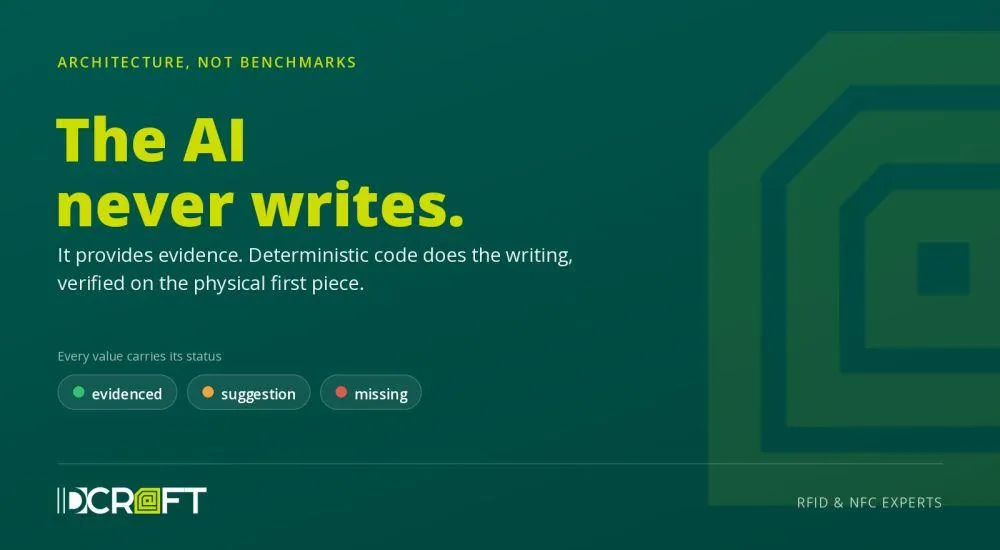
The language model sits in front of this layer. It identifies the order pattern and extracts values from the order text. Instead of free text, it returns structured fields. Each value is linked to the source passage that supports it. Unverified values are marked as suggestions or remain empty.
The final job is assembled by deterministic software. Before series production begins, the first physical item is encoded, read back and confirmed in plain text.
The principle is simple: the AI never writes. If the model makes a mistake, the job should fail during validation or first-piece inspection before it can affect production.
Security Principles Already Exist
The terminology comes largely from IT security. The OWASP Top 10 for LLM Applications lists “Improper Output Handling” and “Excessive Agency” as specific risks. Both address unchecked model output and unnecessary execution rights.
NVIDIA uses execution rails in NeMo Guardrails to control tool and action calls. Constrained decoding can further force output into a predefined schema.
Fraunhofer IOSB’s LLM4OPC project follows a related approach, with a tool agent executing actions after human approval. IDCRAFT’s principle is stricter: the model never executes.
Why Run the Model Locally?
IDCRAFT sees two main reasons for local rather than cloud-based inference.
First, local operation gives companies direct control over the model and inference stack. With open weights, mechanisms such as constrained decoding can be implemented and verified independently instead of relying solely on a cloud provider.
Second, production and order data remain inside the company. This can simplify data protection, IT security and supplier assessments. Bitkom surveys cited by IDCRAFT show how strongly privacy requirements influence digitalization projects in Germany.
Projects such as Soofi, the Sovereign Open Source Foundation Models initiative, aim to establish openly available models developed and trained in Germany. An architecture based on interchangeable local models can adopt such alternatives without rebuilding the application.
Sovereignty is therefore not only about where a model is trained, but also where it runs and where production data flows.
Regulation Favors Clear Responsibilities
The EU AI Act reinforces clearly defined responsibilities inside AI-enabled systems. A deterministic execution layer based on human-defined rules remains conventional industrial software, while the AI component is limited to interpretation and assistance.
What This Means for Auto-ID
In Auto-ID, the bottleneck is often not the hardware but the specialist knowledge required during setup. RFID and NFC encoding can involve memory banks, lock modes, EPC structures, access and kill passwords or NDEF record formats.
A language model does not change the deterministic nature of encoding. What it can change is the interface. A production employee could describe an order in the same language used on the job sheet. The AI extracts and structures the information, while validated recipes, chip data and deterministic software turn it into a controlled encoding process.
“We are currently developing a device based on this architecture for encoding processes at label manufacturers. In the future, this could evolve into a family of expert systems supporting different areas of the Auto-ID industry. We will present our first product on September 1, 2026.”
IDCRAFT GmbH
Companies that want to explore the topic earlier can contact IDCRAFT for vendor-independent RFID and NFC consulting, from chip selection to encoding.