

ETSA Calls for Stronger EU Support for Circular Textile Service Models

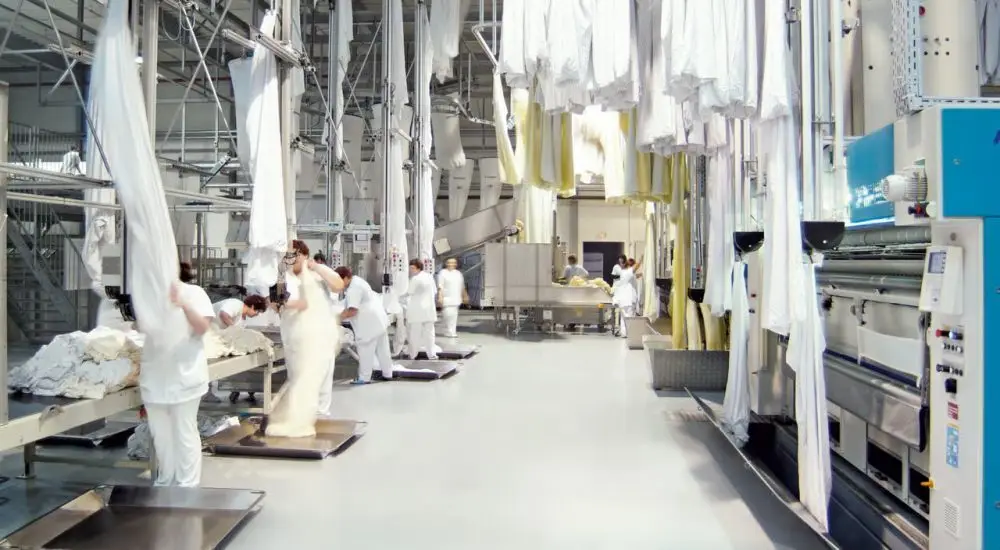
A sponsored contribution from the European Textile Services Association (ETSA), published on Politico, highlights textile services as a proven circular model already operating at scale across Europe.
Textile services should play a stronger role in Europe’s circular economy strategy. This is the central message of a sponsored contribution from the European Textile Services Association (ETSA), recently published on Politico.
According to ETSA, the sector already delivers many of the outcomes targeted by EU policy: extended product lifecycles, reduced material consumption, lower waste, and more resilient local value chains.
The association argues that these service-based models should therefore be more clearly recognized in upcoming legislation.
Across Europe, industrial laundries provide reusable textiles for hospitals, hotels, restaurants, pharmaceutical production, and industrial environments. These include hospital linen, reusable surgical gowns, workwear, bedding, and hygiene products.
While often overlooked, these services are critical to daily operations. ETSA notes that many hospitals and hotels would face disruption within days without a continuous supply of hygienically processed textiles.
Circularity through service models
At the core of the sector is a reuse-based model. Textiles are washed, maintained, repaired, and reused for as long as possible. This reduces waste and lowers demand for virgin raw materials, while supporting local jobs and infrastructure.
In the context of geopolitical uncertainty and supply chain risks, ETSA positions these models as contributing not only to sustainability, but also to European resilience and strategic autonomy.
Public procurement as a key lever
A major focus of the contribution is public procurement. ETSA argues that significant public spending still supports linear and disposable systems, slowing progress toward circular economy goals.
With EU procurement rules under revision, the association calls for mandatory green public procurement across member states. It also emphasizes the need to support leasing and product-as-a-service models, rather than focusing solely on ownership.
In addition, ETSA advocates for lifecycle costing as a standard criterion. This would ensure that environmental and social performance are assessed over the full duration of a contract, not just at the point of purchase.
Longevity before recycling
ETSA also stresses that circular economy policy should prioritize product longevity. The most sustainable product, the association argues, is the one that remains in use the longest.
At the same time, the sector is investing in recycling solutions. ETSA members are developing processes to convert end-of-life textiles into recycled fibers for applications such as insulation materials and industrial uses, with the long-term goal of advancing closed-loop systems.
A proven European model
ETSA’s message is clear: textile services are not an emerging concept, but a scalable European solution already delivering circularity in practice.
By recognizing and supporting service-based reuse models in future legislation, the EU could accelerate sustainability goals while strengthening competitiveness and reducing dependency on external resources.