


Chipless RFID Multi-Sensory Tags Gain Momentum in New IEEE Review

A Research Field Moves Into Focus
A new review article in IEEE Transactions on Instrumentation and Measurement puts a fast-growing RFID field into focus: chipless RFID multi-sensory tags. The paper, titled Chipless RFID Multi-Sensory Tags: Trends, Strengths, Challenges and Prospects, shows how passive, battery-free and chip-free tags are evolving from simple identification concepts into platforms for simultaneous sensing and monitoring.

Chipless RFID Makes Smart Packaging Ready for Mass Adoption
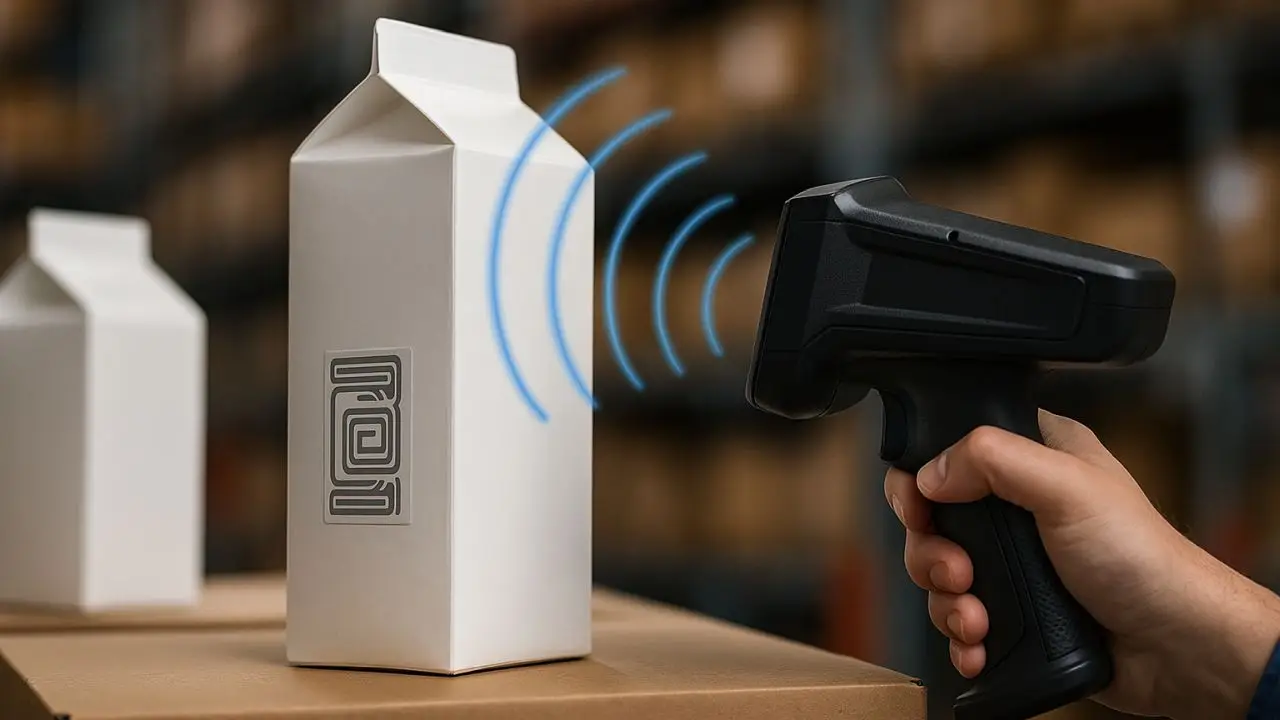
Chipless RFID (RF barcode) offers a scalable, sustainable alternative to chip-based tags by using printed resonant structures and spectral reading, and with improved reader hardware and manufacturing it can enable mass adoption in smart packaging and logistics.
The Authors Behind the Review
The article was authored by A. K. M. Zakir Hossain, S. M. Kayser Azam, M. I. Ibrahimy, Jasim Uddin, M. K. Hasan, Debabrata K. Karmokar, Zahriladha Bin Zakariah, Md. Shazzadul Islam, and Ahmed Jamal Abdullah Al-Gburi.
Together, they provide a broad and structured overview of how multi-parameter chipless RFID tags are being developed, where the technology stands today, and what still limits wider industrial adoption.
From Identification to Sensing
The relevance is clear. Conventional RFID solved some of the weaknesses of barcodes, but cost, integrated circuits, batteries, and limited robustness still remain barriers in many large-scale or disposable applications. Chipless RFID follows a different route. Instead of relying on a silicon chip, these systems use resonator structures that can encode identity and react to environmental changes.
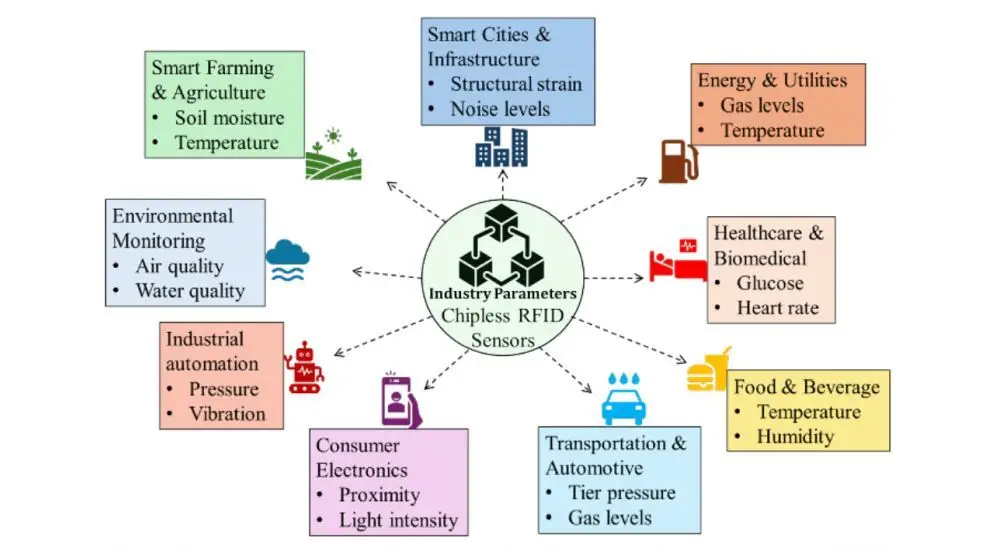
In the reviewed research, this enables tags that can identify an object and at the same time sense parameters such as humidity, temperature, pressure, strain, gases, pH, corrosion, cracks, or displacement.

Chipless RFID sensors: Sustainable measurement and labeling – without chips
Chipless RFID sensors integrate printable resonator-based identification and measurement to provide a low-cost, battery-free and potentially biodegradable approach for contactless sensing and labeling in industrial and environmental applications.
What the Paper Contributes
The strength of the paper lies in how comprehensively it maps the field. It does not only summarize individual prototypes.
It introduces a unified taxonomy for multi-sensory chipless RFID systems, compares resonator types, sensing mechanisms, smart materials, fabrication routes, and decoupling strategies, and benchmarks performance using coding capacity, spectral density, spatial density, sensitivity, dynamic range, and read range.
Challenges Remain
At the same time, the review does not overstate the maturity of the technology. The authors clearly outline the bottlenecks: limited read range, constrained coding capacity, missing standards, lack of dedicated readers, and persistent selectivity challenges when several parameters must be measured in parallel.
These are not side issues. They are the reason why chipless RFID sensing is still largely an emerging research domain rather than an established industrial standard.
Why It Matters for Industry
That is exactly why this review matters. It captures a moment in which chipless RFID is moving beyond the idea of low-cost identification and toward a broader role in IoT, industrial automation, logistics, environmental monitoring, and structural health monitoring.
The article makes clear that the path forward will depend not only on resonator design, but also on better materials, smarter signal processing, and future standardization.
Chipless RFID multi-sensory tags are no longer a niche concept. They are becoming a serious area of development for scalable sensing without chips and without batteries.
Article: Chipless RFID Multi-Sensory Tags: Trends, Strengths, Challenges and Prospects
About the Authors
The study was conducted by an international research team led by institutions in Malaysia, including Universiti Teknikal Malaysia Melaka (UTeM), Universiti Malaya, International Islamic University Malaysia (IIUM), National University of Malaysia (UKM), and Asia Pacific University (APU).
Additional contributions come from Cardiff Metropolitan University in the United Kingdom, the University of Adelaide in Australia, and Iowa State University in the United States.
The collaboration combines expertise in microwave engineering, materials science, sensing technologies, and wireless systems, reflecting the interdisciplinary nature of chipless RFID development.