
AIOTI WG Energy and 6G IA Publish White Paper on Energy and 6G Convergence

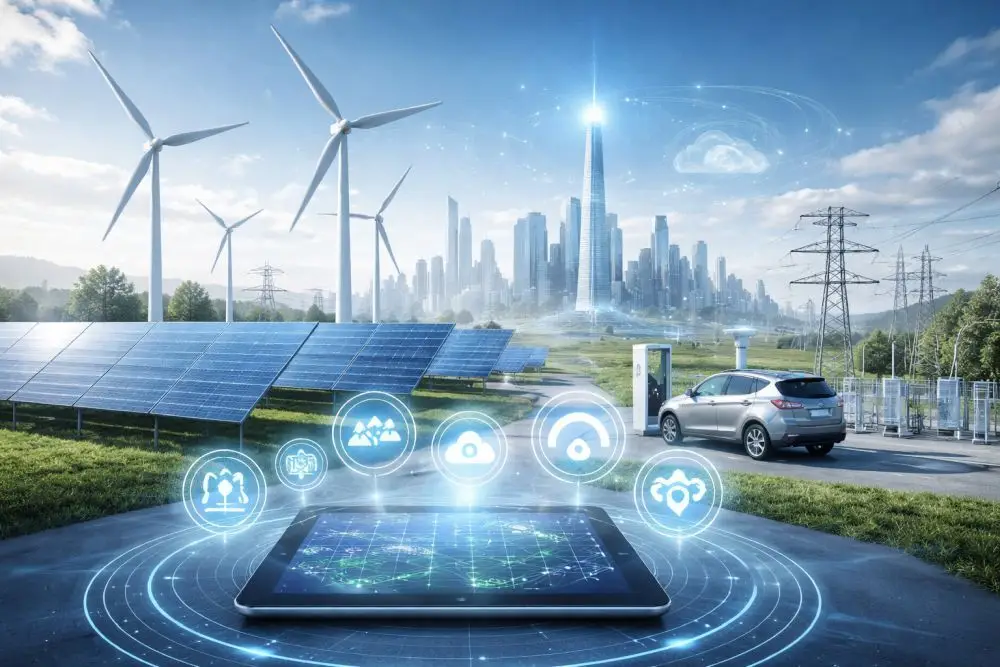
The AIOTI Working Group Energy, part of the Alliance for AI, IoT and Edge Continuum Innovation (AIOTI), in collaboration with the 6G Infrastructure Association (6G IA), announces the publication of the white paper “Energy–6G Convergence: a Perspective.” The publication sets out how Europe can align the next generation of connectivity with the energy transition and why this alignment is critical for secure, resilient, and sustainable energy infrastructures.
Europe’s energy system is undergoing a profound transformation driven by decarbonization, electrification, decentralization, and digitalization. In parallel, 6G is emerging as the next generation communication paradigm, envisioned not only as a faster network, but as an intelligent, sustainable, and human centric digital infrastructure.
The white paper argues that 6G can become a foundational enabler of future energy systems only if its capabilities are aligned with the safety critical, long lived, and sustainability driven nature of energy infrastructures.
Why convergence with 6G
The white paper highlights that the energy transition is turning power systems into a highly distributed, real time cyber physical system, where stability and efficiency increasingly depend on trusted connectivity. As grids integrate growing volumes of distributed energy resources, storage, electric mobility, and flexible demand, operators need scalable observability, coordination, and automation across millions of heterogeneous assets.
Convergence with 6G is therefore about enabling energy operations that are more responsive, resilient, and sustainable, rather than simply increasing bandwidth.
Key findings and implications
The white paper’s central finding is that 6G and energy systems must be designed to evolve together. Future grids, buildings, and industrial energy operations will rely on connectivity that supports real time observability, dependable automation, and cyber resilient control across highly distributed assets, including distributed energy resources, storage, and electric mobility.
To enable this, the paper identifies the IoT Edge Cloud continuum as a practical architectural foundation. Energy data is captured at the IoT level, time critical functions are executed close to operations at the edge, and system wide forecasting and optimization can scale in the cloud.
This end to end approach allows capabilities such as ultra low latency communication, heterogeneous networking, and AI native automation to be applied where they deliver the most value, while supporting phased deployment and coexistence with legacy infrastructures.
Trust must be engineered
A central conclusion is that observability, security, and sustainability are prerequisites for trust. Without standardized energy and carbon metrics that link communication services to measurable energy system outcomes, the contribution of 6G to the energy transition cannot be credibly assessed. Security by design and resilience by design are essential as connectivity becomes embedded in critical energy operations.
Europe’s strategic opportunity
If energy and digital infrastructures evolve independently, Europe risks inefficiencies, fragility, and loss of technological sovereignty. Coordinated evolution, by contrast, positions Europe to lead globally in sustainable and trustworthy cyber physical systems, strengthening critical energy resilience and enabling secure AI supported automation.
About AIOTI
The Alliance for AI, IoT and Edge Continuum Innovation (AIOTI) is a European stakeholder community fostering collaboration and interoperability across AI, IoT, and edge continuum technologies to support Europe’s digital and green transitions.
About the publication
“Energy–6G Convergence: a Perspective” is published by AIOTI WG Energy in collaboration with the 6G Infrastructure Association (6G IA).