
- The hybrid wireless architecture uses IEEE 802.15.4 for dense sensor networks and LoRaWAN for long-range data forwarding.
- Photovoltaic energy autonomy enables long-term, low-maintenance operation in remote agricultural environments without mains power.
- Integrated photosynthetically active radiation measurements complement soil data to provide comprehensive plant growth insights.
- Field testing showed a transmission success rate of 97.5% with effective network ranges of up to 60 m locally and 2 km for long-range links.
In the Elsevier research paper "Efficient irrigation system using a combined wireless sensor network based on LoRaWAN and IEEE 802.15.4 technologies and photosynthetically active radiation measurements," J. Medina-García, J.A. Gómez-Galán, J.M. Vilaplana-Guerrero, and J.A. Bogeat describe the design and field testing of an automated irrigation system that specifically combines two wireless worlds: IEEE 802.15.4 for dense measurement points in the plant population and LoRaWAN for the long distance to the gateway.
The article is explicitly intended as a "low-cost, low-power" solution for agricultural IoT applications and combines hardware, firmware, data pipeline, and user interface into a comprehensive system.
Why one wireless standard alone is rarely enough
Precision irrigation thrives on detail: soil moisture, temperature, and nutrient availability can vary significantly within a few meters. It is precisely this spatial variability that determines whether a system actually saves water or ultimately only delivers average values.
In practice, this requirement often clashes with wireless constraints: Long-range technologies cover large areas, but become expensive and complex when a large number of measuring points need to transmit directly over long distances; local radio networks are ideal for dense sensor technology, but reach their limits over longer distances. The paper addresses this conflict with an architectural principle that separates tasks instead of overstretching a standard.
The architectural idea: local density meets long range
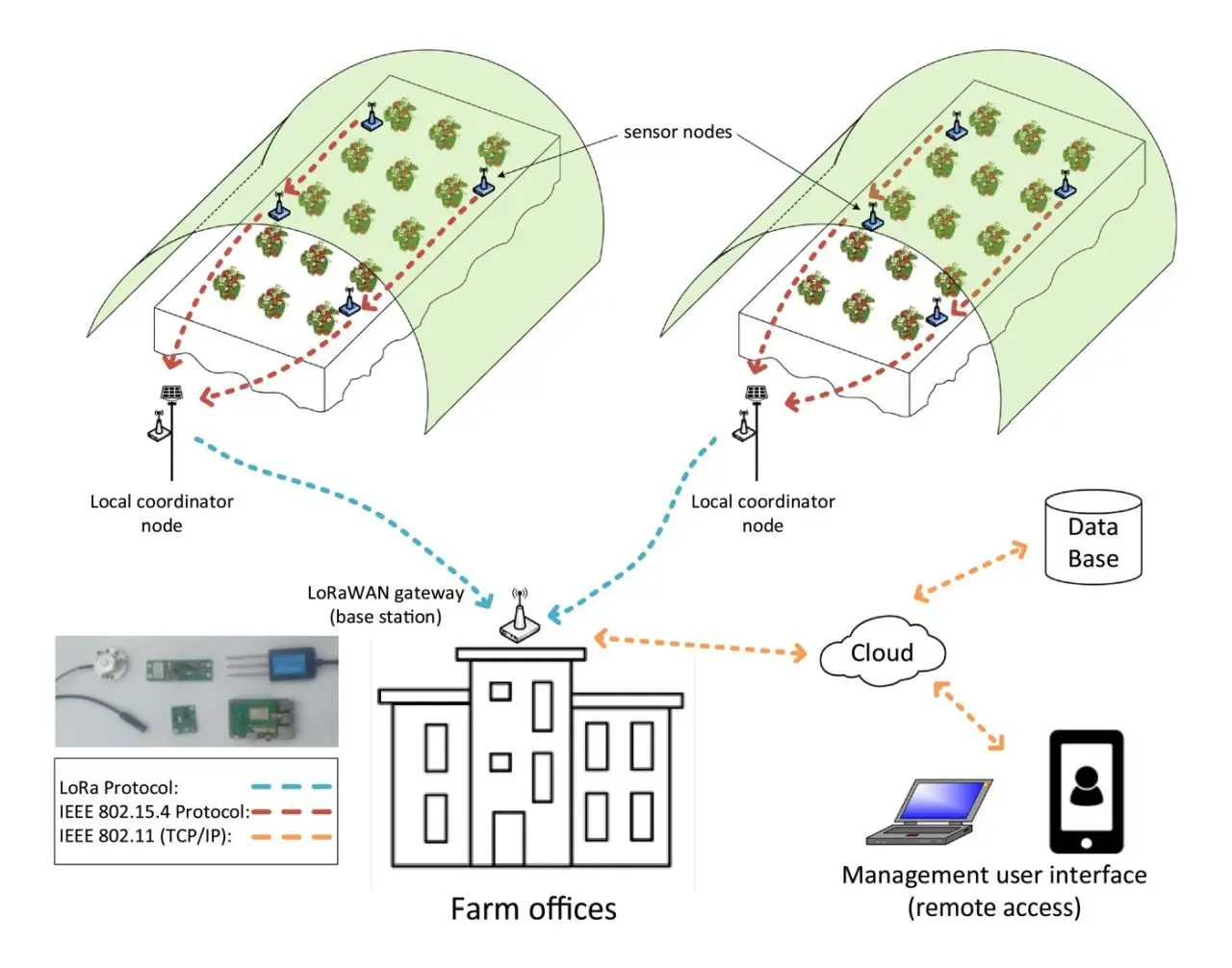
In the field, sensor nodes work with IEEE 802.15.4, a power-saving LR-WPAN standard that is suitable for many measuring points at short to medium distances.
To ensure that the measurement data still arrives reliably at the backend over longer distances, the authors use dual-radio nodes: local coordinators that collect an 802.15.4 subnetwork (tree-like) and then transmit the bundled data to the gateway via LoRaWAN in a star network.
The solution thus combines the advantages of both worlds: 802.15.4 provides spatially detailed in-field information, while LoRaWAN reduces the number of long-range links and thus operating costs, airtime expenditure, and complexity.
Energy autonomy as a prerequisite for scaling
Another key issue is the energy supply. The system is designed to run in the field for long periods without regular intervention. To achieve this, the authors combine low-power hardware with consistent sleep strategies and a photovoltaic-based supply (solar panel, battery, charging electronics).
Operation follows a measurement cycle: brief active measurement and transmission, followed by sleep mode. This interaction aims to achieve low-maintenance deployment that can also be used in remote areas where mains power is not available and battery replacement quickly becomes a cost driver.
Irrigation use case: from measured value to operational decision
The technical chain does not end with wireless transmission. Sensor data is received at the gateway, processed via a control terminal, stored in a database, and visualized via a web interface. The system is thus designed as an end-to-end platform for monitoring and irrigation management, including history and real-time insight.
In addition, the authors integrate photosynthetically active radiation (PAR) at the gateway and calibrate a low-cost sensor by cross-comparison with reference radiometers. This extends classic root zone sensor technology to include a plant-relevant radiation signal that can be important for growth and stress contexts.
Where was it tested?
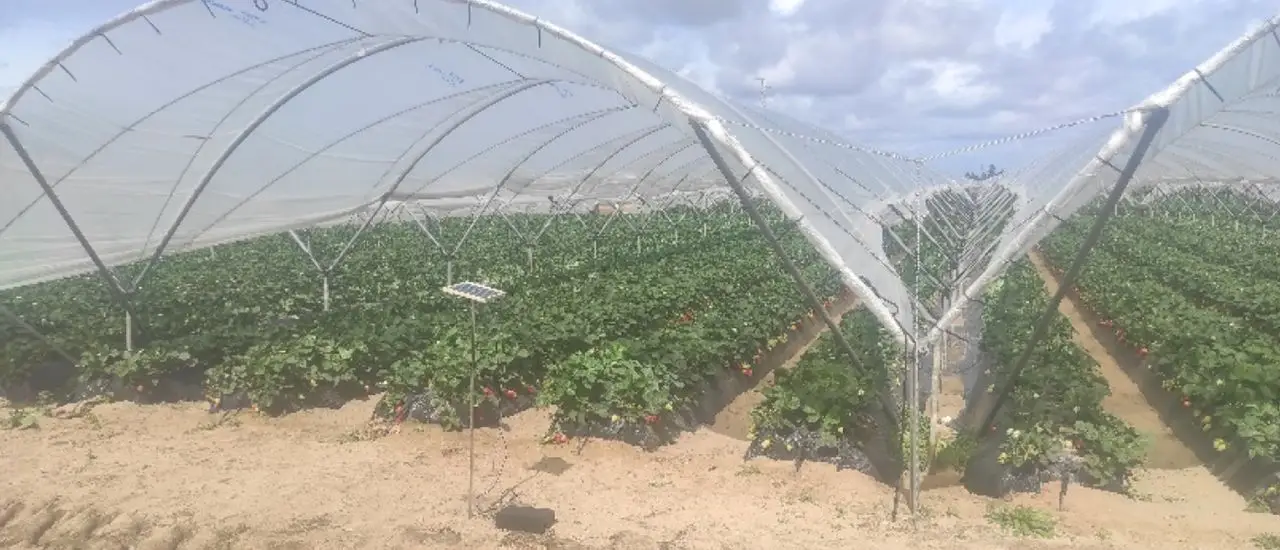
The system was tested in a strawberry plantation in Matalascañas (Huelva), southwestern Spain, near the Doñana National Park. This field environment is relevant because radio and power supply are exposed to real conditions here (vegetation, obstacles, weather).
According to the measurement results reported in the paper, the system ran very stably in test mode: An end-to-end transmission success rate of 97.5% from the measuring point to the LoRaWAN gateway is reported (≈ 2.5% packet loss), with a monitoring latency of < 100 ms.
In the tests, the authors report ranges of up to around 60 m for the 802.15.4 section between the sensor node and the local coordinator, and up to around 2 km for the LoRaWAN link between the coordinator and the gateway – in line with the intended division of tasks.
Classification
The article is particularly strong in areas where smart irrigation often fails in practice: scalable infrastructure. Hybrid wireless solves the range vs. detail problem, energy autonomy reduces operating costs, and the irrigation use case is implemented as a complete data path to the user interface.
Source and authors
Paper (Elsevier/ScienceDirect): https://www.sciencedirect.com/science/article/pii/S2542660525003154
Authors: J. Medina-García and J.A. Gómez-Galán from the Department of Electronic Engineering, Computers and Automation at the University of Huelva (Andalusia, Spain) and J.M. Vilaplana-Guerrero and J.A. Bogeat from the Atmospheric Research and Instrumentation Area of the National Institute of Aerospace Technology (INTA) in El Arenosillo (Huelva, Spain).