
- Volvo Group’s connected logistics platform combines multiple tracking technologies to provide real-time global transparency of packaging assets.
- Manual inventory processes were replaced with tracking data, achieving perfect planning efficiency and reducing costly emergency logistics actions.
- The scalable platform uses middleware and Microsoft Azure cloud architecture to support global deployment while allowing local customization.
- Integrating packaging data with transport and parts tracking enhances operational synergy and reduces overall system costs.
Packaging rarely gets the spotlight in supply chains until it becomes the bottleneck. At Volvo Group, the move toward connected logistics began with this blind spot: highly specialized packaging that protects critical parts and keeps production running but is often managed with limited transparency.
In an interview, Max Odehammar and Julien Bertolini from Volvo Group explain how the team moved from manual, error-prone inventory processes to a data-driven tracking approach. Their experience shows that asset tracking only creates real value when it is directly linked to operational outcomes.
Their key message: success does not depend on choosing one tracking technology. Instead, it requires a scalable platform that combines different tracking methods, connects use cases across organizational silos, and builds a reliable data foundation for future analytics and AI.
Asset Tracking as Part of a Larger Strategy
At Volvo Group, asset tracking is not treated as a standalone technology project. It is part of a broader strategy called Connected Logistics, which supports the company’s goals in digitalization, sustainability, and productivity.
The idea is simple. If companies know where critical assets are in real time, they can stabilize processes, detect bottlenecks earlier, and improve delivery performance. Greater transparency also enables faster and better decisions across logistics operations.
Connected Logistics is already a customer-facing service component at Volvo Group through Volvo Connect for vehicle and fleet services and Logivity’s Connect platform for transport logistics. Asset tracking, by contrast, is a newer development within Volvo Group’s own operations, designed to improve visibility across asset and material flows, strengthen planning, and support more efficient logistics processes.
Max Odehammar explains:
“Asset tracking supports our strategic focus on digitalization, sustainability, and productivity. Real-time transparency in our supply chain helps secure operations so that we can better meet our commitments to customers. Connected Logistics is also part of our service offering, helping customers increase productivity and sustainability by improving uptime and efficiency.”
Packaging: A Critical but Often Invisible Asset
The starting point for Volvo’s tracking initiative was a frequently underestimated supply chain element: specialized packaging.
In the automotive industry, packaging is far more than a transport container. It is often purpose-built equipment designed for specific parts, geometries, and protection requirements. Despite its importance, it is often overlooked as a strategic asset.
This lack of visibility can become costly. Without reliable data on the location and availability of packaging, shortages are often detected too late. Companies then have to react with expensive express shipments or emergency production adjustments. In some cases, long replacement lead times can turn operational disruptions into problems lasting months.
For Volvo’s packaging organization, the requirements were therefore clear. The tracking solution needed to provide global transparency across the packaging pool and enable decisions based on reliable data instead of incomplete manual reports.
Technology Follows the Use Case and the ROI
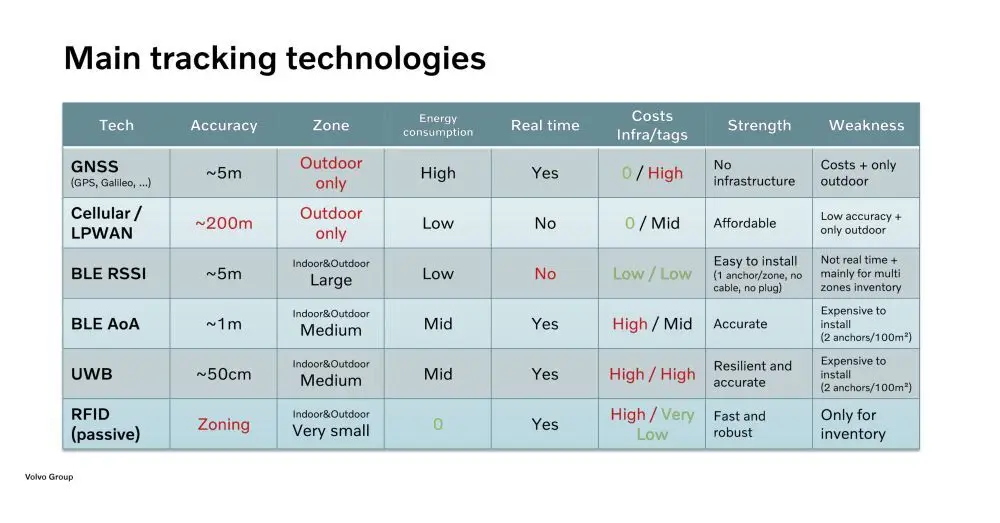
One important lesson from the project: there is no single tracking technology that fits every scenario.
Successful tracking systems combine different technologies depending on the use case while ensuring that the overall solution remains economically viable.
The team emphasizes that companies must first define their goals before selecting technologies. Accuracy requirements, available infrastructure, and process integration all influence the eventual return on investment.
In this sense, tracking is not primarily a sensor issue. It is a system design challenge:
What data is needed?
When and where is it required?
Which technology can deliver it reliably and cost-effectively?
Only after answering these questions can companies realistically evaluate ROI.
How Tracking Works in Practice
From Volvo’s perspective, tracking essentially consists of two basic steps:
Determining the location
Transferring that information to a platform
The technical implementation depends on the chosen technology.
With GNSS or GPS tracking, devices receive satellite signals and send raw data, typically via cellular networks, to a platform where coordinates are calculated.
With Bluetooth Low Energy systems, for example using RSSI-based positioning, scanners detect tag IDs and signal strength. The data is transmitted via networks such as LoRa to a location engine that calculates relative positions.
The real value is created at the platform level, not in the sensor. Here, data from multiple sources is consolidated, processed, visualized, and integrated into operational workflows.
Proof of Concept: From Manual Lists to Reliable Planning
Volvo’s proof of concept focused on tracking specialized packaging. It quickly revealed one of the biggest operational improvements: eliminating manual inventory tracking.
Previously, employees often recorded asset movements manually. This process inevitably produced errors, leading to inaccurate inventory data. As a result, transport orders could be scheduled for quantities that were not actually available.
Tracking-based inventory reporting significantly improved planning reliability. Volvo describes the result clearly: since planning has been based on tracking data, the process has achieved perfect planning efficiency.
In practice, this means that everything scheduled for transport is actually available and delivered as planned. At the same time, expensive express shipments can be avoided and packaging distribution can be optimized because logistics teams now work with reliable data.
Scaling the Solution: Tracking Hub and Cloud Platform
Moving from pilot projects to global deployment is often the hardest step in industrial IoT initiatives. Data volumes grow, integrations increase, and technology stacks become more complex.
Volvo addresses this challenge with two architectural components.
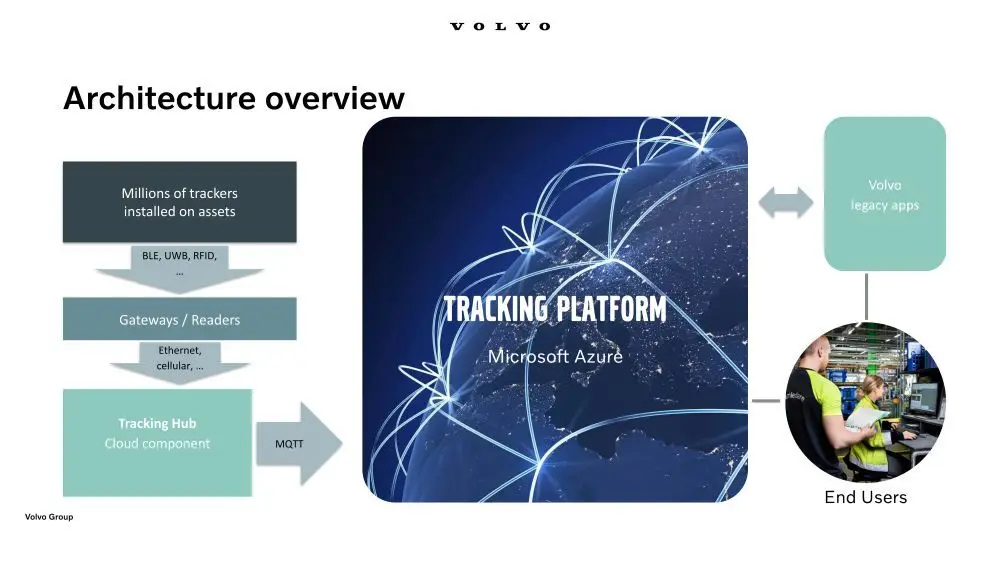
First, a Tracking Hub acts as scalable middleware. It standardizes messages from different tracking technologies and hardware providers and connects devices to the cloud platform.
Second, the platform itself is built on a modern Microsoft Azure architecture, creating a reusable foundation that can be deployed across locations and brands without rebuilding the system.
Breaking Silos: Connecting Use Cases
Another key principle is organizational rather than technical: use cases should be connected rather than isolated.
Packaging does not move through the supply chain on its own. It protects parts, travels with shipments, and often indicates the location of the goods themselves.
By combining packaging data with transport data, companies can generate additional value. For example, transport location data may reduce the need for dedicated GPS trackers on packaging.
This approach lowers overall system costs and can make use cases economically viable that would not justify investment on their own.
However, achieving this requires overcoming traditional organizational silos. Large companies often develop local solutions that optimize only one department or location.
Volvo sees this as a major challenge. Instead of isolated solutions, the company promotes a shared platform strategy and a holistic view of connected logistics.
Global Standardization with Local Flexibility
To balance global consistency with local needs, Volvo relies on a standardized tracking platform that collects data from multiple tracking technologies and visualizes it through maps, dashboards, and reports.
At the same time, business users should not depend entirely on central IT teams. With low-code tools, users can define rules, configure alerts, and customize dashboards themselves.
This allows the platform to remain globally standardized while still supporting local operational flexibility.
Looking Ahead: Reliable Data Before AI
Sustainability is a strategic priority for Volvo Group, including within its own operations. Improving visibility into asset and material flows helps increase logistics efficiency and reduce the company’s climate footprint.
At the same time, Volvo also sees strong potential in artificial intelligence. AI could support future applications such as delay prediction or logistics simulations.
However, AI is only as good as the data it receives. Before advanced analytics can deliver value, companies must first build reliable data foundations. The priority is clear: a scalable tracking solution with high-quality data must come first.
Key Lessons for Other Companies
Volvo’s experience offers several practical insights for organizations exploring asset tracking:
Start with the use case.
There is no universal tracking technology. Solutions must be designed around operational needs.Connect use cases.
Linking packaging, transport, and parts tracking can unlock synergies and improve ROI.Build the data foundation first.
Scalable tracking infrastructure and reliable data quality are prerequisites for analytics and AI.
For Volvo Group, connected logistics is therefore more than a digital experiment. It is becoming a core capability for building a more transparent, efficient, and resilient supply chain.