Less Ferrite, Same Performance in Inductive Charging

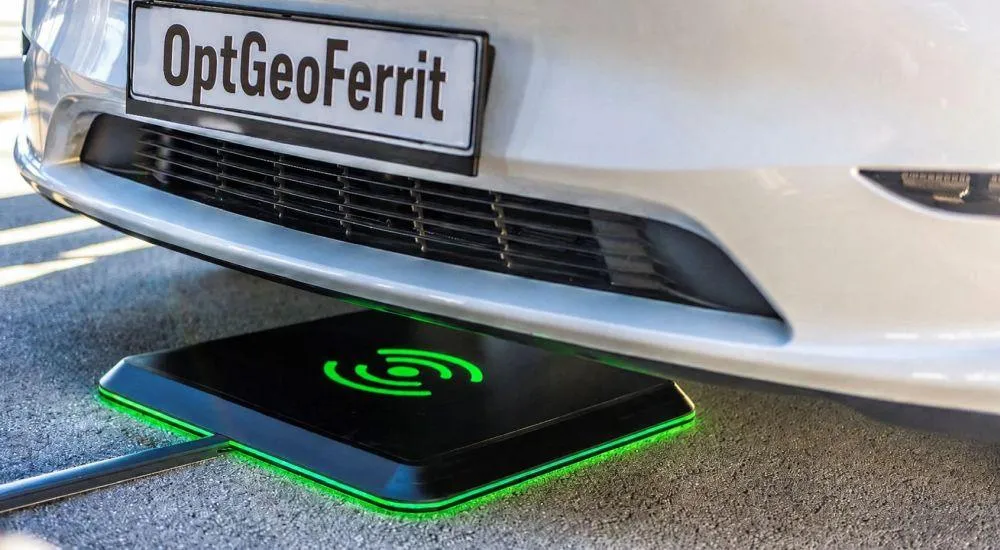
As part of the OptGeoFerrit collaborative project, NEOSID and the University of Stuttgart have developed three-dimensionally optimized ferrite cores for inductive charging systems. Material usage was reduced by approximately 30 percent. A prototype transmitted up to 22 kW at 85 kHz with an efficiency of over 94 percent.
Ferrite as a Key Component
Inductive charging systems transfer electrical energy contactlessly between a ground-mounted transmitter coil and a receiver coil installed in the vehicle. Ferrite structures guide and concentrate the magnetic field. They influence the coupling between the coils, energy losses, and magnetic stray fields.
Conventional systems primarily use planar ferrite plates or standardized ferrite tiles. Due to their high density, they contribute significantly to the weight and material requirements of the coil unit. Especially on the vehicle side, mass and installation space directly affect system integration.

Neosid: Miniature RFID in metal thanks to ferrite
Neosid's mastery of injection-molded soft ferrites combined with end-to-end manufacturing enables reliable, miniaturized HF RFID transponders that operate directly in metal and meet complex industrial demands.
Research project by NEOSID and the University of Stuttgart
OptGeoFerrit was a joint, publicly funded research project between NEOSID Pemetzrieder GmbH & Co. KG and the Institute for Electrical Energy Conversion at the University of Stuttgart. The project ran from June 2023 to July 2025.
The public final report was submitted by the two project partners on April 9, 2026. NEOSID served as the consortium leader. The report documents the material investigations, simulation work, prototype development, and validation of the overall system.
Material and Geometry Optimized Together
The goal was to develop three-dimensional ferrite cores with a relative permeability of more than 1,500. At the same time, weight and material usage were to be reduced by at least 20 percent.
To this end, the project team characterized various MnZn and NiZn ferrites. Among other things, permeability, magnetic saturation, power loss density, electrical conductivity, and thermal properties were investigated. MnZn ferrite F02 was identified as a suitable material.
The material data was imported into ANSYS Maxwell as well as PLECS and MATLAB models. This allowed for the joint analysis of field distribution, losses, temperature development, coil coupling, and power electronics.
Ferrite thickness reduced from five to 3.5 millimeters
The simulation-based optimization led to a reduction in ferrite thickness from five to 3.5 millimeters. This reduced the ferrite mass by approximately 30 percent, exceeding the original target of at least 20 percent.
The geometry was designed to guide the magnetic flux in a targeted manner and reduce local stress peaks. A segmentation concept also takes into account areas subject to particularly high mechanical stress.
NEOSID developed a customized manufacturing tool and produced prototypes in two geometries. According to the final report, the tool achieved a dimensional accuracy of less than ±0.05 millimeters. The cores were subsequently integrated into a complete inductive transmission system.
22 kW at 85 kHz validated
The University of Stuttgart developed a bidirectional system with an active rectifier. The prototype of a vehicle-side coil unit achieved a transmission power of 22 kW at an operating frequency of 85 kHz.
Efficiency levels of more than 94 percent were demonstrated both experimentally and in simulations. Energy transfer remained stable even with lateral and vertical coil misalignments. At the same time, the system complied with the relevant limits for magnetic stray fields.
The investigations were based on the requirements for inductive vehicle charging systems according to SAE J2954. The final report also notes the fundamental compatibility with WPT3/Z3 systems.
New Method for Loss Measurement
Another project outcome is a measurement method based on a Maxwell coil. This allows the magnetic losses of large ferrite samples to be determined thermocalorically.
In addition, the project team investigated frequency- and flux-dependent losses as well as the thermal capacity of the ferrite materials. Thermal tests showed that targeted heat dissipation is necessary at high duty cycles. Using a passive potting solution and water cooling, stable continuous operation below 80 degrees Celsius was achieved.
Relevance for System Developers
OptGeoFerrit demonstrates that ferrite structures should not be designed in isolation as standard components. It is crucial to consider material, core geometry, winding design, power electronics, and thermal behavior collectively.
For manufacturers and integrators, this can result in lower weight, reduced material requirements, and better adaptation to different installation spaces. According to the project report, the developed methods can also be applied to micromobility, drones, logistics systems, medical technology, and industrial applications.
Discuss inductive charging systems
Are you developing a contactless energy transfer system and would like to tailor the ferrite geometry, material selection, or coil design to your application? Contact NEOSID directly to discuss the technical requirements of your project.
For more information on the OptGeoFerrit project and inductive power transfer: https://neosid.de/en/hints-solutions/product-solutions/inductive-charging