
Permanent RFID Tags Could Replace Seasonal Labels on Fruit Crates

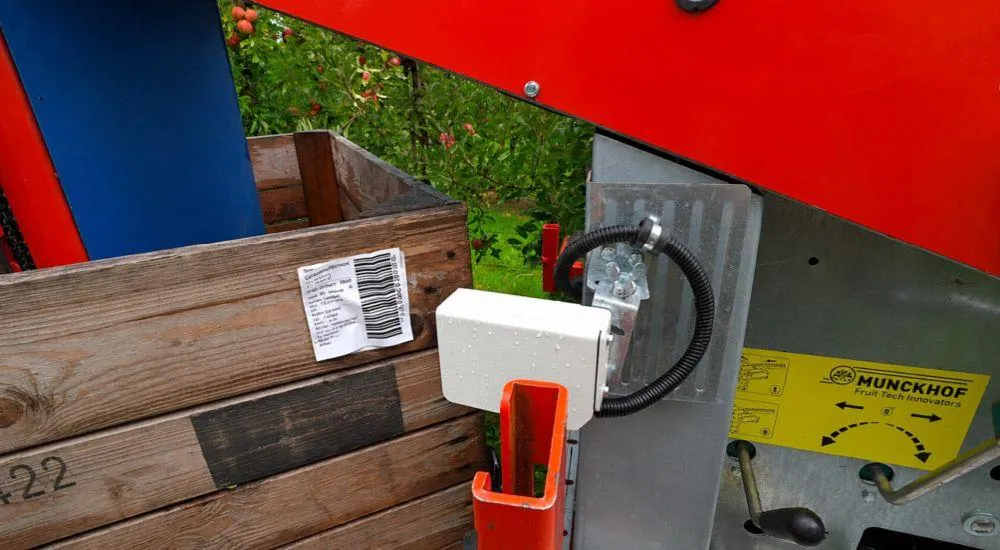
Netherlands-based Munckhof Fruit Tech Innovators, Agromanager, which operates in Belgium and the Netherlands, and five fruit growers in the Netherlands are testing permanent RFID labels on picking crates. The goal is to replace seasonal paper labels with reusable digital identities linked to harvest and traceability data.
One Digital Identity for the Crate
Fruit crates require unique identification during harvest for food safety, certification and traceability. Many growers still use paper barcode labels that must be printed and applied again each season.
The pilot replaces this process with a permanent RFID label with an integrated QR code. According to Munckhof, the label costs around €0.75, comes with a ten-year guarantee and is expected to remain usable even longer.
Unlike a barcode, RFID can be read automatically and wirelessly without requiring line of sight. The QR code remains available as a fallback so workers can identify a crate manually with a smartphone when necessary.
RFID Reading Becomes Part of the Harvest Process
A central element of the trial is the Pluk-O-Trak harvesting platform from Munckhof Fruit Tech Innovators. The machine is already used to improve picking efficiency and reduce fruit damage.
Its M-Connect communication system collects information using GPS, cameras and counting systems and exchanges data with fruit-management platforms such as Agromanager.
For the pilot, the Pluk-O-Trak is equipped with an RFID reader. The system can therefore automatically identify which crate is currently on the machine. The crate ID is directly associated with plot, location, date, time and fruit variety.
This removes a separate identification step from the harvesting workflow. Workers no longer need to attach a new label or manually scan each crate before the information can be linked to the harvest record.
RFID Connects the Physical Crate With Harvest Data
The project goes beyond replacing a paper barcode with another identification technology. A permanent RFID identifier gives the reusable crate a persistent digital identity across multiple harvest seasons.
That identity becomes the link between the physical container and the information generated around it. Positioning data, machine data and harvest information can be associated with the correct crate as part of the normal picking process.
For growers, this could reduce administrative work and prevent identification problems caused by labels that become wet, dirty, damaged or detached during harvest.
A Step Toward the Connected Orchard
Munckhof positions the trial within the broader development of precision fruit growing, where machinery, sensors and farm-management software are increasingly interconnected.
In this architecture, the harvesting machine is no longer only a mechanical tool. Through GPS, cameras, counting systems, RFID identification and M-Connect, it also becomes a data-acquisition point within the orchard.
The RFID-tagged crate adds another physical object to that digital chain. Instead of receiving a temporary label every season, it can retain the same identity while new harvest, plot and location information is linked to it over time.
From Manual Labelling to Automated Traceability
If the field trials are successful, permanent RFID labels could eliminate the annual application of thousands of crate stickers. The expected benefits include less manual administration, fewer identification errors and more consistent recording of traceability, harvest and plot data.
For system integrators, the project illustrates a broader shift in agricultural RFID: the value does not come from identification alone, but from integrating the RFID-tagged asset, reader-equipped machinery, positioning and sensor data, and farm-management software into one automated workflow.
Read more at Munckhof Fruit Tech Innovators: https://www.munckhof.org/en/news/rfid-pilot-scheme-aims-to-eliminate-the-need-for-manual-labelling-of-picking-crates/