From Store Shelf to Laundry: Global Tag Connects Fashion with RFID

A jacket that can be located during inventory, a handbag protected against theft, or a uniform identified after hundreds of wash cycles: RFID and EAS technologies are changing how textiles are managed. Global Tag brings these applications together in a dedicated Fashion Retail portfolio, combining RFID labels, woven transponders, security tags and washable UHF RFID solutions.
Thousands of garments move through fashion retailers' warehouses and stores every day. Some are ready for sale, others are transferred between locations or returned by customers. Keeping track of individual items becomes increasingly difficult when inventory relies on manual barcode scanning.
UHF RFID makes it possible to identify multiple tagged items wirelessly without direct line of sight. Each transponder carries an electronic identifier that can be linked to product and inventory records, enabling faster stocktaking and more efficient goods handling.
Global Tag addresses these applications through its dedicated Fashion Retail business unit. Its portfolio covers six product categories: RFID adhesive labels, hangtags, woven textile tags, laundry tags, combined RFID and EAS solutions, and conventional electronic article surveillance tags.
One Garment, Different RFID Requirements
An RFID tag attached to a luxury handbag faces different requirements from one sewn into a work uniform. Materials, dimensions, attachment methods and expected service life all influence the choice of transponder.
For conventional retail identification, Global Tag offers adhesive RFID labels in formats including 54 × 34 mm, 43 × 18 mm and 30 × 15 mm. The labels can be applied to products, packaging or hangtags and used for automated inventory counts, stock transfers and returns management.
RFID hangtags provide another option, particularly for apparel and accessories where product presentation matters. They are available on reels, in fanfold format, individually cut or as multi-layer composite tags.
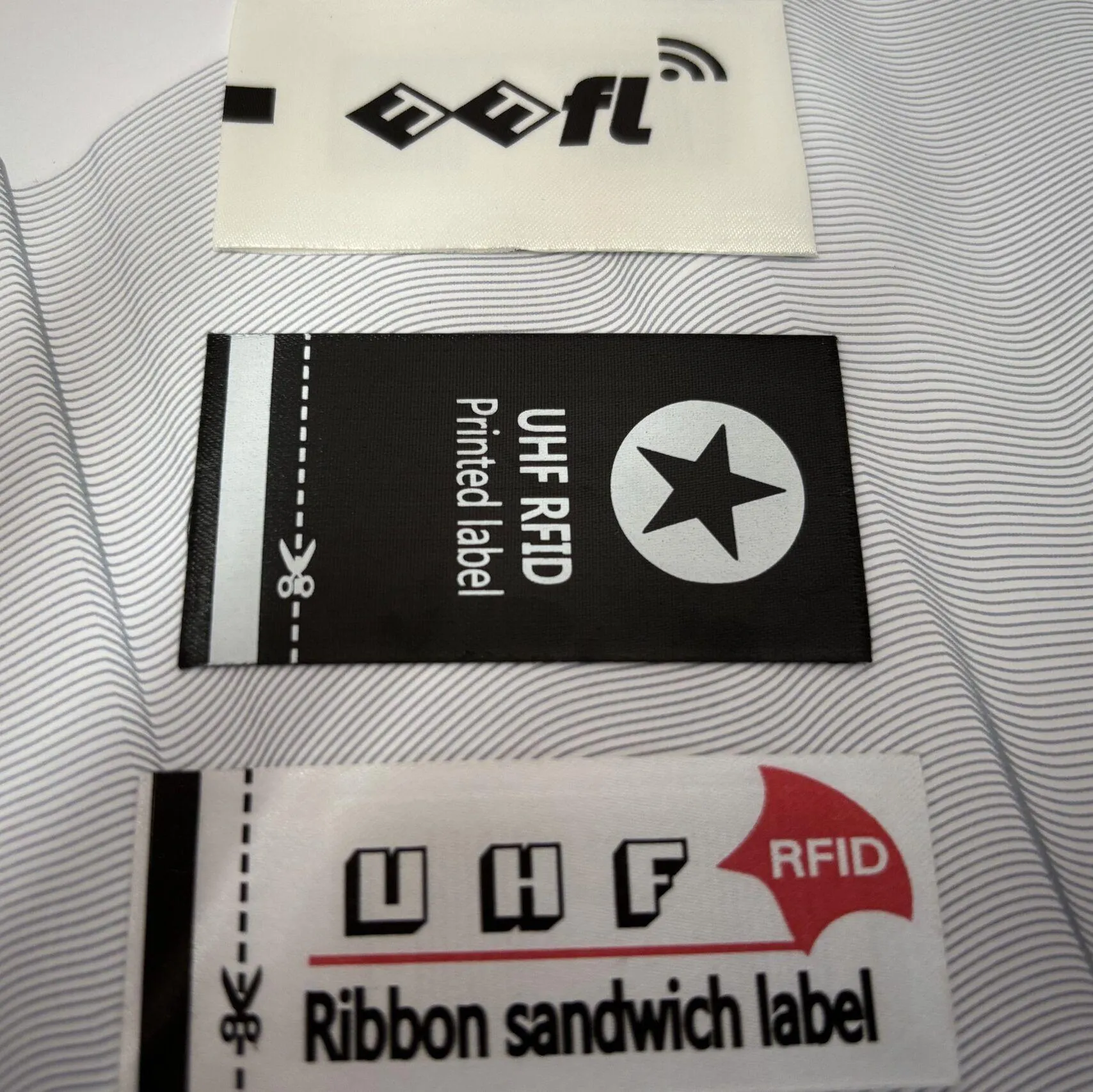
For less visible identification, Global Tag integrates RFID technology into flexible satin and nylon textile labels. These can be sewn into garment seams, hems or internal labels. According to the manufacturer, these woven tags are designed to withstand approximately four to five washing cycles, distinguishing them from specialized industrial laundry transponders.
Inventory Tracking Meets Theft Protection
RFID and Electronic Article Surveillance (EAS) perform different tasks. RFID identifies individual products and connects them with digital inventory systems. EAS detects protected merchandise passing through security gates without proper deactivation or tag removal.
Global Tag combines both functions in its RFID + EAS hard tags.
The product range includes the Standard model with an Impinj R6P chip, a slim Pro version combining RFID with RF-based article surveillance, and an Elite model using acousto-magnetic security technology.
These combined tags allow retailers to use one physical attachment for item identification and theft protection. Depending on the store infrastructure, the same tagged merchandise can support inventory operations while remaining protected by an EAS system on the sales floor.
Global Tag also supplies conventional EAS tags compatible with RF systems operating at 8.2 MHz and AM systems at 58 kHz.
RFID Tags That Survive More Than 200 Wash Cycles
The requirements change considerably when textiles leave the retail environment and enter industrial laundry operations.
Hotels, hospitals and textile rental companies handle large quantities of towels, bed linen and uniforms that repeatedly pass through washing, drying, sorting and distribution.
Global Tag's washable UHF RFID tags are designed for these conditions. Available formats include 30 × 15 mm, 70 × 10 mm, 70 × 15 mm and 80 × 22 mm. According to the manufacturer, the tags can withstand more than 200 industrial wash cycles.
The RFID identifier enables each textile to be recorded at different processing stages, helping operators monitor circulation, identify missing items and maintain inventory records.
But the transponder alone does not determine how long the identification system remains functional. Its integration into the textile is equally important.
Global Tag identifies three attachment methods:
Sewing: A permanent connection for uniforms, workwear and technical textiles. Stitching must avoid the chip area to prevent damage.
Heat sealing: Heat and pressure attach the transponder to flat textiles such as towels and bed linen, without additional stitching.
Protective pouches: The RFID tag is enclosed in a fabric or synthetic pouch, allowing replacement when necessary.
Each method involves different trade-offs between mechanical durability, processing speed and flexibility.

The Right RFID Tag Makes the Difference
A few washing cycles or more than 200. A removable adhesive label or a permanently integrated textile transponder. Inventory tracking or theft protection. The differences between RFID applications in the fashion industry are substantial, and so are the technical requirements.
Global Tag addresses this diversity with customizable RFID and EAS solutions. Tag dimensions, materials, printing, encoding, laser marking, and barcode or QR code integration can be adapted to individual products and workflows.
The portfolio demonstrates how RFID can extend beyond conventional retail inventory management. From identifying garments in warehouses and stores to tracking reusable textiles through industrial laundry processes, the technology provides a common foundation for item-level identification across very different environments.
Discover Global Tag's RFID & EAS Fashion Retail Portfolio and explore its RFID Laundry Tag Application Guide. Have a specific RFID project in mind? Send us a message using the box below and connect with Global Tag!