
- Truvami’s smart label operates without conventional batteries by harvesting energy from ambient light using organic photovoltaics.
- The label is designed to be reusable, flexible, and ultra-flat, enabling tracking of small and valuable assets in intralogistics.
- The product aims for a long service life of up to ten years and requires minimal additional infrastructure for deployment.
- The full industrial launch is planned for the second half of 2026 following a period of pilot testing and product iteration.
Batteries are the silent cost driver in many tracking projects. Devices need to be charged, batteries replaced and failures organised – and the larger the fleet, the higher the operational costs. This is exactly where Truvami comes in. For the past 18 months, the team led by Chiara Koopmans, Managing Director of Truvami, has been developing an ultra-flat, flexible and reusable tracking label that is designed to be powered autonomously by ambient light.
Following intensive development and pilot phases, the company is now preparing for the next step. In the second half of 2026, the smart label is to be launched on the market in larger quantities – marking the transition from prototypes and small pilot projects to widespread availability.
A product that rethinks TCO logic
According to Chiara Koopmans, battery-powered IoT trackers will of course remain a central pillar of modern logistics – especially when applications require extensive, continuous data streams. Truvami also offers powerful battery-based devices. However, discussions with customers over the past few years have shown the young entrepreneur that many processes do not require this maximum granularity.
What they need instead is a solution that can be deployed in large quantities without maintenance and battery management becoming a permanent burden. Chiara Koopmans sums up the essence of this insight. The decisive factor is not the price of the device, but the cost-effectiveness of the overall solution.
"We have learned that the issue of batteries is of central importance, because ultimately it is not about the cost of the device, but about the cost of the overall solution – the total cost of ownership. Traditional trackers need to be recharged or have their batteries replaced after a certain period of time. For customers, this means additional processes, personnel deployment, downtime and thus considerable running costs – especially when there are not just a few dozen, but thousands of assets in circulation," says Chiara Koopmans.
Truvami's goal was therefore clear: to remove this maintenance factor from the equation and make asset tracking truly scalable – especially in intralogistics. This led to the development of the truvami smart label that is as easy to use in everyday life as a sticker – but can do much more than just serve as an identification feature.
The innovation: energy harvesting with ambient light
For a tracking label to function without a conventional battery, it needs an alternative energy source. Truvami relies on energy harvesting via ambient light for this purpose. Specifically, it uses organic photovoltaics (OPV), which can generate energy from existing lighting – for example, in warehouses, logistics centres or production environments.
If sufficient ambient light is available, the label can be operated autonomously. Combined with a very flat form factor, the result is a product that can be integrated into existing processes without batteries.
Chiara Koopmans says: “Our light-powered, energy-harvesting solution supports corporate sustainability goals. Billions of disposable batteries used in devices conflict with many organizations’ environmental and ESG targets. By harvesting energy from ambient light and using a long-life rechargeable cell for storage, this approach is not just a technical advancement but also a strategic lever for sustainability, especially as deployments scale to very large volumes.”
Form factor and reusability as key factors
According to Koopmans, in addition to the energy issue, a second point was crucial in almost all discussions with customers, namely the form factor. In practice, it is not only large containers or pallets that need to be tracked.
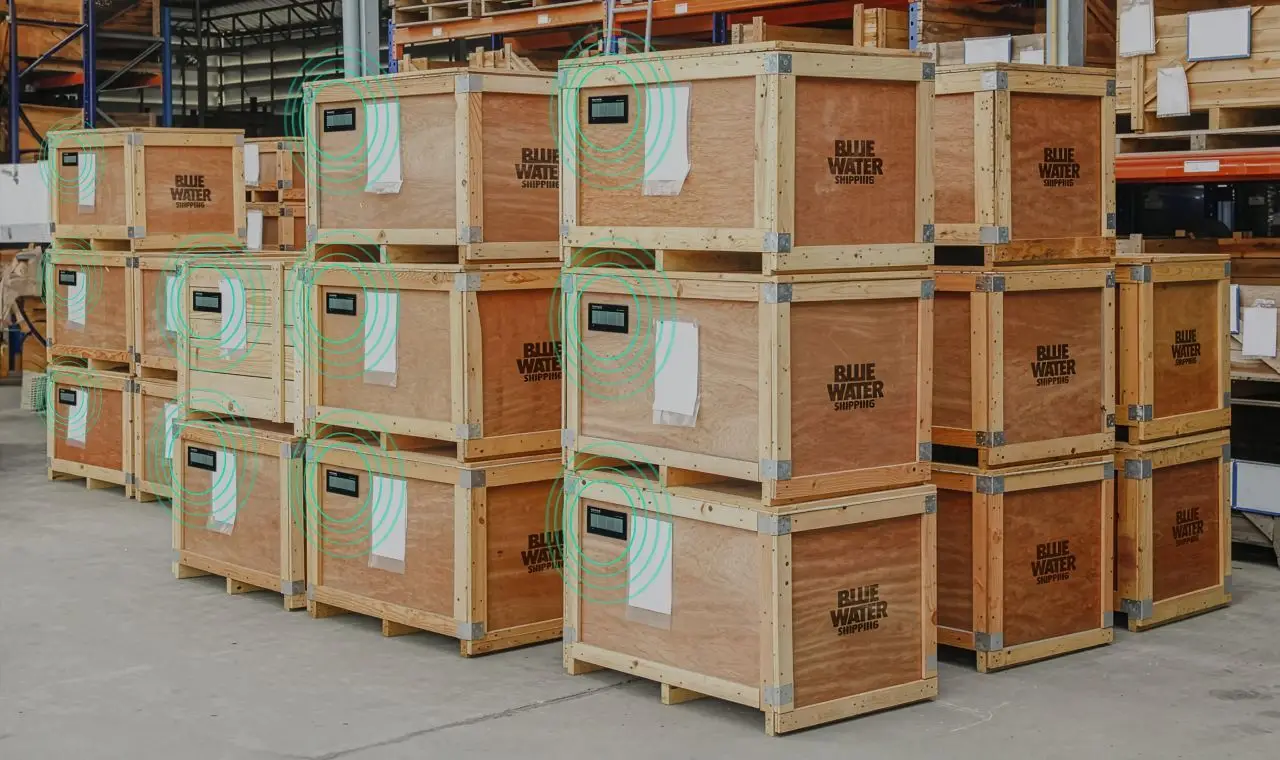
Often, it is small, valuable assets that play a central role in processes and need to be visible – from roll cages and smaller transport containers to devices that circulate between locations. For tracking to be accepted in everyday use, the tracking device itself must fit the asset without causing disruption.
Based on this requirement, Truvami developed a label-like form. The smart label is designed to be flexible and can be attached to curved surfaces. It is also reusable, not a disposable label. A reusable fastening mechanism, such as Velcro, ensures that the label can be used multiple times and in different processes.
From idea to V2: what happened in 18 months
The smart label idea did not come about overnight. Truvami has spent the last 18 months intensively prototyping, testing and iterating. Many questions were discussed. How can a fully autonomous, ultra-flat label powered solely by ambient light be technically realized? How robust is it in real-world operation? How easy is it to reuse? Once the first samples were available, tests with customers, feedback loops and adjustments followed.
The company is currently preparing a Smart Label V2, which is expected to be more powerful than the first version. The aim is to use the second generation as a basis for scaling. The planned roadmap: the product is expected to be available in larger quantities in the second half of 2026. This will be followed by the transition to mass production and broader market penetration.
First customers and typical areas of application
Truvami is already working with selected partners and customers who are testing the Smart Label. The company is deliberately focusing on small pilot projects – typically less than 100 labels per use case.
Koopmans explains the reason: "The team is small, and at this stage, speed of learning is what counts. Too many parallel projects would slow down development and industrialisation work. Instead, we are focusing on pilot customers where the use case and product maturity are particularly well matched."
In terms of content, the focus is clearly on intralogistics – i.e. tracking within company premises and closed systems. This includes hospitals, postal and logistics organisations, and industrial companies. The use cases are similar, as they always involve means of transport such as roll cages or small pallets, container fleets or – in a hospital context – medical equipment that is moved between wards and locations.
The aim is to create transparency about where assets are, how they are used and where processes come to a standstill. This reduces search times, identifies bottlenecks and – with sufficient data – even reduces fleets because existing assets are better utilised.
Price, service life and infrastructure: key figures at a glance
Truvami is still cautious about the price because full industrialisation is currently being prepared. A target price exists, but will only be communicated once it can be reliably achieved.
For many customers, service life is a crucial factor. Truvami is therefore pursuing an ambitious goal. The label is to be designed so that it can be used with assets for up to ten years – especially in scenarios where companies plan for the long term and do not want to replace trackers or set up maintenance projects every two to three years.
Truvami also takes a pragmatic approach to infrastructure. The solution is deliberately designed not to require extensive additional infrastructure. Depending on the circumstances, it may make sense to use LoRaWAN gateways or existing coverage. In addition, if already available, the existing Wi-Fi infrastructure can also play a role, for example to enable localisation via available access points.
For particularly high accuracy requirements in defined areas, additional anchor points can be integrated as an option. However, the goal remains the same: as little infrastructure as possible so that rollouts remain scalable and economical.

Company and team: Development with Swisscom Broadcast
Truvami is currently being established in close collaboration with Swisscom Broadcast, which continues to act as the founding investor.
In addition to Chiara Koopmans, the current management team includes Michael Beutler, Head of Infrastructure and Cloud Platform, and Guillaume Noel, Devices & Operations. Dedicated operational teams for development, platform, and go‑to‑market activities are being built around this core leadership group to drive the next phase of Truvami’s growth.