Printed Batteries Address Limits of Coin Cells in Thin IoT Devices
Coin cells remain a standard energy source for compact electronics, but miniaturized wireless devices expose limits in internal resistance, thickness and material use. Zinergy explains where printed batteries can provide a thinner, flexible alternative.
Coin Cells Remain Proven, But Limited
Coin cells are widely used because they are cost-effective, available at scale and supported by a mature supply chain. For many compact electronic devices, they remain a practical and well-understood power source.
However, their rigid construction creates limits as devices become smaller and thinner. In wireless IoT devices, smart labels, wearable sensors and cold-chain loggers, the battery can define the minimum device size and influence communication reliability.
Internal Resistance as a Design Constraint
The main technical limitation is internal resistance. As coin cells shrink, their internal resistance increases. According to Ohm’s law, this can cause the output voltage to drop when pulse currents are drawn.
This is relevant for wireless communication, where short current peaks are often required. Even if average power consumption is low, transmission bursts can exceed what a very small coin cell can support reliably.
For system integrators and device manufacturers, the battery is therefore not only an energy source. It can become a constraint for product architecture, form factor and wireless performance.
Printed Batteries Use a Different Geometry
Zinergy’s printed batteries use a planar architecture. Instead of placing active materials in a rigid metal casing, the battery chemistry is spread across a larger surface area. This can improve current distribution and reduce internal resistance.
These designs provide low internal resistance and high peak-current capability, exceeding coin cells in these specific parameters. The company positions printed batteries as an alternative where thinness, current delivery and mechanical integration are critical.
Thin, Flexible and Material-Efficient
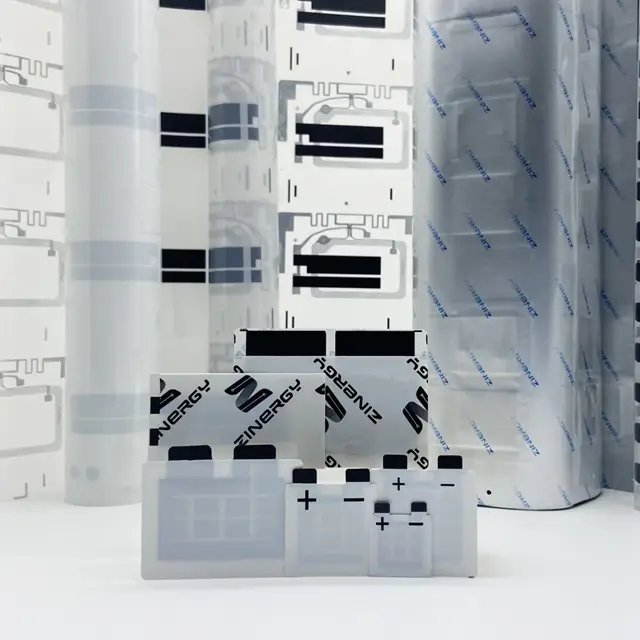
Printed batteries also offer mechanical advantages. Zinergy describes sub-millimetre thickness, bend tolerance across thousands of cycles and stable operation under mechanical deformation.
This enables integration into non-planar and space-constrained products. Relevant examples include conformal wearable health monitors, smart labels for asset tracking and authentication, distributed wireless sensors for perishable goods, and temperature loggers for cold-chain pharmaceuticals.
Printing technology also allows batteries to be designed for the energy needed by a specific application. This can reduce unused capacity and material waste, especially in products with defined lifetimes or duty cycles.
Sustainability and Printed Electronics
Zinergy batteries use zinc-manganese dioxide chemistry and contain no lithium, mercury or solvents. The source also notes that zinc-carbon batteries are recyclable, with laboratory processes recovering up to 99 percent of zinc and manganese and industrial recovery rates typically reaching 75 to 90 percent by weight.
Replacing steel casings and separators used in coin cells may reduce recycling complexity and cost. For high-volume IoT products, this is relevant because sustainability depends on chemistry, material volume, product design and recycling feasibility.
Printed battery fabrication also aligns with roll-to-roll manufacturing used in printed electronics. This supports integrated systems combining printed conductors, passive components, active components or chip-scale-package ICs with an integrated battery layer.
Coin cells will remain suitable for many products. Printed batteries become relevant where thickness, flexibility, high peak-current capability, reduced material use and printed-electronics compatibility are central design requirements.
Read more in the original Zinergy source: https://zinergy-power.com/2026/05/01/when-is-a-printed-battery-better-than-a-coin-cell/
Contact Zinergy to evaluate how printed batteries could support your next thin, flexible or high-volume wireless IoT application. Let’s build the future together!