
ROHM Reduces Size of Buck-Boost Power Supply to 12.87 mm²

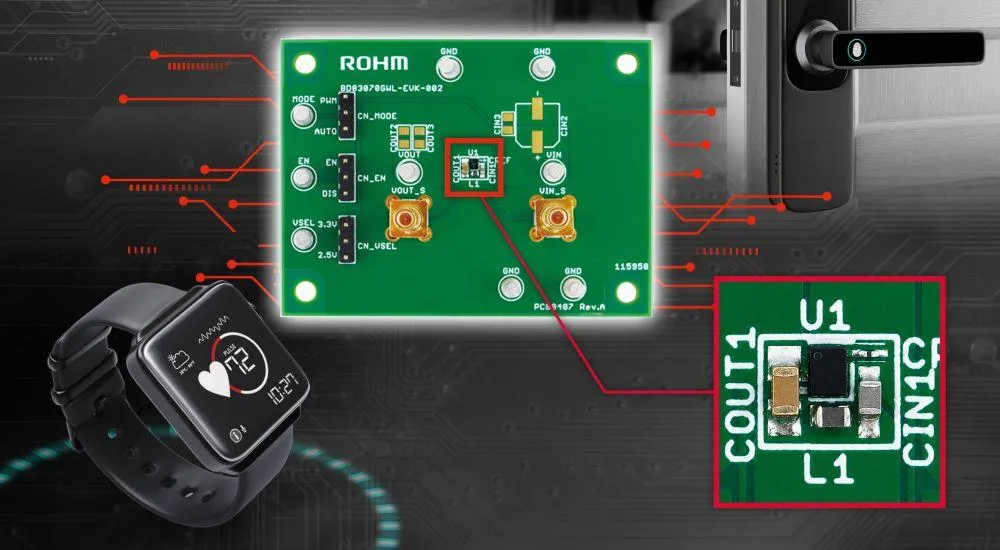
The BD83070GWL-EVK-002 evaluation board combines a highly efficient buck-boost DC/DC converter with just four additional components. Developers can use it to test compact power supplies for wearables, BLE devices, and battery-powered IoT applications and bring them to market more quickly.
Kyoto, Japan, July 22, 2026 – ROHM has introduced the BD83070GWL-EVK-002, a new evaluation board for exceptionally compact and energy-efficient power supplies. The reference circuit demonstrates the features of the BD83070GWL buck-boost DC/DC converter and is intended for developers of small battery-powered devices.
Wearables, mobile electronics, and wireless IoT sensors require a stable supply voltage, even though their battery voltage continuously decreases during operation. At the same time, only a few square millimeters of space are available on the circuit boards of these devices for the power supply.
Buck and Boost in a Single Converter
A buck-boost converter can both step down and step up the DC voltage supplied by a battery. “Buck” refers to stepping down an input voltage that is too high, while “boost” refers to stepping up a voltage that is too low.
For example, if a device requires a constant 3.3 volts, the converter first reduces a battery voltage of 4.2 volts to the required value. If the battery voltage drops below 3.3 volts during discharge, the converter raises it back to the required level.
This allows sensors, microcontrollers, and wireless modules to operate stably over a larger portion of the battery discharge cycle. At the same time, more of the available battery capacity can be utilized, which can contribute to longer operating times, particularly in small wearables and IoT devices.
Up to 97 Percent Efficiency
The BD83070GWL was developed for electronic devices powered by small batteries or other limited power sources. The buck-boost DC/DC converter achieves an efficiency of up to 97 percent and has a quiescent current of just 2.8 microamperes.
A low quiescent current is particularly important for devices that spend long periods in standby or power-saving mode and only collect or transmit data for short periods. These include, for example, BLE sensors, smart locks, digital keys, and compact sensor nodes.
The combination of high efficiency during active operation and low self-consumption at low load helps reduce energy losses and extend battery life.
Power Supply with Just Five Components
The evaluation board was developed with the goal of demonstrating the smallest possible footprint for a buck-boost power supply. The circuit combines the BD83070GWL with a inductor and capacitors.
A total of only five components are required. The power supply itself occupies a footprint of 12.87 square millimeters with dimensions of 3.3 × 3.9 millimeters.
As a result, the reference circuit offers a significant space advantage over conventional buck-boost configurations, including solutions with integrated inductors. The small number of external components also simplifies PCB design and frees up additional space for sensors, wireless modules, antennas, or a larger battery.
From Evaluation Board to Production Product
The BD83070GWL-EVK-002 enables developers to test the converter’s efficiency, load behavior, and voltage regulation under realistic operating conditions.
ROHM provides design resources such as circuit schematics, PCB layouts, and a bill of materials. The reference data is intended to simplify the transition from evaluation to a custom PCB design and subsequent mass production.
For Wearables, BLE Devices, and Sensors
Intended applications include smartwatches, smart rings, and biometric measurement devices. Other applications include AR and VR devices, smartphones, AI sensor nodes, BLE devices, smart locks, small drones, digital keys, electric toothbrushes, and wireless earbuds.
The BD83070GWL-EVK-002 evaluation board is available now.
ROHM provides additional technical information and design resources for the BD83070GWL-EVK-002 on its website.