EM Microelectronic Brings Sustainability Into Semiconductor Development

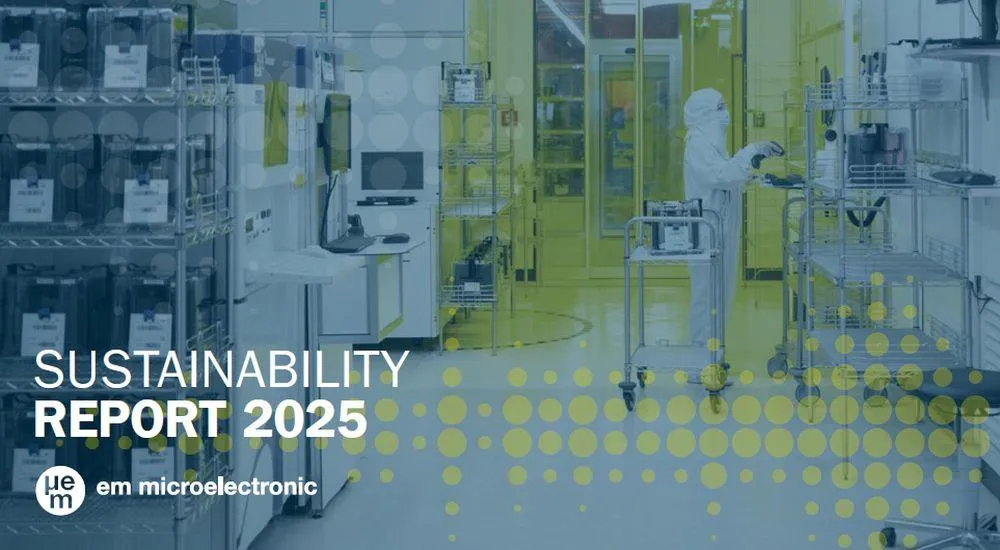
The Sustainability Report 2025 details progress in renewable energy, emissions, circularity and responsible sourcing while bringing sustainability criteria closer to semiconductor R&D.
EM Microelectronic has published its Sustainability Report 2025, outlining how the Swiss semiconductor manufacturer is combining ultra-low-power IC design, energy harvesting, manufacturing efficiency and responsible sourcing with measurable environmental targets.
The report covers EM’s manufacturing operations in Marin, Switzerland, and Bangkok, Thailand, and tracks progress against its Sustainability Roadmap 2030. Sustainability is increasingly being integrated not only into manufacturing operations but also into product development and supply-chain management.
Ultra-Low-Power ICs Reduce Energy and Battery Demand
For the IoT sector, one of the most relevant aspects is the connection between semiconductor design and resource consumption.
EM develops ultra-low-power integrated circuits intended to reduce the energy required by connected devices and extend their operational lifetime. In applications such as access control, wireless sensing, asset tracking and smart buildings, lower power consumption can reduce battery replacement and maintenance requirements.
The company is also developing energy harvesting technologies that convert ambient sources such as light, motion or RF energy into usable electrical power. This can enable connected devices to operate for longer periods with less dependence on conventional batteries.
Within its Connected Modules & Displays business, EM additionally offers post-consumer recycled resin potting for beacon products, reducing the amount of virgin plastic required in selected product designs.
EM launched a project in 2025 to evaluate development projects systematically from a sustainability perspective. The methodology is scheduled to be finalized in 2026 and deployed in 2027, providing measurable indicators for future R&D projects.
80 Percent Renewable Energy Across Manufacturing
Almost 80 percent of the energy consumed at EM’s manufacturing sites came from renewable sources in 2025. The Marin headquarters operated with electricity sourced entirely from certified Swiss hydropower, while 30.5 percent of electricity used at the Bangkok site came from renewable sources, including rooftop photovoltaics.
EM’s 2030 target is to reduce global energy consumption per unit of production by 35 percent compared with 2019. The reduction achieved by 2025 stood at 3.1 percent.
Scope 1 and 2 Emissions Down 65.8 Percent Since 2019
EM Microelectronic has reduced its Scope 1 and 2 emissions — direct operational emissions and emissions associated with purchased energy — by 65.8 percent since 2019. The reduction has been supported by renewable electricity procurement and investments such as heat-pump technology at the Marin site.
In 2025, however, Scope 1 and 2 emissions increased by 4.7 percent compared with 2024. According to the report, this was mainly driven by an 8.6 percent increase in natural gas consumption and an 11.2 percent increase in semiconductor process-gas emissions, with the latter partly linked to higher production.
EM states that the normalized emissions intensity for Scope 1 and 2 has remained broadly stable since 2021 despite expanding production capacity. Further reductions are expected after 2026, when new heat pumps and steam-generation systems from the Marin expansion project become operational.
At the same time, Scope 3 emissions — indirect emissions across the wider value chain, including purchased goods and services, transportation, business travel and employee commuting — accounted for more than 90 percent of EM’s total greenhouse gas emissions in 2025.
Aligned with the sustainability roadmap of its parent company, Swatch Group, EM is targeting climate neutrality for Scope 1 and 2 emissions by 2050, while a long-term reduction target for Scope 3 is still being developed.
More Recycling and Lower Water Intensity
EM’s manufacturing sites generated 362.65 metric tons of waste in 2025, 7.22 percent less than in 2024. At Marin, 74.7 percent of waste was valorized, including 52.47 percent through recycling and 22.22 percent through energy recovery.
New sorting processes introduced for polypropylene wafer boxes and PET transport trays are redirecting materials from incineration to recycling.
Water efficiency also improved. EM reported a 14.7 percent reduction in water consumption per unit of production in 2025. The company aims to increase water recycling at Marin to 40 percent by 2030 and reduce water withdrawal intensity by 20 percent compared with its 2019 baseline.
Semiconductor Supply Chain Moves Into Focus
The report also addresses the upstream impact of semiconductor manufacturing. In 2025, EM asked 121 operational suppliers representing almost 90 percent of purchasing spend to complete sustainability self-assessments. Ninety-two responded, while another 15 suppliers were added to the monitoring framework based on geographical and industry risk.
Responsible sourcing covers materials including gold, tin, tungsten, tantalum and cobalt. EM participates in the Responsible Minerals Initiative and is also working with suppliers on alternatives to PFAS-containing materials — highly persistent synthetic chemicals used in semiconductor manufacturing for properties such as heat and chemical resistance. Its stated target is to exclude PFAS from IC packaging by 2027.
The company received an EcoVadis Bronze Medal in 2025, placing it among the top 35 percent of companies worldwide assessed for sustainability performance. Within the electronic components and boards industry, EM ranks in the top 20 percent overall and the top 6 percent for sustainable procurement. EcoVadis is a global sustainability-rating platform that assesses companies on environmental, labor and human-rights, ethics, and sustainable procurement performance.
Sustainability Moves Into Semiconductor Development
The next step goes beyond improving factories and procurement. EM intends to establish sustainability indicators for product development, providing a framework to evaluate projects from a sustainability perspective and guide future development decisions.
That development connects the sustainability roadmap directly with EM’s core technologies: ultra-low-power ICs, energy harvesting and connected devices designed to operate with less energy and fewer battery replacements.
The complete EM Microelectronic Sustainability Report 2025 covers energy, greenhouse gas emissions, water, waste, materials, employees, occupational safety, supply-chain assessment and responsible sourcing. Read the full Sustainability Report 2025 at https://www.emmicroelectronic.com/news_and_pressrelease/sustainability-news