Key takeaways
- Operates at 865–868 MHz with up to 2 W ERP output power
- Supports multiplex operation with four external antennas
- Linux-based processing supports C, C++, Node.js, and Python
- Rugged IP67 design withstands −20 to +50 °C environments

Talk to the product expert
Hendrik Schnabel, Product Manager RFID UHF Systems
Detailed product information
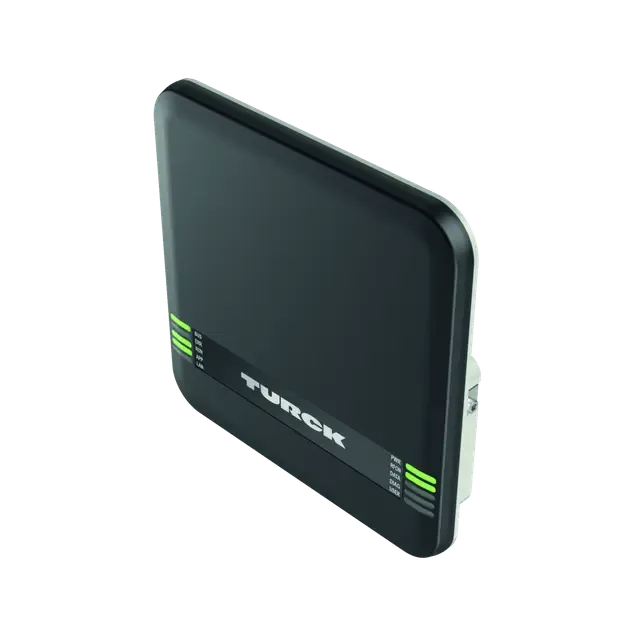
The TURCK Q300 is a freely programmable UHF RFID reader for industrial identification, automated goods detection and track-and-trace applications. Designed for demanding logistics and automation environments, it combines external antenna connectivity, local data processing and industrial Ethernet communication in one rugged device.
Operating in the European UHF RFID band from 865 to 868 MHz, the Q300 reads and writes RFID transponders with adjustable output power of up to 2 W ERP. It is well suited for RFID gates, conveyor systems, loading zones, production stations, pallet tracking and container identification.
Multiplex Operation for RFID Gates
For RFID gate applications, the Q300 supports multiplex operation with connected external UHF RFID antennas. The antennas are addressed sequentially, allowing a single reader to cover several detection positions within a gate.
This helps create a broader and more reliable read zone for pallets, containers and goods moving through loading or unloading areas. Antennas can be positioned at the sides, above or around a passage to improve tag detection from different directions, without requiring a separate reader for every antenna position.
Connect up to Four External UHF RFID Antennas
The Q300 provides four RP-TNC connectors for passive external UHF RFID antennas. This enables flexible antenna layouts for different application requirements, including narrow conveyor sections, wide loading doors and RFID gates for forklift traffic.
Reader performance depends on the selected antenna, tag type, installation position, material environment and process speed. TURCK therefore recommends validating read and write performance under real operating conditions, particularly where metal, moving goods or high-throughput processes are involved.
Local Linux-Based Data Processing
The Q300 is built on an ARM Cortex-A8 processor and provides 512 MB Flash memory and 512 MB DDR3 RAM. As a Linux-based, freely programmable Ethernet reader, it supports applications written in C, C++, Node.js and Python.
RFID data can therefore be filtered, processed and transferred directly at the edge. This can reduce the need for an additional industrial PC and simplify integration with warehouse management, ERP, MES or track-and-trace systems.
Ethernet, PoE+ and Process Integration
The reader connects through TCP/IP via a 10/100 Mbit/s M12 Ethernet interface and supports Power over Ethernet Plus, IEEE 802.3at. Network communication and power supply can be delivered through one Ethernet cable, helping reduce installation and wiring effort.
Four configurable digital channels can be used as PNP inputs or outputs for direct connection of sensors, triggers, push buttons or signal lights. A sensor can trigger an RFID read when a pallet enters the gate, while a signal light can provide immediate feedback on successful or incomplete tag detection.
Rugged Design for Logistics and Industry
With an aluminium housing, IP67 protection, shock and vibration resistance, and an operating temperature range from −20 to +50 °C, the Q300 is designed for industrial use.
- Power over Ethernet (PoE)
- IEEE 802.3at (PoE+)
- Frequency Region
- Europe, India, Turkey, South Africa (865–868 MHz)
- Protocols
- ISO 18000-63, EPCglobal Gen 2
- Output Power
- ≤ 2 W ERP, adjustable
- Antenna Polarization
- Circular/linear, adjustable
- Dimensions
- 300 x 300 x 61.7 mm
- Housing Material
- Aluminium, Silver with glass fiber-reinforced polyamide active area
- Protection Class
- IP67
- Digital I/O Channels
- 4 digital inputs (PNP), 4 digital outputs (PNP)
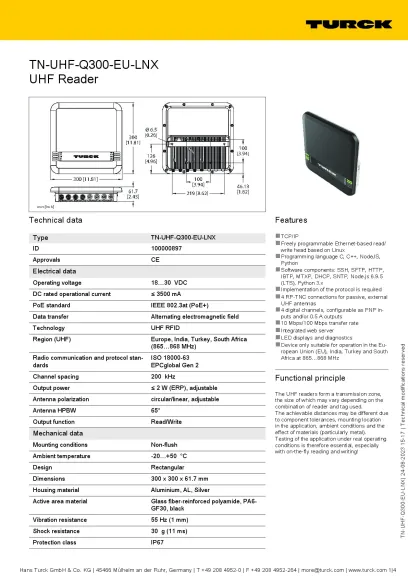
Q300 UHF Reader Datasheet
PDF, 1.76 MB
Product Images